Temperature Setting of Refrigerator: A Homeowner's Guide
Learn safe, energy-efficient temperature settings for your refrigerator and freezer, how to verify with a thermometer, and practical maintenance tips for reliable cooling.


Set and verify your refrigerator to safe, energy-saving temperatures: fridge at 37-40°F (3-4°C) and freezer at 0°F (-18°C). Use a thermometer to confirm, and wait 24 hours after any change for readings to stabilize. According to How To Refrigerator, accurate temperature settings protect food quality and curb energy use.
Understanding why temperature matters
Temperature control inside a refrigerator isn’t just about comfort; it’s a critical factor in food safety and energy efficiency. According to How To Refrigerator, the temperature setting of refrigerator directly influences how long foods stay fresh, how quickly bacteria can grow, and how hard your appliance works to maintain cool temperatures. Small deviations can lead to spoiled milk, wilted greens, or freezer burn on frozen items. The goal is a stable environment where perishable foods stay out of the ‘danger zone’ (40°F/4°C or below) while the freezer locks in moisture and flavor. In practice, most households benefit from keeping the fridge in a consistent range, with minor adjustments to accommodate door openings, ambient temperatures, and monthly usage. Temperature control also affects electricity bills; running a fridge that’s too cold wastes energy and can shorten the appliance’s life. Treat the thermostat as a living setting: check it after groceries, guests, or power outages, and rebalance as needed. This guidance uses both Fahrenheit and Celsius to help you translate settings across models. Remember not to place hot dishes directly into the fridge and to keep door seals clean and airtight for stable cooling. These practices support food safety and consistent cooling year-round. According to How To Refrigerator, your setup should prioritize steady temperatures over chasing the coldest reading.
Recommended fridge and freezer temps
The widely recommended target is a fridge temperature of 37-40°F (3-4°C) and a freezer temperature of 0°F (-18°C). These ranges balance food safety with energy efficiency, reducing the risk of bacterial growth while preserving texture and flavor. Some models offer separate zones (e.g., a crisper drawer with its own setting) or digital menus that allow precise adjustments. If you notice frequent door openings, large crowding in shelves, or warm ambient temperatures, you may need a slightly cooler fridge setting to compensate for heat input. How To Refrigerator analysis shows that many homes operate their refrigerators warmer than the safe range, which can lead to higher spoilage rates and increased energy use over time. On older units with manual dials, aim for the middle of the dial and fine-tune after a day or two. Always cross-check with a thermometer, especially after changing seasons or after power interruptions. When using Celsius, target roughly 3-4°C for the fridge and -18°C for the freezer.
How to locate and adjust controls
Most modern refrigerators have two temperature controls: one for the fridge compartment and one for the freezer. Locate the controls on the sidebar, ceiling panel, or inside the door panel. If you have a dial, gently rotate it in small increments (2-3 units) and give the unit 24 hours to stabilize before testing again. For digital displays, use the +/- buttons to adjust in 1-degree (or 1°C) steps. If there are energy-saving or “eco” modes, prefer standard operation unless you’re actively trying to reduce energy use in extreme heat. If your model uses a single control for both zones, set to a midrange position and monitor temperatures in both compartments to avoid under-cooling or over-cooling.
How to measure and verify temperatures
Use a dedicated fridge thermometer placed in the center of the main shelf, away from the door, and a second thermometer for the freezer if needed. Allow readings to stabilize after any change—this typically requires 12-24 hours, and up to 24 hours for full stabilization. Record fridge readings around 37-40°F (3-4°C) and freezer readings at 0°F (-18°C). If readings deviate beyond ±2°F (±1°C) after stabilization, adjust in small steps and recheck after another 24 hours. Keep thermometers clean and dry, and avoid blocking air vents or placing items directly in front of them. Regular monitoring helps catch thermometer drift, which can masquerade as a temperature problem.
Common scenarios and adjustments
During heat waves or in rooms with high ambient temperatures, your fridge may need a cooler setting to maintain core temperatures. If you frequently open the door, temps can rise; adjust gradually and re-check. After loading groceries or large quantities of warm foods, allow time for the internal environment to rebalance before measuring. If shelves or crisper drawers are overcrowded, air may not circulate properly—reorganize to improve airflow. If your fridge runs constantly or you notice frost buildup, check door seals for leaks, inspect condenser coils for dust buildup, and ensure the unit is level. In some cases, a faulty thermostat or a failed fan may require professional service.
Energy efficiency considerations
Efficient cooling minimizes energy use without compromising safety. Consider routine maintenance—clean condenser coils, replace worn door gaskets, and keep the unit away from heat sources like ovens or direct sunlight. Position items to allow air to circulate, avoid overfilling, and ensure seals are airtight after closing doors. If your model offers smart diagnostics, use them to monitor temperatures over time. Remember, a well-calibrated refrigerator not only preserves food quality but also reduces electricity consumption and wear on the compressor. How To Refrigerator analysis indicates that proper temperature management yields tangible energy savings when done consistently.
Maintenance and troubleshooting for reliable cooling
Schedule periodic maintenance to sustain performance: clean condenser coils at least once a year, inspect door gaskets for cracks or gaps, and verify that the fridge is level. Defrosting is rarely necessary for frost-free models, but if you notice frost buildup, address it according to the manufacturer’s guidelines. If temperatures drift or readings remain inconsistent after stabilization, investigate potential culprits: a faulty thermostat, a failing fan, obstructed vents, or a door that doesn’t seal properly. When in doubt, consult a technician and reference the user manual for model-specific troubleshooting steps. Regular checks and proactive maintenance help prevent cold or warm spots and extend appliance life.
Tools & Materials
- Fridge thermometer (one for fridge, one for freezer if possible)(Place in the middle shelf of the fridge and center of the freezer for accurate readings.)
- Notepad or digital log(Record dates, temperatures, and adjustments.)
- Owner’s manual for your fridge model(Useful for model-specific controls and safe ranges.)
- Cleaning cloth and mild cleaner(Keep door gaskets clean to maintain a tight seal.)
Steps
Estimated time: 24-48 hours
- 1
Locate controls for fridge and freezer
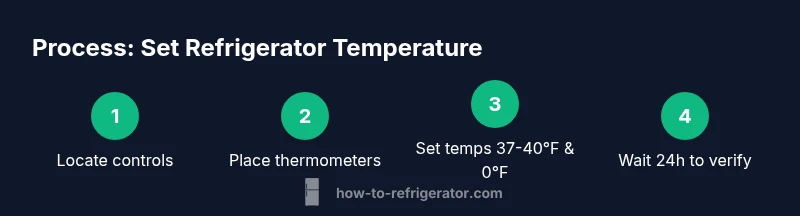
Find whether your unit uses manual dials or digital panels. Identify which control adjusts the fridge compartment and which controls the freezer. If you’re unsure, consult the owner’s manual or manufacturer support.
Tip: If you can’t locate the controls, check behind the vegetable crisper or inside the upper cabinet area near the hinge. - 2
Place thermometers in correct spots
Position a thermometer in the center of the fridge, away from the door, and another in the freezer, verifying readings reflect true ambient temperatures rather than air drafts.
Tip: Avoid placing thermometers directly against the back wall where convection can skew readings. - 3
Set initial target temperatures
Set fridge to 37-40°F (3-4°C) and freezer to 0°F (-18°C). If your controls are digital, adjust in 1-degree steps; if dial-based, move toward mid-range.
Tip: When using a dial, small changes have a big impact; always wait 24 hours before rechecking. - 4
Allow temperature stabilization
After changes, keep doors closed and allow 12-24 hours for readings to stabilize. Use this window to observe any shifts that may indicate issues.
Tip: Avoid opening doors frequently during this period to prevent artificial fluctuations. - 5
Re-check and fine-tune
Reassess temperatures after stabilization. If readings are outside range by more than 2°F (1°C), adjust by small increments and wait another 24 hours.
Tip: Document the changes so you can track how stable the temps stay over time. - 6
Check air flow and seals
Ensure shelves are evenly spaced to allow airflow; inspect door gaskets for cracks and replace if needed to prevent warm air leaks.
Tip: A loose seal is a common cause of temperature drift and higher energy bills. - 7
Record and schedule ongoing checks
Keep a log of temperatures, settings, and maintenance tasks. Schedule quarterly checks and annual coil cleaning for optimal performance.
Tip: Set a reminder to re-evaluate settings at season changes.
FAQ
What is the recommended temperature for the refrigerator?
Keep the fridge at 37-40°F (3-4°C) to balance safety and energy use. Use a thermometer to verify.
Keep your fridge between 37 and 40 degrees Fahrenheit and verify with a thermometer.
How often should I check refrigerator temperature?
Check the temperature after any major change (new groceries, outages) and recheck at least monthly to ensure stability.
Check after big changes and at least monthly to ensure the temperature is stable.
My fridge is running constantly; what should I do?
Inspect door seals for leaks, ensure proper airflow around vents, and clean condenser coils if dusty. If the problem persists, consult a professional.
If it runs constantly, check the door seals and coils, and call a pro if needed.
Can I set the fridge warmer in hot weather?
In very hot rooms, you may need a cooler fridge setting to maintain safe temperatures. Avoid setting below 32°F (0°C).
In hot weather, you might need a cooler setting, but never go below freezing.
What is the difference between fridge and freezer temps?
Fridge target is 37-40°F (3-4°C); freezer targets 0°F (-18°C). Both require stable temps to keep foods safe.
Fridge should be about 37-40 degrees, freezer around 0 degrees.
What if my digital display won’t go below a certain temperature?
Some models have minimum settings; consult the manual or service if readings don’t reach safe ranges.
If the display won’t go low enough, check the manual or contact service.
Is a thermometer necessary?
A thermometer helps confirm accurate temps and catch calibration drift that a dial might miss.
Yes—use a thermometer to verify temps beyond the dial.
Watch Video
Top Takeaways
- Set fridge to 37-40°F (3-4°C) and freezer to 0°F (-18°C).
- Verify temps with a separate thermometer, not just the built-in dial.
- Stabilize for 24 hours after any change before rechecking.
- Keep door seals clean and check airflow to avoid hotspots.
- Maintain a simple log for ongoing temperature management.