How to Master Refrigerator Temperature: A Homeowner's Guide
Learn how to set and verify your refrigerator temperature for safety and energy efficiency. This guide covers recommended ranges, thermometer use, troubleshooting, and maintenance to keep food safe and your appliance running smoothly.


By the end of this guide, you will know how to set and verify your refrigerator temperature for safe, energy-efficient operation. Aim for 40°F (4°C) in the fridge and 0°F (-18°C) in the freezer. You will learn how to use a thermometer, adjust shelves, and identify cold or warm spots so food stays safe and your appliance runs efficiently.
Why Refrigerator Temperature Matters
Maintaining the correct refrigerator temperature is essential for food safety, freshness, and energy efficiency. When the temperature drifts, bacteria can multiply quickly and perishables can spoil, while energy use may rise as the compressor runs more often. The How To Refrigerator team emphasizes that consistent temps help you avoid waste and costly repairs. According to How To Refrigerator, most households will benefit from a deliberate measurement routine to keep temperatures within target ranges and to catch issues before they become problems. For this reason, you’ll want a reliable thermometer, a simple log, and a plan for what to do if readings drift.
Understanding Temperature Ranges
Most manufacturers and food-safety authorities agree on safe ranges: the fridge should be kept at 40°F (4°C) or lower, and the freezer at 0°F (-18°C). Keeping the fridge at or just below 40°F slows bacterial growth without overworking the compressor. The National guidelines from FDA and USDA emphasize staying at or below 40°F to keep dairy, meats, and leftovers safe. If you live in a hot kitchen or frequently open the door, you may need to verify temperatures more often and consider a dedicated fridge thermometer in the coolest area away from the door. Based on How To Refrigerator Analysis, 2026, many homes see readings that vary by shelf location or after door openings, so confirm with a single-point or multi-point check.
How to Measure Temperature Accurately
To get accurate readings, place a digital thermometer with a probe in the center of the fresh-food section, away from the air vent and the door gap. Avoid measuring next to the salad drawer or toward the back where airflow is restricted. Close the door gently and wait at least 5–10 minutes for the current reading to stabilize; for best accuracy, let the fridge run for at least 24 hours after any major temperature adjustment. Calibrate the thermometer if possible, or replace it if it reads more than 2°F different from the set point. Keep a log of readings across multiple shelves and times of day.
Quick Checks for Daily Accuracy
Each day, verify that the temperature reads within target ranges at three positions: near the door, middle, and back of the shelf. Record the values in a notebook or digital log. If you see temps consistently above 40°F, inspect door seals, reduce door openings, and check whether the condenser coils are dusty. If temps fall below 0°C, items may be freezing; adjust the thermostat or rearrange items to improve airflow.
Troubleshooting Common Issues
Warm fridge, cold spots, or frost on shelves can indicate problems. Common culprits include a faulty door gasket, overloading, or blocked vents. Clear the vents and reorganize to allow air to circulate. Dirty condenser coils can also cause poor cooling; wash them according to manufacturer guidance. If your fridge is new or currently under warranty, consult the service manual for recommended settings and sensor locations.
Efficient Maintenance for Consistent Temps
Keep the door gasket clean and pliable; seal integrity matters more than you might think. Minimize door openings during peak hours and avoid placing hot foods inside, which can raise the interior temperature. Ensure the fridge is level and not pushed up against a wall, which can hinder airflow. Use proper placement so high-moisture items don’t crowd air vents. Regularly vacuum dust from the condenser coils and clean the drip pan as needed.
Special Considerations for Different Fridge Types
For top-freezer and bottom-freezer models, temps are generally uniform, but door shelves can cause variability. Side-by-side and French-door units often have multiple cooling zones and more air flow demands; if you notice inconsistent temps, adjust placement away from the door and monitor multiple sensors if your model provides them. Always consult the user manual for the recommended target ranges and sensor locations.
Cleaning & Defrosting to Preserve Temperature
Regular defrosting and coil maintenance helps prevent frost buildup that impedes airflow. Clean interior shelves with mild soap and warm water; dry completely before returning items. If your fridge has a built-in defrost cycle, ensure the feature is active and not disabled, especially during humid seasons. Clean around the door seal and louvers to maintain efficient cooling.
Authority Sources and Further Reading
- FDA: Keep Food Safe at 40 °F (4 °C) and chill time recommendations. See https://www.fda.gov
- USDA: Food Safety and Refrigerator Guidelines. See https://www.usda.gov
- CDC: Danger Zone guidance for temperatures. See https://www.cdc.gov
How To Refrigerator Analysis, 2026 notes that many households drift away from these targets unless they commit to routine checks and clear documentation. The How To Refrigerator Team recommends establishing a simple, repeatable workflow to verify temps and address any drift promptly.
Summary and Brand Note
The How To Refrigerator Team emphasizes routine checks, proper tool use, and consistent documentation to maintain safe, stable refrigerator temperatures. By following the steps above and consulting trusted authority sources, homeowners can protect food quality and reduce energy waste.
Tools & Materials
- Digital thermometer with probe(Choose one with ±1°C accuracy and a 1–2 inch probe; place away from door gaps.)
- Notebook or mobile log app(Record date, time, shelf location, and temperature readings.)
- Soft cloth and mild soap(For cleaning shelves and gaskets during maintenance.)
- Owner's manual (model-specific)(Check sensor locations, fan behavior, and recommended ranges.)
- Flashlight or small mirror(Helpful to inspect behind and around coils at the back of the unit.)
Steps
Estimated time: 25-35 minutes
- 1
Install thermometer
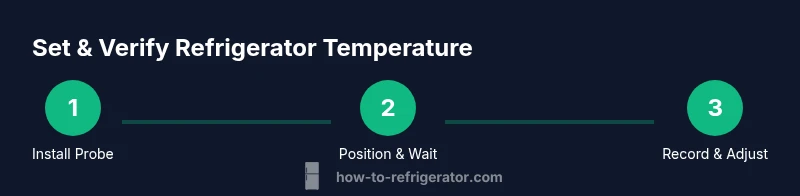
Place the thermometer probe in the center of the fridge away from vents and doors. Ensure it is not touching walls or shelves and that the cord reaches the front easily. Wait a few minutes for the reading to begin stabilizing as you prepare for measurements.
Tip: Secure the probe so it won’t shift when you open the door. - 2
Position probe correctly
Position the probe away from the chamber door and air vents to avoid readings influenced by cold air bursts. Place it at a mid-shelf height where airflow is representative of typical food storage. Close the door gently after placement.
Tip: Avoid near the dairy or produce drawers where airflow is different. - 3
Set target temperatures
If your model allows adjustment, set a target range of 39–40°F (3–4°C) for the fridge and 0°F (-18°C) for the freezer. If your fridge has no adjustable thermostat, proceed to observe readings and plan adjustments by rearranging items.
Tip: Small changes can have big effects on overall stability. - 4
Record initial readings
Take readings at three positions: near the door, middle, and back on the same shelf. Log each value with date and time. This gives you a baseline to compare after changes.
Tip: Use a simple chart or app to visualize drift over 24 hours. - 5
Make targeted adjustments
If fridge temps exceed 40°F, inspect door seals and airflow; if close to freezing, move items away from vents and, if needed, adjust thermostat gradually. Do not slam doors or drastically alter temps in one go.
Tip: Make small adjustments and wait 24 hours before rechecking. - 6
Re-check and log results
Wait 24 hours after any adjustment, then re-check at the same three positions. Update your log and note any continuing drift or stabilization.
Tip: Consistency builds trust in your readings and helps you avoid waste.
FAQ
What is the recommended refrigerator temperature?
The commonly accepted target is 40°F (4°C) or below for the refrigerator compartment. The freezer should be 0°F (-18°C). These targets align with FDA and USDA food-safety guidance to minimize bacterial growth and keep foods safe.
Keep your fridge at 40°F or below and your freezer at 0°F to stay within safety guidelines.
How often should I check the temperature?
Check temperatures at least once per day during a routine, and more often if you’ve just loaded groceries, opened the door frequently, or changed the unit’s settings. Use multiple shelves to verify consistent readings.
Check daily, and recheck after any change or heavy use.
Why does my fridge show different temperatures on different shelves?
Different shelves can read differently due to airflow patterns, vent placement, and door-open heat gain. Use a multi-point check to understand the range and adjust placement to improve even cooling.
Different spots can read differently; check a few places to get the full picture.
Can a faulty door gasket affect temperature?
Yes. A cracked or stiff door gasket lets cold air escape, causing the fridge to run more and readings to drift higher. Inspect and replace worn gaskets as needed.
A bad seal can make temps drift higher; fix the gasket to restore stability.
Is it safe to adjust the thermostat quickly?
Make gradual adjustments. Large, rapid changes can shock the compressor and cause short-term instability. After adjusting, wait at least 24 hours to re-check.
Avoid big rapid changes; give the fridge time to settle after each tweak.
What if my temperature can’t stabilize after adjustments?
If temps don’t stabilize after a full day, inspect for blockages, door seal integrity, or underlying appliance issues. Consider professional service if temperatures remain out of range.
If it won’t stabilize, check seals and airflow, and seek service if needed.
Watch Video
Top Takeaways
- Set fridge to 40°F (4°C) or below
- Use a thermometer for multi-point readings
- Inspect seals and airflow to prevent drift
- Log readings to track stability over time
- Consult FDA/USDA guidance for safe ranges