Refrigerator Freezer Temperature: Set, Test, and Maintain
Learn how to set and verify refrigerator freezer temperatures for safe food storage, energy efficiency, and reliable performance with practical steps and checks.


By the end of this guide you will be able to set and verify your refrigerator and freezer temperatures for safe food storage and energy efficiency. You’ll learn the recommended ranges (fridge around 35–38°F; freezer at 0°F), how to measure with a dial or digital thermometer, and practical steps to adjust controls and verify stability.
Understanding Refrigerator Freezer Temperature: What It Controls
Temperature is the invisible regulator of every food item in your kitchen. When the refrigerator and freezer maintain stable temperatures, food safety is preserved, bacterial growth is slowed, and energy is used efficiently. According to How To Refrigerator, proper temperature management also helps protect dairy, meats, and produce from quality loss and spoilage. In practice, you’re balancing two goals: keeping perishable items cold enough to stay safe, while avoiding excess cooling that wastes energy and dries out foods. The physics behind temperature control involve door openings, the placement of items, vent locations, and the overall efficiency of your unit. Understanding these factors helps you diagnose drift and make targeted adjustments instead of random fiddling.
Understanding Refrigerator Freezer Temperature: What It Controls
Temperature is the invisible regulator of every food item in your kitchen. When the refrigerator and freezer maintain stable temperatures, food safety is preserved, bacterial growth is slowed, and energy is used efficiently. According to How To Refrigerator, proper temperature management also helps protect dairy, meats, and produce from quality loss and spoilage. In practice, you’re balancing two goals: keeping perishable items cold enough to stay safe, while avoiding excess cooling that wastes energy and dries out foods. The physics behind temperature control involve door openings, the placement of items, vent locations, and the overall efficiency of your unit. Understanding these factors helps you diagnose drift and make targeted adjustments instead of random fiddling.
Recommended Temperature Ranges: Fridge vs Freezer
The standard target is straightforward: the fridge should be kept cold enough to slow bacterial growth without freezing foods accidentally, while the freezer should stay at rock-solid freezing temperatures. Typical recommendations are about 35–38°F (2–3°C) for the refrigerator and 0°F (−18°C) for the freezer. These ranges strike a balance between safety and energy efficiency. If your unit has a built-in thermometer, aim for these targets and use a separate probe for verification, since built-in indicators can be imprecise. Remember, small deviations for short periods aren’t critical, but persistent drift warrants adjustment and monitoring. Regular checks help you catch problems early and prevent costly spoilage.
Recommended Temperature Ranges: Fridge vs Freezer
The standard target is straightforward: the fridge should be kept cold enough to slow bacterial growth without freezing foods accidentally, while the freezer should stay at rock-solid freezing temperatures. Typical recommendations are about 35–38°F (2–3°C) for the refrigerator and 0°F (−18°C) for the freezer. These ranges strike a balance between safety and energy efficiency. If your unit has a built-in thermometer, aim for these targets and use a separate probe for verification, since built-in indicators can be imprecise. Remember, small deviations for short periods aren’t critical, but persistent drift warrants adjustment and monitoring. Regular checks help you catch problems early and prevent costly spoilage.
Tools You Need to Measure Temperature Accurately
To verify temperatures accurately, you need reliable tools that aren’t biased by door openings or heat from nearby items. A digital thermometer with a probe provides precise readings and can be left in place for continuous monitoring. An optional analog thermometer can work as a backup. Use a notepad or app to log readings and spot trends over several days. If you have a model-specific menu, keep the owner’s manual handy for understanding control labels and quirks. Clean surfaces before inserting probes to avoid skewed measurements caused by condensation or spills.
Tools You Need to Measure Temperature Accurately
To verify temperatures accurately, you need reliable tools that aren’t biased by door openings or heat from nearby items. A digital thermometer with a probe provides precise readings and can be left in place for continuous monitoring. An optional analog thermometer can work as a backup. Use a notepad or app to log readings and spot trends over several days. If you have a model-specific menu, keep the owner’s manual handy for understanding control labels and quirks. Clean surfaces before inserting probes to avoid skewed measurements caused by condensation or spills.
How to Read and Interpret Temperature Readings
Reading temperatures isn’t just about finding a number; it’s about recognizing stability. Take readings at typical meal times or after door openings to assess how quickly the unit recovers. Record both fridge and freezer values, and note how long they take to settle after a door event. If you see temperatures reverting toward the high end of the range in a 24-hour period, that’s a drift signal. Consistent drift indicates a need for adjustment or a service check. Use a simple table to compare daily readings against the targets (37°F for fridge, 0°F for freezer).
Step-by-Step: Setting Your Fridge and Freezer Temperatures
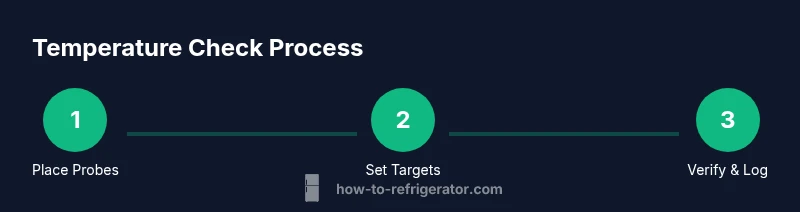
A structured approach helps you avoid guesswork. Start by locating the temperature controls and measuring points for both compartments. Then set initial targets (fridge around 37°F/3°C and freezer at 0°F/−18°C). After that, wait for stabilization and verify readings with your thermometer. If readings drift, adjust in small increments and recheck over 24 hours. Finally, document your setup and establish a routine to recheck weekly for the first month.
Step-by-Step: Setting Your Fridge and Freezer Temperatures
A structured approach helps you avoid guesswork. Start by locating the temperature controls and measuring points for both compartments. Then set initial targets (fridge around 37°F/3°C and freezer at 0°F/−18°C). After that, wait for stabilization and verify readings with your thermometer. If readings drift, adjust in small increments and recheck over 24 hours. Finally, document your setup and establish a routine to recheck weekly for the first month.
Common Causes of Temperature Instability
Temperature drift can stem from frequent door openings, warm items loaded near vents, overloaded shelves, or dirty condenser coils. Also, weather fluctuations, long runs between defrost cycles, and failing door seals can cause drift. Identifying the dominant cause helps you apply a targeted fix: reorganize the interior, replace torn gaskets, clean coils, or adjust door opening frequency. When in doubt, start with the simplest fix—reduce door openings and re-test for stability.
Common Causes of Temperature Instability
Temperature drift can stem from frequent door openings, warm items loaded near vents, overloaded shelves, or dirty condenser coils. Also, weather fluctuations, long runs between defrost cycles, and failing door seals can cause drift. Identifying the dominant cause helps you apply a targeted fix: reorganize the interior, replace torn gaskets, clean coils, or adjust door opening frequency. When in doubt, start with the simplest fix—reduce door openings and re-test for stability.
Maintenance Tricks to Keep Temperatures Stable
Regular maintenance supports consistent temperatures. Vacuum condenser coils every 6 to 12 months, clean door gaskets, and ensure the unit has adequate clearance for air flow. Keep the back of the appliance free of dust, and avoid stacking items against vents. If your unit has an energy-saving mode, verify that it doesn’t overly restrict cooling during peak usage. Routine upkeep reduces energy use and helps preserve food safety by minimizing unnecessary temperature drift.
Maintenance Tricks to Keep Temperatures Stable
Regular maintenance supports consistent temperatures. Vacuum condenser coils every 6 to 12 months, clean door gaskets, and ensure the unit has adequate clearance for air flow. Keep the back of the appliance free of dust, and avoid stacking items against vents. If your unit has an energy-saving mode, verify that it doesn’t overly restrict cooling during peak usage. Routine upkeep reduces energy use and helps preserve food safety by minimizing unnecessary temperature drift.
Food Safety Practices Linked to Temperature
Temperature control isn’t just about a number; it’s about safe food handling. Perishable foods should be kept within target ranges to slow bacterial growth. When in doubt, err on the side of caution: discard foods left in the “danger zone” (40°F–140°F) for more than 2 hours. Keep raw and ready-to-eat items separate, label leftovers with dates, and ensure leftovers are reheated to safe temperatures before consumption. Consistent temperatures support food safety year-round.
Food Safety Practices Linked to Temperature
Temperature control isn’t just about a number; it’s about safe food handling. Perishable foods should be kept within target ranges to slow bacterial growth. When in doubt, err on the side of caution: discard foods left in the “danger zone” (40°F–140°F) for more than 2 hours. Keep raw and ready-to-eat items separate, label leftovers with dates, and ensure leftovers are reheated to safe temperatures before consumption. Consistent temperatures support food safety year-round.
Troubleshooting Quick Fixes When Temperatures Drift
If you notice drift, start with quick, conservative fixes. Check that doors seal properly and no items block vents. Move the thermometer away from vents and door jams to avoid false readings. If drift persists beyond 24 hours after a single notch adjustment, consult the manual or a professional technician. Document what you changed and when you checked again to track effectiveness.
Tools & Materials
- Digital thermometer with probe(Place probe in center of fridge shelf and another in the freezer; avoid door areas.)
- Notepad and pen(Log daily readings for at least 7 days to identify drift.)
- Owner’s manual or model guide(Helps locate exact temperature control locations and features.)
- Cleaning cloth(Wipe surfaces before measurement to remove condensation or spills.)
Steps
Estimated time: 45-60 minutes
- 1
Find and understand temperature controls
Open the fridge and freezer doors to locate the temperature controls. Note whether there are separate thermostats for each compartment or a combined control. If the controls are unclear, consult the owner’s manual or model guide for exact labels and ranges.
Tip: If your control is a dial, set to the middle first, then fine-tune after initial readings. - 2
Install thermometer probes
Insert the fridge probe into the center of a shelf away from the door, and place the freezer probe in the center of the freezer. Avoid placing probes near vents, shelves, or deep inside crisper drawers where airflow is restricted.
Tip: Keep probes away from warm foods and frequent door openings to improve accuracy. - 3
Set initial temperature targets
If you have separate controls, set the fridge to 37°F (3°C) and the freezer to 0°F (−18°C). If you only have a single control, choose the middle setting and then adjust in small increments after testing.
Tip: Avoid drastic changes; small steps reduce overshoot and short-term instability. - 4
Wait for stabilization
Keep doors closed and allow the temperatures to stabilize for 6–12 hours. Take readings in the morning and again in the evening to assess consistency.
Tip: Stability is more important than a single perfect reading. - 5
Record readings and verify
Log fridge and freezer readings for several days. Compare against targets and look for drift trends. Multiple readings provide a clearer picture than a one-off value.
Tip: Create a simple table: date, fridge temp, freezer temp, notes. - 6
Adjust if readings drift
If readings drift above fridge target or above 0°F in the freezer, adjust the appropriate control by one notch or degree and recheck after 24 hours.
Tip: Make small adjustments and document each change. - 7
Document changes and set a routine
Maintain a change-log and schedule weekly checks for the first month, then monthly after stability is confirmed.
Tip: Set reminders on your phone or calendar to avoid gaps. - 8
Maintain clean coils and seals
Regularly clean condenser coils and inspect door seals for leaks or tears that can cause temperature drift.
Tip: Vacuum coils every 6–12 months and replace damaged gaskets promptly.
FAQ
What is the recommended temperature for a refrigerator?
Most guidelines suggest 35–38°F (1.7–3.3°C) for the refrigerator, which slows bacterial growth without freezing items. Use a separate thermometer to verify accuracy.
Aim for about 37 degrees Fahrenheit in the fridge and verify with a thermometer to ensure accuracy.
What is the recommended temperature for a freezer?
The recommended freezer temperature is 0°F (−18°C). This keeps foods safely frozen while avoiding ice crystal damage when not overfrozen.
Keep the freezer at zero degrees Fahrenheit and check with a thermometer to confirm.
How often should I check temperatures?
Initial checks should occur daily for the first week, then weekly for a month, and monthly once stability is established.
Check temperatures at least weekly after you confirm stability.
Why does temperature drift after door openings?
Door openings cause heat exchange that momentarily raises temperatures. Proper seals and airflow minimize drift over time.
Drift happens because opening the door lets warm air in; good seals help reduce it.
Can I rely on the fridge's built-in thermometer?
Built-in indicators are convenient but often less precise than a dedicated thermometer. Always verify with an external probe.
External thermometers give a more accurate reading than the built-in gauge.
Watch Video
Top Takeaways
- Set fridge to 37°F (3°C) and freezer to 0°F (−18°C).
- Use a thermometer and log readings regularly.
- Adjust in small increments and recheck for stability.
- Keep coils clean and seals intact for consistent performance.
- Establish a routine to verify temperatures monthly.