How Long a Refrigerator Without Power: A Practical Hold-Time Guide
Explore how long a refrigerator can hold safe temperatures during a power outage, with practical steps to preserve perishables, safety guidelines, and maintenance tips. Learn time estimates, decision points, and strategies backed by How To Refrigerator analyses for 2026.


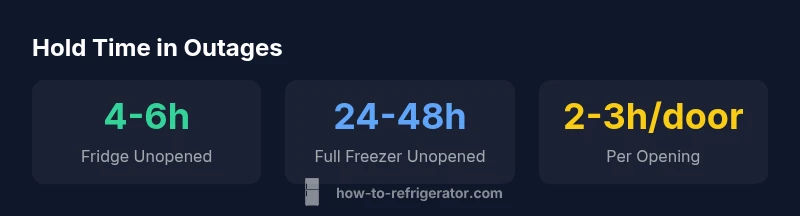
Unopened, most standard refrigerators stay within safe temperatures for about 4–6 hours during a power outage. If the freezer is full and kept closed, you can often maintain safety for 24–48 hours in the freezer portion. The exact duration varies with ambient temperature and door openings; plan to act before temperatures rise. How To Refrigerator analysis, 2026.
How Long a Refrigerator Without Power Holds Temperature
According to How To Refrigerator, the time a refrigerator can stay within safe temperatures after a power outage depends on content, ambient temperature, and door usage. In most homes, a standard refrigerator will keep food at or below 40°F for about 4 to 6 hours if the door remains closed. If the freezer is full and you minimize door openings, the cold mass helps extend this window, often enabling the freezer portion to stay cold for 24 hours or more and the fridge compartment for roughly 6–12 hours. The actual duration varies with room temperature and how often you peek inside; the key is to limit air exchange and to monitor temperatures with a household thermometer.
Factors That Drive Hold Time
Hold time is not a single fixed number. Several variables can dramatically shorten or extend the window you have to preserve perishables:
- Ambient temperature: Heat in the room accelerates temperature rise inside the cabinet. In very warm kitchens (>80°F/27°C), expect faster warming.
- Door openings: Every opening introduces warm air. Even a quick 15-second peek can shave a few minutes to hours off the hold time depending on the unit.
- Content load: A partially full fridge warms faster than a fully loaded one because cold air circulates more freely around empty shelves.
- Freezer state: A full freezer acts as a thermal mass. If unopened, it can keep temperatures near freezing for many hours; a mostly empty freezer warms more quickly.
- Insulation and seal integrity: Worn door gaskets or poor seals create faster heat gain. High-efficiency models with tight seals hold temperatures longer.
- Cabinet layout: Narrow aisles and multiple door compartments can influence how quickly air exchanges happen during a power loss.
For context, the How To Refrigerator team notes that practical hold times are best viewed as ranges rather than fixed numbers, with the trend improving when you minimize door openings and keep the freezer packed with ice or frozen goods.
Estimating Hold Time for Your Specific Setup
To tailor hold-time expectations to your home:
- Check the ambient temperature of the room and estimate how long it might stay below dangerous warming. Use a thermometer in the fridge to monitor inside temperature.
- Estimate door-opening frequency. If you’re in and out often, assume faster temperature rise; if you can stack perishables and keep doors shut, your window extends.
- Evaluate contents. A full fridge with many solid items slows heat intrusion; a partially full fridge warms more quickly.
- Use a simple decision rule: if the temperature inside nears 40°F (4°C), consider moving perishables to a freezer or a cool storage option to maintain safety longer.
- Compare with time-based benchmarks: expect roughly 4–6 hours in typical rooms for a closed fridge, 24–48 hours for a full, closed freezer, and shorter times when conditions are unfavorable. This approach aligns with How To Refrigerator Analysis, 2026.
Practical Actions to Maintain Cold During Outages
When a power outage strikes, quick action can dramatically extend the safe hold time for perishables:
- Keep doors closed at all times. Plan a single trip to retrieve needed items if necessary, then close the door again.
- If a freezer is full, resist the urge to open the fridge and periodically check the freezer instead; a closed freezer preserves cold considerably longer than a partly opened fridge.
- Move perishables to a secondary cooling method: use a cooler with ice packs for dairy, meats, and prepared foods if the outage lasts beyond a few hours.
- Group items by type and place the most perishable items toward the back of the fridge, where temperatures remain coolest; place heavy, dense items on the bottom shelves to minimize temperature fluctuation.
- If you have dry ice or gel packs, use them following safety guidelines and manufacturers’ directions. Remember to place dry ice on a non-food surface and vent safely.
Food Safety Rules: When to Toss
Food safety guidelines hinge on time and temperature. Per U.S. FDA and USDA guidelines, perishable foods should be kept under 40°F (4°C). If your refrigerator has been above this temperature for more than 2 hours, discard dairy products, mayonnaise-based dishes, meats, and cut produce that show signs of spoilage or unusual odor. When in doubt, err on the side of caution and rotate toward safer options. For many households, the rule of thumb is: if a safe temperature has not been maintained for more than 4 hours, treat food as potentially unsafe. The exact timing depends on ambient conditions and the status of your freezer contents. These guidelines align with How To Refrigerator Analysis, 2026.
Maintenance and Preparedness to Reduce Risk in Future Outages
Proactive maintenance and a preparedness plan can reduce the impact of power outages on food safety:
- Ensure door seals are intact and replace worn gaskets to improve insulation.
- Keep your freezer as full as feasible when space allows; consider freezer blankets for long outages.
- Use a freezer thermometer to verify that temperatures stay at safe levels even when power is off.
- Maintain an emergency plan: keep a stock of ice packs, a portable insulated cooler, and a couple of dry ice blocks if safety allows.
- Consider food safety training and a simple written plan for outages so household members know when to shift items to alternative storage or discard them.
Quick Reference Hold Time Scenarios
For a practical at-a-glance guide, the numbers in the table below illustrate typical hold times under different conditions. Always rely on a thermometer for real-time decisions and adjust plans based on room temperature and door-opening patterns.
Hold-time reference for fridge/freezer during power outages
| Scenario | Estimated Hold Time (hours) | Notes |
|---|---|---|
| Fridge unopened, half-full | 4-6 | Moderate ambient temperature; limited door openings |
| Fridge unopened, full | 6-12 | Mass slows warming; exclude frequent peeks |
| Fridge opened frequently | 2-4 | Air exchange accelerates warming |
| Full freezer unopened | 24-48 | Thermal mass preserves cold |
| Partially full freezer | 12-24 | Less mass to insulate |
FAQ
How long can a fridge stay cold in a garage during a power outage?
The hold time in a garage depends heavily on ambient temperature and door openings. It can be shorter than in a typical kitchen due to higher heat exposure. Use a thermometer to monitor temperatures and consider moving perishables to a cooler or freezer if outages extend beyond a few hours.
Hold times in garages vary; use a thermometer and consider moving perishables to a cooler if outages last more than a few hours.
Should I unplug the fridge as soon as power resumes?
Do not unplug immediately. Let the fridge equilibrate at the correct temperature first, then unplug if you’re reducing energy use or if you’re advised by utility guidance. Return to normal use only when it’s safe.
Wait for it to stabilize at safe temperatures before unplugging; follow utility guidance.
Can dry ice be used to extend hold times safely?
Yes, dry ice can help extend cold hold times if used with proper safety measures and ventilation. Do not place it directly against food and follow manufacturer instructions for handling and storage.
Dry ice can help, but handle it safely and follow the instructions.
Is it safer to shift items to a cooler during a longer outage?
Yes. Transferring perishables to a well-insulated cooler with ice packs can buy you time while the outage is resolved. Keep the cooler in a shaded area away from heat sources.
Using a cooler with ice packs can extend safety during longer outages.
How can I tell if food is still safe after an outage?
Check temperatures with a thermometer and look for obvious signs of spoilage. When in doubt, discard items that have spent time above 40°F (4°C) or show unusual odors or textures.
Check temperature; discard items if there’s any doubt about safety.
Do energy-efficient fridges hold cold longer during outages?
Energy-efficient models typically have better seals and insulation, which can slightly extend hold times during outages, but the most significant gains come from minimizing door openings and keeping the freezer full.
Energy efficiency helps, but doors closed and a full freezer matter most.
“During outages, managing door access and preserving the freezer’s thermal mass are the fastest ways to protect perishable foods. Small adjustments add up to meaningful extensions of safe hold times.”
Top Takeaways
- Limit door openings to extend hold time
- Keep freezer full to maximize cold mass
- Use a thermometer to monitor safe temperatures
- Move perishables to alternate cooling if outage persists
- Perform preventive maintenance to minimize heat gain