How Long Is Refrigerator Good Without Power: A Practical Guide
Discover how long a refrigerator stays safe without power, how long freezer items stay frozen, and actionable steps to protect perishables during outages.


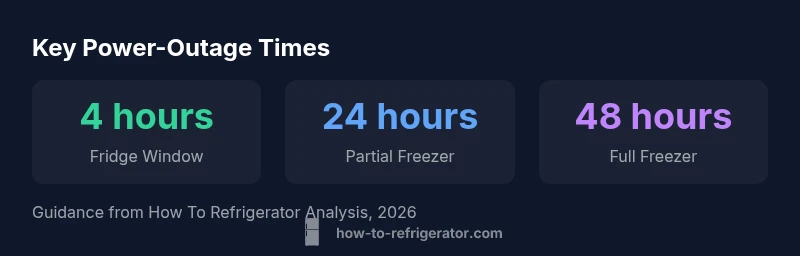
During a power outage, a refrigerator will generally keep perishable foods safe for about 4 hours with the doors kept closed. A full freezer can protect frozen foods for about 48 hours, while a partially filled freezer may keep items safe for about 24 hours. After that, discard or check with a thermometer before consuming.
What "good without power" means for your refrigerator
According to How To Refrigerator, the practical question isn’t whether the appliance is on, but how long it can keep temperatures safe after a power outage. The goal is to preserve the cold chain for perishable foods and reduce waste. The How To Refrigerator team found that, for most homes with typical refrigerator and freezer setups, staying with the door closed is the single most important habit. Temperature inside a fridge typically remains at or below 40°F (4°C) for roughly four hours after power loss if you minimize door openings. A closed freezer, particularly a full one, can keep food frozen much longer, often up to 48 hours. These timeframes are estimates and depend on how full the unit is, how often you open the door, and the ambient room temperature.
Key factors that influence how long it stays cold
Several variables determine how long your fridge or freezer maintains safe temperatures without power. First, fullness matters: a full refrigerator preserves cold air more efficiently because empty spaces fill with cold air; a nearly empty fridge warms up faster. Second, door usage: each opening introduces warm air; plan to limit entries and organize items so you can retrieve needed foods quickly. Third, ambient temperature: a hot room accelerates warming; cooler rooms help prolong safe temperatures. Fourth, insulation quality and seal integrity: worn door seals or damaged gaskets cause faster heat transfer. Fifth, freezer configuration: a full, well-packed freezer acts as a thermal battery, resisting temperature rise longer than a half-empty one. Finally, the presence of freezer items in a working freezer can delay the temperature rise if the outage is brief. The data here reflect general patterns observed in typical residential units, and should be used as a planning baseline rather than a guarantee.
Refrigerator versus freezer: Time without power
Refrigerators and freezers respond differently during outages. The fridge’s interior temperature is more susceptible to warming, so even with the door closed, perishable items such as dairy, meat, and prepared foods may reach unsafe temperatures after a few hours. Freezers, when unopened, typically retain temperatures well longer, with full freezers offering the best protection, often until power restoration approaches, potentially up to 48 hours. The difference between full and partial freezer occupancy is substantial: a full freezer can hold at near freezing temps longer, while a half-full freezer loses temperature more quickly. In all cases, the critical factor is whether the door is opened frequently, which dramatically accelerates temperature rise.
Practical steps to maximize safety during outages
Plan ahead to minimize risk. Before outages, inventory items in both the fridge and freezer and set a plan for what to transfer if necessary. During the outage, keep the doors closed as much as possible; consider moving meats, dairy, and prepared foods to the freezer, if space allows. Use a thermometer to monitor the fridge’s temperature if you have one; many households don’t, but a basic appliance thermometer is worth investing in for emergencies. If your outage lasts longer than a few hours, think about temporary cooling strategies, such as packing items into a cooler with ice or using a generator for refrigeration where safe and permitted. Remember that while the timeframe above provides guidance, you should verify the status of your perishable items using safe-handling guidelines provided by food-safety authorities. The How To Refrigerator team emphasizes practical, safe steps above all.
Temperature and food safety: What to monitor
Food safety guidelines define safe temperatures for refrigerated foods as at or below 40°F (4°C). Without power, the safest approach is to assume anything that has been above 40°F for more than two hours is unsafe to eat. For freezer items, the key is whether they are still frozen or slushy; items should be discarded if they have thawed completely. If you have a working thermometer, use the fridge to verify if it remains under 40°F and the freezer remains frozen. In a power outage, your goal is to keep the cold mass inside the appliance as large as possible and to minimize door openings. By keeping items organized, you can retrieve what you need with minimal temperature disruption. The How To Refrigerator analysis uses widely accepted food-safety practices as a baseline for planning.
What to do after power returns
Once power has been restored, check all perishable items for spoilage before consumption. Refrigerated foods that have been above 40°F for more than two hours should be discarded. When you resume operation, allow the refrigerator to return to its normal temperature before restocking. You should clean and sanitize any shelves that were exposed to room temperature long enough to affect safety. If you moved items to a cooler or freezer during the outage, verify they’re still safe to eat. If you’re unsure, play it safe and discard or reheat to safe temperatures. The goal is to restore normal operation and avoid future risks.
Special cases: Small kitchens and long outages
Small apartments with compact refrigerators can lose cool more quickly than large kitchen units, because smaller capacity means less thermal mass. If you face a prolonged outage, you might plan for alternate storage: a corraled cooler, pre-chilled ice packs, or a neighbor’s freezer storage, if allowed. For long outages, you may also consider transferring items to a neighbor’s household freezer if permitted. In all cases, plan ahead by labeling items and planning for safe re-entry once power returns. The How To Refrigerator team encourages homeowners to consider a short-term outage plan to minimize spoilage and reduce waste.
Common myths debunked about outages and refrigeration
Myth 1: Milk lasts longer in a closed fridge during a power outage. Reality: Perishables should be treated as if the fridge is no longer reliable beyond a few hours. Myth 2: If the power is out, all foods in the fridge are safe indefinitely. Reality: Food safety thresholds apply; extended outages require safer storage solutions or disposal. Myth 3: Frozen foods remain frozen forever during an outage. Reality: Food safety depends on how full the freezer is and whether it’s kept closed.
Food handling and planning for outages: backup strategies
To be prepared, keep a thermometer, a sturdy cooler, and ice packs on hand. Create a two-column inventory of fridge and freezer items and a simple rule-of-thumb for what you will move if there is a power outage. Practice quick-turnaround retrieval during outages to minimize temperature fluctuations. After power returns, pan-fry or reheat leftovers to safe temperatures if you can’t determine safety by smell or feel. The main goal is to maintain food safety while reducing waste and keeping your family safe.
Estimated safe windows for fridge and freezer during a power outage
| Scenario | Approximate Safe Duration | Notes |
|---|---|---|
| Refrigerator (closed door) | 4 hours | Keep doors closed to maintain temperature |
| Full freezer (unopened) | 48 hours | Best for long outages when fully stocked |
| Partial/freezer (unopened) | 24 hours | Temperature can rise sooner if opened |
FAQ
How long can I expect my fridge to stay cold during a power outage?
If kept closed, expect about 4 hours of safe cooling for the fridge. Freezer timing varies by fullness, with up to 48 hours for a full freezer.
About four hours for the fridge if you keep the door closed; up to 48 hours for a full freezer.
What should I do if the outage lasts longer than a few hours?
Use a cooler with ice, move foods to the freezer if possible, and minimize opening the fridge doors to preserve temperature.
Put items in a cooler with ice and limit door openings if outages persist.
Can my freezer help preserve food during an outage even if it’s not full?
A full freezer preserves temperature longer than a half-full one. If half-full, expect around 24 hours; full may approach 48 hours if unopened.
A full freezer can last much longer than a half-full one when the power is out.
How do I tell if food is safe after the outage?
Food above 40°F for more than two hours should be discarded. Use a thermometer when possible; if unsure, err on the side of safety.
If it’s been warm above 40°F for over two hours, discard it. When in doubt, throw it out.
Are there backup storage options I should consider?
Yes—plan ahead with a sturdy cooler, pre-chilled packs, and neighborly freezer options if permitted. Label items clearly for quick recovery after power returns.
A cooler with ice and clear labeling can save you during outages.
What should I do when power comes back on?
Check all foods for safety, allow the fridge to re-stabilize to its normal temperature, and sanitize shelves exposed to room temperature.
Let the fridge settle, check foods, and clean as needed after power returns.
“Outages are a common reality; practical, safety-first planning minimizes waste and protects your family. Trustworthy guidance helps you act quickly and correctly.”
Top Takeaways
- Keep fridge doors closed to maximize cold retention.
- A full freezer preserves cold longer than a half-full freezer.
- For outages beyond a few hours, use a cooler with ice.
- Monitor temperatures if you have a thermometer available.
- Return foods to safe temperatures and discard uncertain items after power returns.