How Long Can a Refrigerator Go Without Power? Timelines & Safety
Discover how long a refrigerator and freezer stay safe during a power outage, the official timelines, and practical steps to protect food. Learn with real-world scenarios and trusted guidelines.


Understanding the temperature dynamics during a power outage
When the power goes out, the temperature inside your fridge and freezer begins to rise. The rate of warming depends on how full the units are, how often the doors are opened, the ambient room temperature, and how well the doors seal. A powered fridge maintains a temperature near 37°F (3°C); once power is lost, the interior temperature climbs. A full fridge retains cold longer than an empty one because dense food mass slows heat transfer. Conversely, an empty fridge has more air pockets that warm faster. The practical takeaway is that the safe window for a fridge is about 4 hours if the door remains closed, but this window shortens quickly if you open the door repeatedly. Food safety hinges on keeping foods at or below 40°F (4°C). Bacteria multiply rapidly above that threshold, increasing the risk of spoilage and illness. In our analyses, How To Refrigerator aligns with federal guidelines and emphasizes minimizing door openings, using the coldest shelf for perishables, and relying on a thermometer to guide any decisions about keeping or discarding foods.
What counts as 'unopened' and 'full' in practice
In the context of a power outage, 'unopened' means the door has remained closed for as long as possible. Each opening introduces warm air and accelerates temperature rise. fullness matters: a full fridge has less air to circulate and slows warming; a nearly empty fridge warms more quickly. The freezer behaves similarly: a fully filled freezer traps cold air and retains frost, whereas a mostly empty freezer warms faster due to more air exchange with the room. If the unit is well insulated and door openings are minimized, the window to preserve foods extends by a meaningful margin. For families with sporadic outages, arranging items strategically—placing meats and dairy on shelves closest to the back and bottom—can help maintain cooler temperatures longer. Remember that even in a well-sealed fridge, the internal temperature will drift toward room temperature over time. The practical rule of thumb remains: minimize door openings and plan ahead with a thermometer to verify temperatures before making disposal decisions.
Official guidelines and how they apply to your kitchen
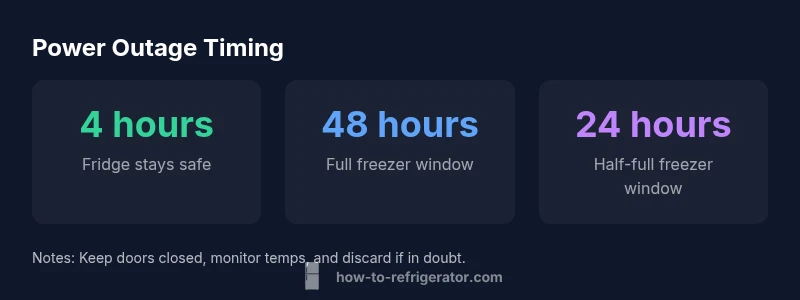
Federal food-safety guidance provides a simple, actionable framework: a refrigerator can keep foods at safe temperatures for roughly 4 hours if the door stays closed during a power outage, and a full freezer can maintain safe temperatures for about 48 hours, or about 24 hours if it is half-full. These figures are conservative estimates and assume typical residential appliances and room temperatures. Real-world performance varies with the weather and construction quality. For homeowners, the primary objective is to recognize when perishable items may have exceeded 40°F (4°C). A digital thermometer placed in the fridge and a backup thermometer in the freezer help monitor progress. When the temperature in the fridge exceeds 40°F for more than 2 hours, perishable items should be assessed and, if uncertain, discarded. For freezers, items that have remained consistently frozen or near 0°F (-18°C) are generally still safe for longer, but once thawed to above 40°F, they should be treated with caution. Our synthesis at How To Refrigerator emphasizes combining the official guidelines with practical actions that fit your household.
Real-world scenarios: household configurations
Consider different home setups to translate the guidelines into action:
- Small apartment fridge (compact unit): The safe window may be shorter due to less mass and tighter insulation.
- Standard family fridge: Expect the 4-hour window if doors stay closed, with more flexibility if you minimize door openings.
- Upright freezer (full vs. partial): A full unit holds cold longer; a half-full freezer can keep items safely frozen for roughly half that time, depending on room temperature and how quickly you recover power.
- Chest freezer: Often provides longer insulation due to mass and air circulation patterns, but you still must prioritize keeping doors closed during outages. In all cases, the key is to stage perishables in a way that reduces heat exposure and to use a thermometer to verify temperatures before deciding what to keep or discard. How To Refrigerator’s analysis helps translate appliance differences into practical steps.
Practical steps to maximize safety during outages
To extend the safe window during a power outage, follow these actionable steps:
- Keep doors closed: Each door opening lets in warm air and accelerates the temperature rise.
- Group items by temperature needs: Raw meat, dairy, and leftovers should be prioritized toward the back of the fridge and on lower shelves where temperatures stay colder.
- Use the freezer for buffering: If the outage is prolonged and your freezer is full, keep it closed to preserve its cold. If the outage extends, consider moving items to the freezer where possible.
- Use ice packs or dry ice (if available): In longer outages, dry ice or gel packs can help maintain cold temperatures, but follow safety guidelines for handling.
- Monitor temperatures: Place a digital thermometer in the fridge and freezer. If either unit surpasses 40°F for more than a couple of hours, evaluate items for safety.
- Prepare a contingency plan: Have a cooler and ice on hand for transporting perishables if you need to relocate food to a cooler with ice. These steps reduce waste and protect health during outages, aligning with How To Refrigerator’s practical approach.
When to discard food after a power outage
Disposal decisions should be based on temperature history and time out of the safe zone. If the fridge has been above 40°F for more than 2 hours, perishable items should be discarded according to federal guidance, even if they look fine. In the freezer, foods that have thawed to above 40°F should be handled with caution, as some may be safe if they had remained very cold for most of the outage. Use a thermometer to determine the current temperatures and inspect items carefully for off-smell, texture changes, or freezer burn. When in doubt, throw it out to avoid foodborne illness. The broader lesson is: active monitoring during outages reduces waste and protects your household’s health. The How To Refrigerator team emphasizes relying on verified temperature data rather than guesswork.
Planning for outages: sizing, placement, and maintenance
Proactive planning reduces the risk of spoilage during outages. Start with proper appliance selection based on household size and typical outage risk in your region. Consider a fridge that preserves cold temperatures efficiently, with good insulation and a reliable door seal. Position the fridge away from heat sources and in a climate-controlled area to minimize heat gain. Regular maintenance—clean coils, check gaskets, ensure proper door alignment—improves efficiency and resilience during outages. For freezers, ensure you have a plan to utilize the extra cold mass, and keep an organized storage system to minimize rummaging. In multi-story homes or apartments with variable power reliability, a secondary cooler or a small chest freezer can be a pragmatic backup. Our analysis from How To Refrigerator combines practical maintenance steps with real-world scenarios to help homeowners plan effectively for outages.
Data sources and how we interpret guidelines
This article synthesizes federal food-safety guidance with practical appliance behavior, drawing on data from the USDA and related sources, and aligning with How To Refrigerator Analysis, 2026. We emphasize time-to-temperature windows (fridge ~4 hours, full freezer ~48 hours, half-full ~24 hours) and translate the numbers into actionable steps for households. While individual results vary by appliance and environment, the core principle remains: minimize door openings, verify temperatures with thermometers, and decide on keeping or discarding foods based on documented time-temperature thresholds. We present conservative timelines to reduce risk and waste, and we encourage readers to consult the authority sources for their location and update future best practices.