How Long Is Food Safe in a Refrigerator Without Power
A homeowner’s guide to safe storage during power outages, with practical timelines for fridge and freezer foods, step-by-step actions, and how to assess safety after restoration.


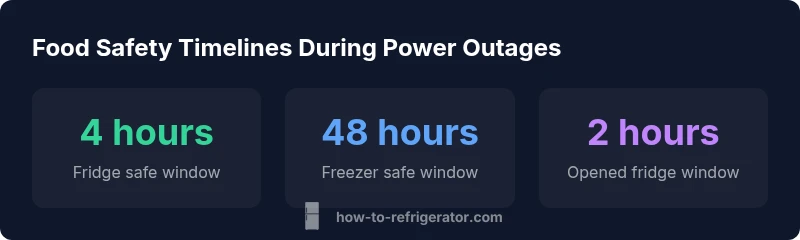
During a power outage, a refrigerator generally keeps perishable food at safe temperatures for about 4 hours if kept closed; a full freezer can stay cold for up to 48 hours, while a half-full freezer may last about 24 hours. After that, foods can reach unsafe temperatures and should be checked or discarded.
Why the power outage changes food safety dynamics
When a power outage occurs, the entire system for keeping food safe shifts from a steady cold hold to fluctuating temperatures as doors are opened and closed. According to How To Refrigerator, homeowners should think in practical windows rather than exact minutes. When considering how long is food good in refrigerator without power, the short answer is that cold air retention and the fridge's fullness are the two biggest variables. In most homes, if the fridge remains closed, perishable foods stay within a safe range for about 4 hours. A full freezer preserves more heat energy than a sparsely filled one, offering roughly 48 hours of safety if the doors stay shut, while a half-full freezer can provide about 24 hours. The initial temperature when the outage begins, the ambient room temperature, and how often you open the doors all influence outcomes. After roughly four hours, begin a careful assessment of items you want to keep and discard anything with signs of spoilage, texture change, or off odors. This nuanced approach reduces waste while protecting health.
Maximizing safety with a closed fridge and freezer
The simplest risk reduction during a power outage is to keep doors shut. Each door opening introduces warm air that accelerates temperature rise. For a typical household refrigerator that is moderately full, maintaining closed doors can preserve the cold chain for the 4-hour window; for a full freezer, the 48-hour rule holds when the freezer remains sealed. Use a thermometer to track internal temperature if possible; aim to keep the fridge below 40°F (4°C) and the freezer below 0°F (-18°C). If the outage lasts longer, consider moving items with high risk to a cooler filled with ice or dry ice if available, labeling foods, and grouping leftovers by date cooked. Upon restoration, adjust the thermostat and rearrange foods by shelf life for quicker safety checks.
Freezer strategy: full vs partial for best preservation
Full freezers retain cold better than near-empty ones due to the mass of frozen items acting as a thermal sink. If the freezer is full and remains unopened, you can typically count on around 48 hours of safety. A half-full freezer has roughly half that duration, about 24 hours, because there is less stored cold mass to buffer the rise in temperature. Avoid frequent door openings; plan how you will reallocate items once power returns. If you must open the freezer, do so quickly and close it promptly. If your freezer contains ice packs or dry ice, use them strategically to extend the safe window for perishables you plan to keep.
Step-by-step during outage: what to do in the moment
Create a quick outage plan. Before power goes out, assemble a small kit with a thermometer, a cooler, ice packs, and a backup power option if available. When the outage begins, keep doors closed and group items by how quickly they spoil. If power is out for more than a couple of hours, you may want to transfer dairy, meat, and leftovers to a cooler packed with ice. Label foods by the time they were placed in the fridge or freezer to track safety windows. As temperatures change, move the most sensitive items to the coldest part of the unit and avoid mixing raw meats with ready-to-eat goods to prevent cross-contamination.
Food-by-food safety during outages
Dairy: Milk, yogurt, and soft cheeses can perish quickly if kept above 40°F (4°C) for extended periods. Eggs, hard cheeses, and butter tend to endure longer, but quality declines. Meat and poultry should be handled with extra care; raw poultry and beef can become unsafe faster than intact, sealed products. Leftovers should be assessed for texture, smell, and color. Produce varies—many vegetables tolerate brief power loss better than dairy or meat. Canned goods and pantry items do not require refrigeration and remain safe if intact. Always check a thermometer and rely on the 2-hour rule for opened fridges and the 4-hour window for closed fridges.
After power returns: evaluating safety and when to discard
Once power is restored, check all foods with a thermometer. If dairy, meat, or leftovers have sat above 40°F (4°C) for more than 2 hours, discard them. If there is any doubt about a food’s safety, err on the side of caution and discard. When in doubt about frozen items, you can perform a visual and odor check for signs of thawing, refreezing, or freezer burn. If you have doubts about the safety of a larger quantity of food, consider consulting local food safety resources or a professional. Recycle or compost as appropriate rather than risking illness.
Pre-outage planning to minimize spoilage
Preventive steps before any outage include keeping a well-stocked freezer (as full as practical), placing a thermometer in both the fridge and freezer, and knowing where to locate dry ice or extra ice packs. Create a simple plan: what items must stay cold, what can be swapped to a cooler, and how you will label foods to track safety timelines. If you anticipate extended outages (for example, after major storms), identify backup cooling options and communicate with family members about proper handling and discarding rules. Preparedness dramatically reduces waste and improves safety during power interruptions.
Common myths and mistakes to avoid
Myth: You can safely taste-test questionable foods to decide if they are safe. Reality: Taste and smell are not reliable indicators of safety after heating or refrigeration breaks. Mistake: Opening the fridge frequently will not help; it accelerates heat gain. Reality: The safest practice is to minimize door openings. Myth: Freezing food after it has begun to thaw is always safe. Reality: Refreezing may preserve safety for some items if they are still solidly frozen and at a safe temperature, but many foods lose quality and may become unsafe if thawed for an extended period.
Safe timeframes after a power outage
| Scenario | Estimated safe time | Notes |
|---|---|---|
| Fridge (closed) during outage | 4 hours | Doors kept closed maintain cold air |
| Freezer (unopened) during outage | 48 hours | Full freezer lasts longer than half-full |
| Fridge (opened) during outage | 2 hours | Limit door openings; monitor temps |
| Thawed items post-outage | Varies | Discard if above 40°F for more than 2 hours |
FAQ
How long can I keep food in the fridge without power?
Approximately 4 hours if the door remains closed and the fridge temperature stays near 40°F (4°C). After that, safety declines and you should assess each item.
You typically have about four hours in the fridge with the door shut. After that, check each item and discard anything risky.
Can frozen foods stay safe after 24 hours without power?
Unopened, a full freezer can hold temperature for about 48 hours; a half-full freezer for about 24 hours. After that, evaluate items carefully.
A full freezer can stay safe for up to 48 hours if unopened; a half-full freezer about 24 hours.
What should I discard after a power outage?
Discard any perishable food that has been above 40°F (4°C) for more than 2 hours, and trust your senses for the rest. When in doubt, throw it out.
If it’s been above 40 degrees for over two hours, discard. When in doubt, throw it out.
Is it safe to refreeze thawed items?
Only refreeze foods that still contain ice crystals or have remained at 40°F or below. If thawed completely and above 40°F for more than 2 hours, do not refreeze.
Don’t refreeze thawed foods that have been above 40°F for more than two hours.
Are canned goods safe during a power outage?
Yes. Canned foods that are sealed and undamaged remain safe and do not require refrigeration even during outages.
Canned foods stay safe and don’t need refrigeration even during outages.
What are best practices for a prolonged outage?
Use dry ice or extra ice packs, keep doors closed, move high-risk items to cooler storage, and have a plan for longer outages.
Keep doors closed, use ice if possible, and have a plan for long outages.
“During outages, the fastest path to safety is to minimize heat transfer by keeping the doors shut and using cold packs if you have them. Planning ahead makes a real difference for food safety.”
Top Takeaways
- Keep fridge doors closed to preserve cold air.
- Estimate safe windows: fridge ~4 hours, freezer ~48 hours.
- Discard any questionable foods after the recommended window.
- Check temperatures with a thermometer after power returns.