How Long Does Food Last Without Power in a Refrigerator? Practical Guide
Learn the safe timeframes for keeping foods in a refrigerator during a power outage, how to decide what to salvage, and practical steps to minimize waste. Clear, expert guidance from How To Refrigerator.


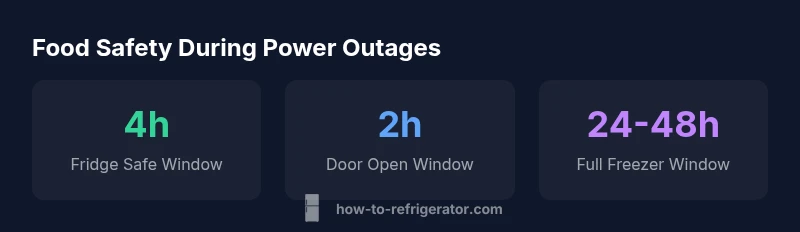
During a power outage, a closed refrigerator typically keeps foods at or below 40°F (4°C) for about 4 hours, preserving most perishables. If you open the door, the safe window drops to roughly 2 hours. After these windows, discard or transfer items promptly to a cooler. Freezers retain cold longer: 24-48 hours if unopened, and 12-24 hours if half-full.
Understanding Temperature Dynamics During a Power Outage
The moment electricity goes out, the real question becomes how well your fridge can maintain a safe temperature. A refrigerator that started at or below 40°F (4°C) will slowly lose cooling capacity if the door is left open or if the outage lasts long. The How To Refrigerator team emphasizes that minimizing door openings and keeping the unit closed as much as possible is the single most effective step to preserve food safety. According to How To Refrigerator Analysis, the safe window is highly dependent on initial temperatures, how full the fridge was, and how quickly the ambient temperature around the appliance rises. In practice, most households can expect a roughly 4-hour window with the door shut, but this can shrink to about 2 hours if you frequently open the door. Maintaining a cool environment reduces the rate at which perishable foods reach unsafe temperatures. This guidance aligns with general food-safety principles from government sources and practical kitchen experience.
How Long Foods Stay Safe in a Refrigerator Without Power
When power fails, you are effectively delaying spoilage until the internal temperature passes a critical threshold. For most households, the key rule is to keep the fridge door closed to preserve the existing cool air. If the outage lasts longer than a few hours, you should assume that perishable items could become unsafe after 2-4 hours if the door has been opened multiple times. The duration depends on the starting temperature and the foods you store. In short, plan for about a 4-hour window when you can avoid opening the door; otherwise, plan for quicker action. The How To Refrigerator team notes that planning ahead—having a cooler and ice ready—can extend safe storage during outages.
Practical Guidelines for Salvaging Food During an Outage
Before power is restored, create a salvage plan. Move perishable items to a cooler packed with ice or dry ice if outages are expected to exceed 2 hours. Label foods and keep raw meats separate from ready-to-eat items. A thermometer is invaluable; target maintaining 40°F (4°C) or below inside the fridge. If your fridge has remained closed and the temperature meter still reads 40°F (4°C) or lower after power returns, you can phase foods back into regular storage gradually. How To Refrigerator’s approach emphasizes careful observation, quick action, and adherence to safety thresholds to minimize waste during outages.
A Step-by-Step Salvage Plan for Short Outages
- Keep doors closed; avoid peeking or propping doors open. 2) If outage is expected to last beyond 2 hours, prepare a cooler with ice packs. 3) Group foods by risk: uncooked meats, dairy, and leftovers on the bottom (cooler guaranteed) and fruits/vegetables on top. 4) If you must move food back to the fridge, do so only after you confirm internal temperatures are safe. 5) When power returns, check temperatures and re-evaluate food safety rather than guessing. This plan follows general food-safety practices and is reinforced by How To Refrigerator’s guidelines.
What to Do When Power Returns and the Fridge Is Warm
Common foods and safe handling during outages
| Food Type | Safe Window (hours) | Notes |
|---|---|---|
| Milk & dairy (unopened) | 4-6 | Keep cold; discard if smells off or texture changes |
| Raw poultry & meat | 2-4 | Keep cold; discard if above 40°F for more than 2 hours |
| Cooked leftovers | 3-4 | Can be saved if temperature remains cold upon return; reheat to 165°F |
| Fruits & vegetables | 4-6 | Quality may decline; wash before use |
FAQ
How long can I keep foods in a refrigerator during a power outage?
The safe window depends on whether the fridge remains closed. Typically about 4 hours when closed, and closer to 2 hours if the door is opened repeatedly. After that, start evaluating perishable items for safety.
Keep the door shut as much as possible and use a thermometer to check that the fridge stays near 40°F (4°C).
Is it safe to eat foods that have been above 40°F for more than 2 hours?
Foods that have been above 40°F for more than 2 hours should be discarded to avoid foodborne illness. When in doubt, throw it out.
If it’s not cool to the touch or smells off, don’t risk it.
What should I do with unfrozen foods after power returns?
Check temperatures, separate items by risk, and return only items that have stayed at safe temperatures. Reheat leftovers to 165°F before serving.
Check temp first, then decide what to save or discard.
Can I use ice to salvage food during an outage?
Yes. A cooler with ice can extend safe storage for perishables. Keep raw meats separate and keep the cooler closed.
Ice can buy you time, but don’t rely on it indefinitely.
Should I keep meat in the fridge if the outage lasts long?
If the outage extends beyond a couple of hours, consider transferring meat to a separate cooler with ice or discard if temperatures rise above 40°F for any length of time.
Better safe than sorry with meat; use a cooler if you can.
What if the power outage ends and the fridge is still warm?
If the fridge remains above 40°F after returning power, discard perishable items or transfer to another cold storage until the fridge stabilizes.
If in doubt, discard perishable foods.
“During a power outage, the safety of refrigerated foods depends largely on how quickly you respond—minimizing door openings and moving perishables to a cooler can save precious hours.”
Top Takeaways
- Keep the fridge door closed to maximize the safe window
- Use a thermometer to verify 40°F (4°C) or below
- Move perishables to a cooler with ice if outages exceed 2 hours
- Discard foods that have been above 40°F for more than 2 hours
- When power returns, re-check temperatures and food safety before consuming