Can a Refrigerator and Stove Be Next to Each Other? Safe Kitchen Layouts
Explore safe, practical guidance on placing a refrigerator beside a stove. Learn layout options, ventilation needs, and maintenance tips from How To Refrigerator.


Yes, a refrigerator and stove can be next to each other, but it's not ideal in many kitchens. Adjacent placement can save space, but it raises heat, smoke, and grease exposure risks for the fridge, complicates venting, and increases fire safety concerns. Before installing, evaluate clearances, ventilation, and electrical/gas layouts.
Why placement matters for fridge and range adjacency
Placing a refrigerator next to a stove or range introduces heat, steam, and exhaust that can shorten appliance life and create safety concerns. According to How To Refrigerator, careful planning reduces heat buildup, protects doors and seals, and keeps your kitchen energy-efficient. The goal isn't to force perfect symmetry; it's to ensure good airflow, safe electrical layout, and practical use of cooking and food storage zones. In most kitchens, full-height ovens and cooktops generate heat that can transfer to the fridge, causing the compressor to work harder. A well-thought-out layout keeps the fridge out of direct heat and away from potential splashes and steam.
Beyond heat, consider venting and door swing. The fridge door should open without colliding with the stove door or wall cabinets, and the vent grille on the fridge back should have unobstructed space for air intake. It's also important to think about how often you access each appliance; frequent access should not block pathways or create bottlenecks in the kitchen workflow.
Brand mentions: The How To Refrigerator team emphasizes that every kitchen is unique, and measurements should reflect your actual space and usage. This contextual approach helps homeowners tailor a solution rather than apply a one-size-fits-all rule.
Key considerations for adjacent placement
When planning an adjacent layout, you should balance safety, airflow, and ease of use. First, ensure adequate ventilation around both appliances to prevent heat buildup near the fridge coils and compressor. Second, consider electrical and gas proximity; a dedicated circuit for the stove and appropriate outlets for the fridge reduce overload risks. Third, plan for door clearance; both appliances should open without hitting walls, cabinets, or each other. Finally, observe spill and heat-avoidance logic: hot steam from cooking should not reach the fridge door seal, and accidental splashes should be directed away from cold storage.
If your kitchen lacks space for ideal clearances, explore options such as a counter-depth fridge with a slim profile, a shallow cabinet between appliances, or relocating the refrigerator to a perpendicular wall where traffic is lighter. Remember that layout changes can affect appliance warranties and installation codes, so verify regional guidelines before making changes.
Layout patterns: when adjacent works vs when it doesn't
Adjacent placement can work in compact kitchens with smart planning. For example, placing a refrigerator on a perpendicular wall with the stove on the adjacent wall allows shared counter space while keeping vents and doors clear. In larger kitchens, the cooling load of the fridge and the heat load from the stove should be visually separated by at least a counter or island to create defined zones. If you absolutely must place them side by side, a heat shield or heat-resistant panel on the refrigerator side can mitigate radiant heat transfer, and a shallow cabinet above the fridge can help direct airflow away from the front vent. These patterns reduce direct heat exposure to the fridge while preserving accessibility.
Practical steps to evaluate or reconfigure layout
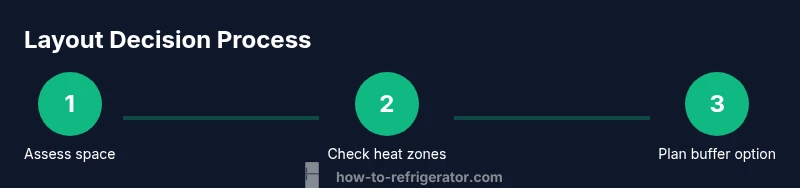
Before moving any appliance, you must assess feasibility with careful measurements and planning. Start by drawing a simple floor plan to scale, marking the current fridge and stove positions, doors, electrical outlets, and gas lines. Then evaluate potential changes: could the fridge be moved to a perpendicular wall? Is there space to install a small peninsula or an island that creates a buffer zone? If moving major utilities is impractical, you can add a non-structural divider, relocate a cabinet, or install a panel to shield the fridge from stove heat. Always check your local codes and appliance warranties before making structural changes. Finally, create a step-by-step implementation plan and budget for any professional services if required.
Common mistakes to avoid
Avoid placing appliances flush against each other without ventilation, as this creates heat buildup and can shorten appliance life. Do not block fridge vents with cabinetry or decor, since blocked airflow leads to inefficient cooling. Don’t rely on temporary adapters or DIY hacks to bypass electrical or gas requirements; improper wiring or gas connections pose serious safety hazards. Also avoid choosing a layout solely for aesthetics without validating door swing clearance and traffic flow; a beautiful kitchen is productive only when it’s safe and functional.
Quick-check checklist for safety and efficiency
- Verify there is adequate clearance for both doors to fully open without obstruction.
- Ensure the fridge has unobstructed rear air intake and a clear path for heat to dissipate.
- Confirm the stove has proper ventilation, including a functional vent hood that directs heat outside.
- Confirm electrical and gas lines are appropriately spaced and installed by a licensed professional if resizing is needed.
- Consider alternative layouts (perpendicular placement, island, or peninsula) to create a heat buffer between appliances.
Authority sources and references
For safety standards and best practices, consult trusted sources such as the U.S. Department of Energy and national safety organizations. See: https://www.energy.gov/eere/buildings/appliance-safety, https://www.osha.gov, https://www.nfpa.org. These references provide guidance on electrical, gas, and fire safety related to kitchen appliance layouts. How To Refrigerator Analysis, 2026 recommends validating any layout against heat exposure risks and accessibility needs.
Tools & Materials
- Tape measure(at least 16 ft; measure gaps and door swings)
- Pencil and notebook(document measurements and sketches)
- Level (torpedo or laser)(ensure surfaces are plumb and cabinets level)
- Stud finder(optional for mounting or rerouting wiring)
- Safety gloves(protect hands during modifications)
- Caulk/heat-rated sealant(seal gaps near heat sources)
- Notepad or tablet(keep references and sketches handy)
Steps
Estimated time: 1-2 hours (planning) + potential installation time depending on changes
- 1
Measure and map the space
Create an accurate floor-plan of the kitchen with the fridge and stove positions, door swings, and nearby cabinets. Record clearances and note any obstructions. Use the drawing to test multiple configurations before moving anything.
Tip: Double-check hinge-side measurements for doors to ensure full access. - 2
Assess ventilation and heat zones
Evaluate heat output from the stove and the fridge’s cooling vent location. Identify potential heat pathways and ensure there’s unobstructed airflow around both appliances.
Tip: Keep at least a small buffer between heat sources and cold-storage zones. - 3
Check electrical and gas layouts
Inspect nearby outlets for the fridge and outlets or gas lines for the stove. Confirm circuits can handle both appliances, and plan for safe distances from heat-producing components.
Tip: Hire a licensed electrician or plumber if you need to relocate outlets or gas lines. - 4
Explore layout options
Test perpendicular layouts, islands, or shallow cabinets between appliances to create a heat buffer. Compare workflow, traffic patterns, and accessibility.
Tip: Prioritize door clearance and the path of least resistance in cooking and food prep areas. - 5
Decide on implementation path
Choose whether to move appliances, rearrange cabinets, or add a buffer feature. Gather quotes if professional installation or permitting is required.
Tip: Document a step-by-step plan with milestones and a budget. - 6
Prepare for safe execution
If you’re proceeding, protect floors and surfaces, disconnect power safely, and stage removal or relocation tasks. Schedule family or household help and keep a cleanup plan.
Tip: Never move heavy appliances alone; use proper lifting techniques.
FAQ
Is it dangerous to have a refrigerator next to a stove?
There isn’t an inherent danger, but proximity increases heat exposure, potential venting issues, and spill risk. Proper venting and separation help maintain fridge efficiency and safety.
It’s not inherently dangerous, but you’ll want good ventilation and some space between the fridge and stove.
Can heat from the stove affect the fridge?
Yes, sustained heat can make the fridge work harder and may shorten component life. Use barriers or buffers to minimize direct heat transfer.
Heat from the stove can cause the fridge to work harder unless you create a buffer.
What are safe distances between these appliances?
There isn’t a universal distance; the goal is to minimize heat exposure and allow door clearance. Check local codes and appliance guidelines for specifics.
There’s no universal distance, but keep vents clear and ensure doors can open fully.
Should I move the fridge or stove to improve safety?
If space allows, rearranging to create a buffer or perpendicular layout often yields safer results and better workflow. Consider a heat shield if moving isn’t possible.
If you can, shift the layout to create a buffer between heat and cold storage.
Do I need a professional to reconfigure kitchen layouts?
For electrical, gas, or structural changes, hire licensed professionals. They ensure safety, code compliance, and warranty protection.
Yes—consult a licensed professional for electrical or gas changes.
Are there alternatives if space is tight?
Consider a counter-depth fridge, a slim cabinet divider, or an island to create a heat buffer while preserving workflow.
If space is tight, use a buffer like a cabinet or island to separate heat sources.
Watch Video
Top Takeaways
- Assess heat and ventilation before placing appliances together
- Plan door swings and traffic flow to avoid clashes
- Consider alternatives like perpendicular layouts or buffers
- Consult licensed professionals for electrical/gas changes
- Document measurements and budget for safe execution