Refrigerator and Gas Stove on the Same Circuit: Safe Wiring Guide
Explore whether a refrigerator and gas stove can share a circuit, why dedicated appliance circuits are recommended, and how to plan a safe, code-compliant kitchen electrical layout. Learn practical steps for homeowners and when to call a licensed electrician.


In most homes, a refrigerator should have its own dedicated circuit, typically 15-20A, separate from a gas stove. A gas stove often uses a different circuit and sometimes a dedicated appliance branch circuit. Sharing can overload circuits, trip breakers, and create safety hazards. Always consult a licensed electrician for a proper assessment.
Can the fridge and gas stove share a circuit? A practical safety overview
If you’ve ever asked the question, can a refrigerator and gas stove be on the same circuit, the short answer is typically no. The refrigerator usually needs a dedicated circuit to ensure steady cooling, while a gas stove’s electrical demands often require separate, appropriately sized wiring. The Cannot-share baseline is not just a rule of thumb; it’s a protective measure that minimizes the risk of nuisance trips and potential overheating at the panel. According to How To Refrigerator, understanding kitchen circuit rules helps homeowners avoid overload and unsafe conditions. Placing these two high-draw appliances on a single circuit can create voltage fluctuations that affect both appliances’ performance and, in worst-case scenarios, pose safety hazards in a busy kitchen environment. For most households, keeping them on separate circuits is the simplest, most reliable path to stable operation, fewer trips, and safer electrical room management.
The How To Refrigerator team emphasizes that dedicated appliance circuits help prevent unpredictable loads from spilling into other outlets and devices, which is especially important in rooms with multiple heavy-use appliances. In addition to preventing trips, a dedicated circuit makes it easier to diagnose issues when something goes wrong. Homeowners should treat the question not as a minor DIY tweak but as a system design decision with safety and reliability at its core.
Tools & Materials
- Non-contact voltage tester(Essential for safely checking outlets and panels without contact)
- Multimeter(Helpful for verifying voltage and continuity when planning changes)
- Insulated screwdriver set(For panel screws and outlet hardware with proper insulation)
- Electrical tape(Use for temporary labeling and insulation during planning)
- Voltage tester(Confirm circuits are de-energized before touching components)
- Safety glasses(Eye protection during any inspection or work)
Steps
Estimated time: 2-6 hours (planning and coordination; full wiring by a licensed pro may take longer)
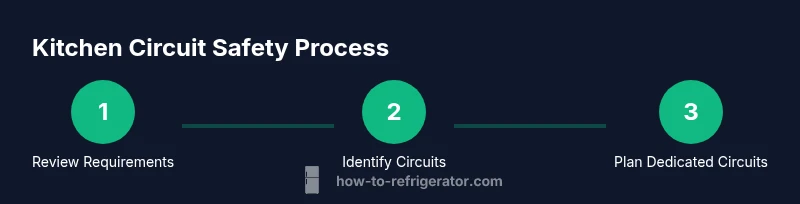
- 1
Review appliance requirements
Begin by collecting each appliance’s manual and any nameplate data. Document the circuit size, amperage, and any dedicated circuit recommendations. This helps you understand whether a dedicated circuit is required for the refrigerator and for the gas stove.
Tip: Have the manuals handy and note the manufacturer’s circuit guidance. - 2
Identify existing kitchen circuits
Open the main panel and locate breakers feeding the kitchen outlets, refrigerator, and range. Label them if needed and check whether there is a shared circuit currently in use for these appliances. Do not assume—verify with the panel and test equipment.
Tip: Take photos of panel labeling before making changes. - 3
Consult a licensed electrician
If you suspect the fridge and stove share a circuit, schedule a professional evaluation. A licensed electrician can assess panel capacity, wiring method, and code requirements, then design a compliant plan.
Tip: Do not attempt major rewiring yourself; electrical work in kitchens has safety and code implications. - 4
Plan dedicated circuits per appliance
With the electrician, plan separate circuits for the refrigerator and the gas stove, ensuring correct breaker size, outlet type, and appropriate GFCI/AFCI protection where required by code and local rules.
Tip: Ensure the refrigerator’s dedicated circuit is easily accessible for maintenance. - 5
Implement and verify with careful testing
After installation, test each circuit with appropriate equipment. Confirm no shared neutrals or overlapping loads, and ensure the range and fridge run independently without tripping breakers.
Tip: Keep a record of the changes and label the circuits clearly. - 6
Document and future-proof
Update floor plans and electrical diagrams to reflect the new dedicated circuits. This helps future maintenance and ensures any future remodels understand the kitchen wiring layout.
Tip: Maintain a copy of the updated diagrams with household wiring documents.
FAQ
Can a fridge and stove be forced onto the same circuit?
In most cases, sharing a circuit between a refrigerator and a gas stove is not recommended due to potential overloads and nuisance trips. Dedicated circuits help maintain cooling performance and ensure stove function stays reliable.
Usually not. It's safer to use separate circuits for a fridge and a stove.
What happens if these appliances share a circuit?
Shared circuits can trip the breaker, causing interruptions to cooling or cooking. Over time, voltage fluctuations may affect appliance performance and create unsafe conditions in the kitchen.
It can trip breakers and lead to unsafe operation.
Can a modern gas stove be on a 15A circuit?
Gas stoves typically require dedicated circuits sized per the manufacturer’s guidelines. Always refer to the stove’s installation manual and local code for final sizing.
Check the stove manual; many models need their own circuit.
What about AFCI/GFCI protections in kitchens?
Many jurisdictions require AFCI and GFCI protection in kitchen circuits, especially for countertops. Verify local code and ensure protections meet those standards.
Kitchens often need both AFCI and GFCI protections.
How can I verify safety after changes?
Have a licensed electrician test the circuits with appropriate instruments and confirm there are no shared circuits or overloads before use.
Get a pro to test and sign off on the work.
Watch Video
Top Takeaways
- Keep fridge and stove on separate circuits for safety.
- Consult a licensed electrician for any changes in kitchen wiring.
- Document circuit changes with updated diagrams.
- Ensure proper AFCI/GFCI protection per local code.