What Temperature Should My Refrigerator Be Set At? A Homeowner's Guide
Discover the recommended fridge and freezer temperatures, how to verify them with a thermometer, and practical steps to maintain safe cooling while saving energy. A data-backed, homeowner-friendly guide from How To Refrigerator.


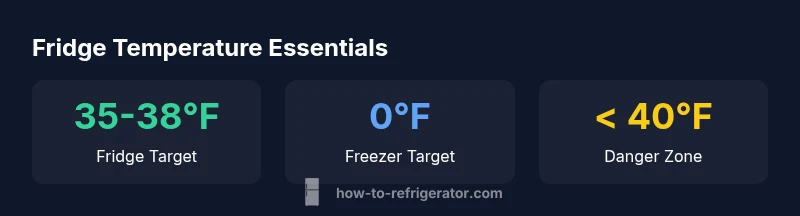
The refrigerator should be set to 35-38°F (2-3°C) for safe food storage, with the freezer at 0°F (-18°C). Keeping the fridge within this range minimizes bacterial growth while conserving energy. If your food isn’t staying cold enough or is freezing, adjust gradually, and verify with a thermometer. How To Refrigerator explains these targets clearly.
Why Temperature Matters for Food Safety and Energy Use
The short answer is simple: the temperature inside your refrigerator directly affects food safety and energy bills. Keeping the cavity at the right level slows bacterial growth and reduces the load on the compressor. For most homes, the practical target is 35-38°F (2-3°C) for the fridge and 0°F (-18°C) for the freezer. This aligns with national guidelines and consumer-tested best practices. If you ask, 'what temperature should my refrigerator be set at' in real terms, you’re balancing safety margins with everyday convenience. Even small deviations can add up over days and weeks, so accuracy matters.
- Use a thermometer, not guesswork
- Keep door openings to a minimum
- Place items to avoid blocking vents
According to How To Refrigerator, the exact numbers can vary by model and layout, but staying within this core range is the most reliable starting point for most households.
How to measure your fridge temperature accurately
To accurately verify the temperature, start with a digital thermometer placed in the middle shelf, away from the door and vents. Record the reading after at least 24 hours of stable operation. Repeat measurements on different days to account for normal fluctuations (for example, after grocery storms or more frequent door openings). If readings drift beyond the 35-38°F range, adjust the thermostat in small increments (1-2°F) and recheck over another 24 hours. For best results, keep a small, unobtrusive thermometer on hand and log results weekly to spot drift early.
- Don’t rely on door-panel readouts alone
- Verify with a dedicated thermometer for accuracy
- Re-check after any mechanical changes
The How To Refrigerator team emphasizes verification because trust is built on measured data, not impressions.
How temperature affects food safety and energy use
Food safety and energy efficiency go hand in hand. Bacteria multiply rapidly in the “danger zone”—roughly between 40°F and 140°F (4°C–60°C). Keeping the refrigerator at 35-38°F (2-3°C) slows microbial growth while avoiding unnecessary freezing of fresh produce. Cooler temperatures beyond 40°F do not significantly improve safety and can waste energy by forcing the compressor to run longer. Conversely, a fridge held too warm may lead to spoiled dairy, wilted produce, and shortened shelf life. If you see condensation, frost buildup, or inconsistent cooling, those are early signs your temps may be drifting. Regular checks help you balance safety with energy use.
- Safety first: stay below 40°F (4°C)
- Consider mixed loads and door opening patterns
- Use energy-efficient settings as a baseline
Based on How To Refrigerator research, maintaining the recommended range consistently yields the best overall outcomes for both food quality and household electricity use.
Common misconfigurations and how to fix them
Many households drift into suboptimal temps due to simple habits or worn components. Common culprits include a loose door gasket, a light left on, or items blocking air vents. Start by inspecting the door seal; press a dollar bill into the door and see if you can pull it out with some resistance—if so, the gasket likely needs replacement. Next, rearrange shelves to restore airflow, ensuring there’s space around tall bottles and bulky foods. Elevate the thermostat setting carefully if the freezer constantly freezes items, or if the fridge runs non-stop in hot weather. Finally, clean condenser coils (usually on the back or underneath) every 6–12 months to prevent energy waste. Adjustments should be gradual to avoid sudden temperature swings.
- Test door seals with a simple bill-test
- Maintain airflow by not overpacking
- Clean coils to improve efficiency
How The To Refrigerator recommends a routine: check temps after any changes and review airflow paths.
When to adjust for specific scenarios
Your baseline is the general rule, but scenarios can justify small deviations. If you regularly store a lot of raw meat or dairy, a tighter fridge range (36-37°F) can reduce spoilage risk. After hosting a large meal, you may temporarily creep up to 39°F to accommodate increased volume, then return to the standard range after a day. In warmer climates or homes without good insulation, a slightly cooler fridge can compensate for heat load, but monitor energy usage. If you notice frequent door openings, consider a thermometer outside the door to track actual interior temperatures time-averaged over the day. This helps distinguish user-driven variation from equipment drift.
- Use 36-37°F for high-volume perishable storage
- Don’t push temperatures too far; re-check after 24 hours
- Consider ambient temperature and insulation when setting defaults
The difference between fridge and freezer temps and how to maintain both
Fridge temperatures typically sit around 35-38°F, while freezers should be at 0°F to maintain long-term food integrity. Freezer drift often manifests as ice crystals on foods or frost buildup; this signals the need to defrost or inspect the appliance. Do not combine cold zones—keep items spaced to maintain airflow. When calibrating, verify both compartments separately using two thermometers. If you notice frequent cycling in either compartment, consider a service check of the thermostat or an internal sensor.
- Fridge: 35-38°F; Freezer: 0°F
- Monitor for frost and moisture buildup
- Use separate thermometers for each compartment
The How To Refrigerator team notes that consistent monitoring across both compartments is essential for overall performance and energy efficiency.
How to adjust if you have an older fridge or inconsistent temps
Older refrigerators may have degraded seals, worn gaskets, or compromised insulation, which can cause more temperature drift. Start with a gasket inspection and cleaning, as well as coil maintenance to restore efficiency. If temperatures remain inconsistent, you can still optimize within practical limits by adjusting in small increments and using internal thermometers. Where advanced diagnostics are unavailable, schedule a low-cost service check to test the thermostat and sensor calibration. If you’re buying a replacement, consider models with better insulation and auto-defrost features to minimize temperature fluctuations.
- Inspect gaskets and seals regularly
- Clean coils to improve efficiency
- Consider professional service for sensor calibration
The How To Refrigerator approach emphasizes data-driven checks and gradual adjustments over guesswork.
Tips for maintaining steady temps long-term and avoiding drift
Maintaining steady temps is less about bold changes and more about consistent habits. Keep the door closed as much as possible, organize shelves to allow air to circulate, and keep the unit in a cool, well-ventilated area away from direct sunlight. Schedule periodic maintenance: coil cleaning, gasket inspections, and thermostat checks. If you notice increasing energy bills, unexpected frost, or frequent cycling, re-check the temperature with a dedicated thermometer and log readings for a couple of weeks to catch gradual drift early.
- Build a simple monthly temp log
- Keep the door closed and vents clear
- Schedule semi-annual maintenance checks
When to rely on professional service and what to expect
If temperatures drift despite adjustments, or if you hear unusual noises, it’s time to call a professional. A service visit can verify the thermostat, sensor calibration, and refrigerant levels, and may include a condenser coil cleaning. Ask for a diagnostic report that documents temperatures in both compartments, any observed drift, and recommended fixes. For most households, a professional check is a cost-effective way to extend appliance life and protect food safety without guessing at settings.
- Seek a written diagnostic and clear cost estimate
- Ensure the technician checks sensors and the thermostat
- Consider service for older units with intermittent temps
Quick reference: temperature settings by scenario
| Scenario | Typical Temperature Setting | Notes |
|---|---|---|
| Standard fridge use | 35-38°F (2-3°C) | Balanced safety and energy |
| Very crowded fridge | 34-36°F (1-2°C) | Keeps perishables safer |
| Old fridge with poor sealing | 38-40°F (3-4°C) | Monitor for spoilage risk |
FAQ
What temperature should my refrigerator be set at?
The standard recommendation is 35-38°F (2-3°C) for the fridge and 0°F (-18°C) for the freezer. This balance helps prevent the growth of harmful bacteria while keeping foods fresh. Adjust gradually and verify with a thermometer to avoid large swings.
Set the fridge to 35-38°F (2-3°C) and the freezer to 0°F (-18°C). Verify with a thermometer after any adjustment.
How can I tell if my fridge is too warm or too cold?
Use a digital thermometer placed in the middle shelf, away from the door. If readings are outside the recommended range for more than 24 hours, adjust by 1-2°F and recheck after another day.
Place a thermometer in the middle shelf and recheck after 24 hours if temps drift.
Is 34°F too cold for a fridge?
34°F is within the common safe range and is unlikely to damage most foods, but it may cause light freezing of sensitive items. If you notice frost or freezing, raise the setting slightly.
34°F is generally okay, but watch for freezing of delicate items and adjust if needed.
Should the freezer be at 0°F?
Yes. 0°F (-18°C) is the standard target to keep frozen foods safe and maintain quality over time. Avoid higher temps that may cause freezer burn or spoilage.
Yes, aim for 0°F in the freezer; it keeps food safe and preserves quality.
What if my fridge is old and doesn’t hold temperature well?
Older fridges can drift due to worn seals or insulation. Inspect gaskets, clean coils, and consider professional calibration. If temps remain unstable, a replacement may be more cost-effective in the long run.
If it drifts despite maintenance, consider a professional check or replacement.
How often should I verify the refrigerator temperature?
Check at least once a week with a dedicated thermometer, then after any major door openings or changes in weather. Keep a simple log to spot drift early.
Check weekly with a thermometer and log the results.
“Setting temperatures within the recommended range is the simplest, most reliable way to protect food safety and save energy.”
Top Takeaways
- Set fridge to 35-38°F and freezer to 0°F.
- Verify temps with a dedicated thermometer, not eyeballing the feel of items.
- Minimize door openings to maintain stable temperatures.
- Regularly check door seals and clean condenser coils.
- Make small adjustments and re-check after 24 hours.