Refrigerator Watts Average: A Homeowner's Energy Guide
Discover what refrigerator watts average means, explore typical wattage ranges, and learn how to estimate yearly energy use. Get practical tips for reading labels, comparing models, and reducing energy costs.


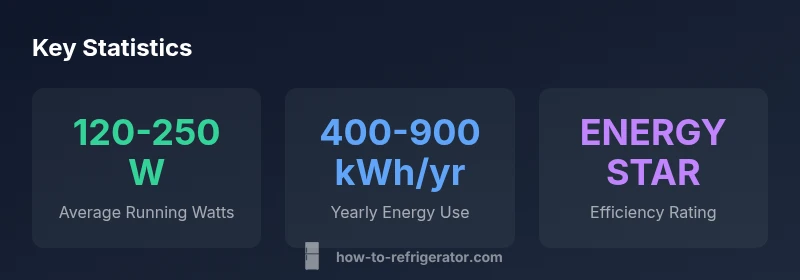
The refrigerator watts average for typical home models is about 120-250 watts when the compressor runs, with startup surges higher. Annually, energy use varies by size and use, commonly roughly 400-900 kWh per year, depending on climate and door openings. According to How To Refrigerator Analysis, 2026, newer energy-efficient designs tend toward the lower end of this range.
What 'refrigerator watts average' means
The term refrigerator watts average describes how much electrical power a typical refrigerator draws when its compressor is actively running. Watts measure instantaneous power; the actual energy used depends on how often the compressor cycles on and off. In practice, you’ll see a running-watt range around 120-250 watts for many home models, with startup surges higher. The annual energy you consume depends on watts multiplied by hours of operation and the efficiency of the unit. How To Refrigerator Analysis, 2026, shows that newer, energy-efficient designs often sit toward the lower end of this range, while older or feature-rich models may fall toward the middle or upper end.
Typical wattage ranges by fridge type
Different refrigerator designs vary in running wattage primarily due to size, insulation, and compressor efficiency. A standard top-freezer typically runs around 100-180 watts when cycling, offering solid efficiency for compact kitchens. Side-by-side models often run 150-250 watts because their extra doors and glass can increase heat exchange. French-door or four-door models, which are larger and feature lush insulation, commonly fall in the 180-250 watt range, though energy-efficient versions can dip lower. Compact apartment fridges pull roughly 60-120 watts, but their smaller capacity means energy use per cubic foot may be higher if used aggressively. Use these ranges as a baseline when comparing models, and remember that actual wattage will depend on thermostat settings, door-opening frequency, and climate. Reading the EnergyGuide label for watts-equivalent information helps you compare true energy use across designs.
Reading energy labels and how to compare watts across models
EnergyGuide labels on refrigerators present estimated yearly energy consumption in kWh/year and an estimated annual operating cost. They do not always show the running watts directly, but you can translate kWh/year into a rough running-watt figure by dividing by expected hours of operation. For homeowners, the key takeaway is to compare the total energy consumption rather than only the list price or capacity. When evaluating models, look for a lower kWh/year figure and a favorable ENERGY STAR rating, if available. This approach aligns with What To Expect from modern appliances and is consistent with How To Refrigerator’s guidance on decoding appliance labels.
How climate and usage pattern affect watts
Ambient temperature and how often you open the door can significantly affect a refrigerator’s watts average. In hot, sunny kitchens or garages, the compressor works harder to remove heat, increasing wattage and shortening cycles. In colder climates with steady usage, wattage tends to be steadier and lower. Usage patterns also matter: frequent ice maker use, long door-open times, or storing warm leftovers can push energy use upward. To get an accurate sense of your own unit’s watts and energy bill impact, track usage for a full week or month and average the readings with a power meter. How To Refrigerator’s data emphasizes that real-world use often deviates from label estimates based on ideal operating conditions.
The impact of features on wattage
Extra features can both raise and lower overall energy consumption. An ice-maker, water dispenser, or smart-control functions may add standby power or increase compressor run time. However, high-efficiency components, improved door seals, and inverter compressors can offset these increases, pulling the overall wattage downward in daily use. Dual compressors, multi-sensor controls, and advanced insulation often contribute to better energy performance, particularly in larger families that rely on regular cold storage. When comparing models, don’t assume features always increase watts; instead, check the EnergyGuide and model specs for net energy use and, where available, the ENERGY STAR rating.
Tips to reduce watts without sacrificing performance
- Keep doors closed and ensure door seals are clean and intact to minimize heat ingress.
- Position the fridge away from heat sources and provide adequate ventilation around coils and rear vents.
- Clean condenser coils at least twice a year; dirty coils raise wattage by making the compressor work harder.
- Set the thermostat to the manufacturer’s recommended range; avoid excessively cold settings that waste energy.
- Use LED interior lighting and minimize unnecessary features running in standby mode when not in use.
- Defrost manual/freezer compartments if frost buildup reduces efficiency; a frost-free system can still benefit from periodic maintenance.
How to estimate annual energy use and cost
A practical way to translate watts into annual energy cost is to multiply the running watts by the average daily run-hours and then apply your local electricity rate. For example, if your fridge runs at 150 watts on average and operates about 18 hours per day, daily energy use is 150 W × 18 h = 2.7 kWh. Yearly energy use would be 2.7 kWh × 365 ≈ 985 kWh. At an electricity rate of $0.13 per kWh, annual cost would be around $128. This is a simplified method; real-life usage varies with climate, placement, and usage patterns. The How To Refrigerator team recommends using a power meter for precise readings to forecast bills and plan potential upgrades.
When to upgrade: energy efficiency considerations
Upgrading may make sense if your current refrigerator is old (typically over 10–15 years), has rising repair costs, or consumes significantly more energy than newer models. A more energy-efficient model can reduce watts average and lower annual energy costs—especially in households with high usage. When evaluating upgrades, compare running wattage equivalents, estimated kWh/year, and the payback period based on your electricity rate. Also consider the space you have, the type of fridge you prefer (e.g., French-door vs side-by-side), and how the unit fits into your kitchen. The How To Refrigerator team recommends focusing on whole-house energy efficiency and long-term cost savings rather than initial price alone.
Estimated ranges by fridge type
| Model Type | Avg Running Watts | Estimated Yearly Energy (kWh) | Notes |
|---|---|---|---|
| Standard Top-Freezer | 100-180 | 350-600 | Common efficient option |
| Side-by-Side | 150-250 | 500-900 | Larger varied energy use |
| French-Door | 180-250 | 700-900 | Higher capacity, energy use varies |
| Compact Apartment Fridge | 60-120 | 120-320 | Small footprint, energy use per cubic foot can be high |
FAQ
What is the typical refrigerator watts average?
Wattage varies by model, but running wattage for many home refrigerators commonly falls within the 120-250 W range when the compressor is active. Startup surges can exceed this range briefly. Use energy labels and meter readings for precise numbers.
Most fridges run around 120-250 watts when active, with brief startup spikes.
How do I measure my fridge's wattage?
Check the EnergyGuide label or the model’s spec sheet for running watts, or use a plug-in power meter to measure actual consumption over a representative period.
Use the EnergyGuide label or a power meter to measure actual watts.
Do newer fridges use less energy?
Yes. Many newer models are designed for better energy efficiency and commonly sit at the lower end of wattage ranges, especially ENERGY STAR certified units.
Yes—newer models are usually more energy efficient.
How can I reduce fridge wattage without sacrificing performance?
Optimize temperature settings, keep seals clean, improve ventilation, clean coils, and limit heat sources near the fridge. These steps reduce compressor work and save energy.
Keep the door seals clean and coils clean to save energy.
Is wattage the same as energy cost?
No. Watts measure instantaneous power; energy cost depends on how long the unit runs and electricity rates. Use kWh/year estimates to approximate bills.
Wattage is power at a moment; cost comes from how much you use it.
When should I upgrade due to wattage?
Consider upgrading if your fridge is old (over 10–15 years), shows rising energy bills, or lacks modern efficiency features. Weigh upfront cost against long-term savings.
Upgrade if energy bills rise or performance drops and payback looks favorable.
“Understanding wattage helps homeowners estimate energy costs and plan upgrades without guessing.”
Top Takeaways
- Read energy labels to compare true energy use.
- Expect higher watts for larger or feature-rich models.
- ENERGY STAR models typically use less energy.
- Maintain coils and seals to keep watts down.
- Upgrade when payback period justifies the cost.