How many watts for refrigerator: A practical guide to power use
Learn the running wattage and startup surge of common refrigerators, how to measure true power, and practical tips to estimate energy use and reduce costs.


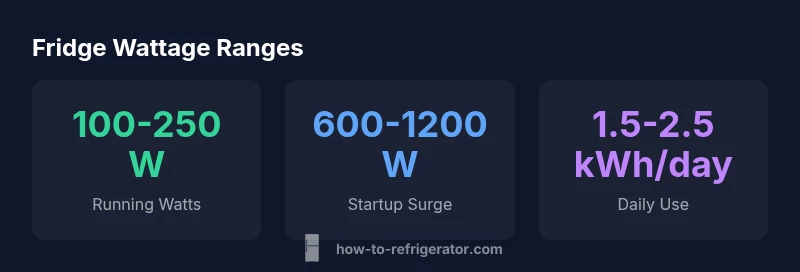
Most residential refrigerators run on roughly 100-250 watts of continuous power. Expect startup surges of 600-1200 watts when the compressor starts, though actual values vary by model and settings. Using a watt-meter can confirm your unit's running wattage and peak draw for accurate planning. Plan for a baseline around 150 W and a startup spike near 1000 W, but check your own appliance.
Understanding fridge wattage: running power vs startup surge
Wattage is the measure of electrical power a refrigerator consumes in real time. When homeowners ask how many watts a refrigerator uses, they're really asking about two numbers: the running wattage (continuous power during normal operation) and the startup surge (the peak drawn when the compressor starts). According to How To Refrigerator, the typical running wattage for a standard household fridge falls in a conservative range, while startup spikes are substantially higher but brief. This distinction matters for circuit planning, outlet capacity, and energy budgeting, especially if you’re adding other appliances on the same circuit. By understanding these two components, you can estimate whether your existing outlet and breaker can handle the load and plan for future replacements. Throughout this guide, you’ll see practical steps to verify your unit’s numbers with a watt-meter, and tips to compare models without overbuying power.
Typical wattage ranges by fridge type
Different fridge configurations have different power profiles. The running wattage tends to follow size and insulation quality, while startup surges relate to the compressor and defrost cycles. Here are general ranges you can expect (note that exact figures vary by model and age):
- Compact / Mini Fridge: running 40-100 W; startup 150-300 W
- Top-Freezer: running 100-250 W; startup 600-900 W
- Bottom-Freezer: running 150-300 W; startup 700-1000 W
- French-Door / Side-by-Side: running 170-300 W; startup 800-1200 W
These values are useful for initial planning, but the best practice is to measure your own unit as described in the next section. The aim is to estimate a baseline running wattage and to anticipate a brief startup spike when the compressor engages.
How to measure your refrigerator's actual wattage
To get an accurate picture of how many watts your fridge draws, you should measure both running watts and startup surge. Start by locating the model’s energy label and ratings, then verify with a dedicated power meter (such as a Kill-A-Watt device) plugged between the outlet and the fridge. Run the appliance through a full cycle (at least 24–48 hours) to capture typical cycling, door openings, and thermostat responses. Record both the average running watts and the peak surge during compressor start-up. If you’re using smart plugs, export the data to see hourly fluctuations. This practical measurement approach aligns with How To Refrigerator’s methodology for energy auditing.
How to estimate annual energy use from wattage
Once you have a reliable running wattage (and surge data), you can estimate annual energy use with a simple approach. Multiply the running watts by the expected daily on-time (in hours), convert to kilowatt-hours, and then multiply by 365 days. For example, a fridge with 150 W running power that operates about 18 hours per day would yield roughly 2.7 kWh per day, or about 986 kWh per year, depending on cycling and ambient conditions. If your unit experiences longer compressor cycles in hot weather, those figures can trend higher. Using a watt-meter to confirm your unit’s exact profile makes these estimates much more accurate.
How to compare models and plan electrical load
When evaluating fridges, wattage is a critical, but not sole, factor. Look at energy efficiency labels, estimated annual energy consumption (kWh/year), and real-world running watts. A higher upfront wattage does not necessarily mean better cooling if insulation and compressor efficiency are poor. For homes with limited circuits, ensure the planned fridge’s running watts fit within the circuit’s capacity, and reserve headroom for temporary peak draws. If you’re replacing an older unit, consider Energy Star-rated models that typically balance performance with lower running power.
Practical tips to reduce fridge wattage
Small changes add up: keep doors closed, minimize time with the door open, ensure a tight door seal, and avoid placing the fridge next to heat sources or in direct sunlight. Clean condenser coils every 6-12 months to improve heat rejection and reduce compressor workload. Check the thermostat setting and keep it at the recommended level; an overcool setting increases energy use. Regular defrosting (if applicable) prevents ice buildup that raises energy consumption. Periodic maintenance and clean coils alone can shave some watts off your running load.
Mini-fridges vs full-size: wattage differences
Mini-fridges typically run on lower wattage than full-size models, but the efficiency depends on the specific unit. Small units can be less efficient due to older compressors or poorer insulation. For households seeking low power draw, a newer, well-insulated mini-fridge might outperform an older full-size model in running watts, though startup surges may still be significant relative to size. When choosing, compare running watts, peak surges, and the energy label rather than relying on size alone.
Troubleshooting unexpected energy use
If you notice unexpectedly high energy use, check for common culprits: worn door seals, blocked vents, dusty condenser coils, or improper air flow around the unit. Ensure the fridge is level, and verify that the door closes properly every time. Remove clutter on top or around the unit that can trap heat. If you suspect a fault in the compressor or thermostat, consult a qualified technician for diagnosis and repair.
Wattage ranges by common fridge configurations
| Fridge Type | Typical Running Wattage | Startup Surge (Peak) |
|---|---|---|
| Compact / Mini Fridge | 40-100 | 150-300 |
| Top-Freezer | 100-250 | 600-900 |
| Bottom-Freezer | 150-300 | 700-1000 |
| French-Door / Side-by-Side | 170-300 | 800-1200 |
FAQ
What is the typical wattage range for a standard household refrigerator?
Most fridges run at 100-250 watts during normal operation, with startup surges of 600-1200 watts. Actual values vary by model and settings.
Most standard fridges run around a few hundred watts, with brief startup spikes that can be over a kilowatt. Check your model for exact numbers.
How can I measure my refrigerator's wattage accurately?
Use a watt-meter or smart plug; measure over 24-48 hours to capture cycling. Record running watts and peak surge for a reliable estimate.
Plug a watt-meter into the outlet, then connect the fridge to read running and peak watts.
Does a higher wattage mean a better fridge?
No. Wattage is not a quality indicator. Efficiency, insulation, and compressor design determine performance and energy use.
Higher watts don't mean better cooling; efficiency and design matter more.
Why does energy use vary with seasons?
Ambient temperature, door openings, and thermostat settings influence compressor duty cycles and heat rejection, causing energy use to rise in hot weather and fall in milder conditions.
Hot weather and frequent door openings can raise energy use; cooler conditions often reduce it.
Are mini-fridges more energy-efficient than full-size models?
Many mini-fridges use less energy, but efficiency varies by model. Modern, well-insulated mini-fridges can be efficient, while older units may consume more.
Some mini-fridges are cheaper to run, but check the energy label on the model.
What maintenance steps reduce wattage?
Keep door seals tight, clean condenser coils, ensure proper airflow, and set the thermostat to an appropriate level. Defrost when required.
Keep seals tight, coils clean, airflow clear, and thermostat balanced to save watts.
“Understanding the difference between running power and startup surge helps homeowners size circuits correctly and avoid unexpected trips. A watt-meter provides a practical, objective reading you can trust.”
Top Takeaways
- Measure your fridge with a watt-meter for accuracy
- Differentiate running watts from startup surge for planning
- Use Energy Star models and proper maintenance to reduce consumption
- The How To Refrigerator team recommends verifying wattage and following a practical maintenance checklist