How Much Refrigerator Watts: A Homeowner's Guide
Learn how many watts a refrigerator typically uses, the difference between running and starting watts, how to measure them at home, and practical tips to save energy.


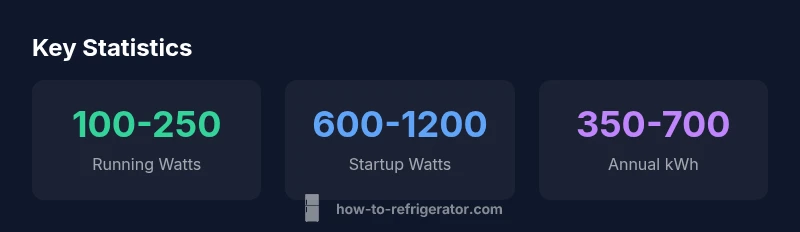
How much refrigerator watts? Most modern fridges run about 100-250 watts during normal operation, with brief startup surges that can reach 600-1200 watts. On a 120V circuit, that means running power in the hundreds of watts and startup spikes that can briefly exceed a kilowatt. Annual energy use commonly falls in the 350-700 kWh range, depending on size, efficiency, and usage patterns.
How to conceptualize refrigerator watts
Power is the electrical current a device draws when it's running, measured in watts. For a home fridge, watts matter because they drive both the circuit load and energy bills. When homeowners ask how much refrigerator watts, they usually want two things: running watts (continuous power) and starting watts (peak power when the compressor kicks on). Understanding these two numbers helps you size circuits, estimate energy costs, and compare models. In practice, most modern refrigerators operate around 100-250 watts during normal cooling. Large or feature-rich models may be toward the upper end of that range, while compact units stay lower. Starting watts can spike well above running watts, often 600-1200 watts for a moment. This spike is why many kitchens require a dedicated circuit for heavy appliances, and why energy efficiency matters for long-term costs.
Running watts vs starting watts: why the difference matters
Running watts are the steady power your fridge uses to keep temperatures in the refrigerator and freezer compartments. This value is what stays on most of the time, except during defrost cycles or when the compressor restarts. Starting watts, by contrast, are the brief, higher surges triggered when the compressor starts. Those surges can be several times larger than running watts and can momentarily trip circuit breakers if the wiring and breaker size are marginal. For homeowners planning appliance loads, it’s essential to separate these two numbers. In practice, the running watt range of 100-250 W means a typical circuit must supply at least a few hundred watts of continuous load, while the surge capacity (600-1200 W) ensures the unit can start without voltage dips that affect nearby electronics. When you select a new fridge, check both figures and compare them to your circuit breaker rating.
Factors that influence fridge wattage in daily use
Several variables influence the actual watts you see from a refrigerator in daily use:
- Size and type: Larger units and complex configurations (French doors, multiple compartments) generally pull more power.
- Age and compressor type: Older models and traditional compressors may be less efficient than modern variable-speed designs.
- Ambient temperature: Hot kitchens raise condenser workload, while very cold rooms reduce it.
- Door openings and internal temperature targets: Frequent door openings or aggressive temperature settings increase compressor cycles.
- Defrost cycles and lighting: Automatic defrost and bright LED lighting can add modest ongoing load.
Understanding these factors helps you interpret spec sheets and real-world measurements. If you want a practical rule of thumb, expect the watts to drift within the 100-250 W range for running power, with occasional spikes during startup depending on efficiency and design.
How to measure watts at home
To verify the watts your fridge actually uses, use a plug-in energy meter such as a Kill A Watt device. Unplug the fridge, connect the meter between the outlet and the appliance, and observe both running watts and startup spikes over a 24- to 72-hour period. For best results, measure while the fridge is at normal temperature in typical daily use. If your fridge is on a dedicated circuit, you may need to temporarily remove other devices to avoid skewed readings. Record nightly averages and note peak surges to inform circuit sizing and energy budgeting. This hands-on check complements the label data on the model’s Energy Guide or user manual.
Wattage by fridge type: what to expect
Different fridge configurations vary in wattage. In general, compact units lean toward the lower end of the running watt spectrum, while expansive families can push higher. Typical ranges include:
- Compact/minibar: 60-120 W running; 300-600 W startup
- Top-freezer: 100-200 W; 600-1000 W startup
- Bottom-freezer / French-door: 150-250 W; 800-1200 W startup
- Side-by-side: 180-250 W; 800-1200 W startup
These values reflect common designs found in households and are useful when comparing models. Always check the Energy Guide for your specific model.
Estimating annual energy costs from wattage
Estimating annual energy costs from wattage involves a simple conversion: multiply the running watts by the hours per day the compressor runs, then divide by 1000 to convert to kilowatt-hours (kWh). Then multiply by your local electricity rate. For example, a fridge averaging 150 W running time for 24 hours uses about 3.6 kWh per day, or roughly 1,300 kWh per year at constant operation. Real-world use is less than 100% due to cooling cycles and door openings, so your actual cost will be somewhere in a range. In the United States, typical electricity rates translate this to roughly $40-$90 per year for a standard fridge, depending on efficiency and usage. Use your meter readings to refine the estimate for your home.
Maintenance tips to reduce watts consumption
Small maintenance actions can reduce watts consumption noticeably:
- Check door seals: A leaky gasket can cause the compressor to run longer to maintain cold, increasing energy use.
- Clean condenser coils: Dusty coils force the compressor to work harder; vacuum or brush quarterly.
- Set proper temperatures: Refrigerator 37-40°F (3-4°C) and freezer around 0°F (-18°C) balance energy and food safety.
- Manage interior lighting: If you have incandescent bulbs, switch to LED to reduce heat and drain.
- Keep airflow clear: Don’t block vents or stack food in a way that impedes cooling.
How to compare models: reading wattage specs and energy guides
When comparing models, read both the labeled wattage and the Energy Guide/Annual Energy Consumption value. Wattage indicates instantaneous draw, while annual consumption shows expected usage under normal operation. Compare apples to apples by looking at similar sizes and features. Energy Star certified models generally offer better efficiency and lower long-term operating costs. Consider the difference between 0.15-0.25 kWh per day in real use across models and how that translates into yearly savings.
Common mistakes when evaluating wattage
Common mistakes include assuming a low wattage means low energy use, ignoring startup surges, and overlooking ambient conditions. Another error is not accounting for door openings, light usage, or defrost cycles that increase running time. Finally, buyers often focus on upfront price rather than long-term energy costs, missing the true total cost of ownership. Use a meter and compare annual energy consumption to select the most economical choice.
Tools and resources for DIY energy checks
Tools you can use:
- Plug-in energy meters (Kill A Watt, etc.)
- Manufacturer Energy Guide labels and user manuals
- Online wattage calculators and energy cost estimators
- Smart home energy monitors for real-time feedback
Resources:
- Energy.gov energy efficiency resources
- ENERGY STAR product finder
- Local utility energy programs
Keep in mind measurement conditions and ensure you source data for your specific model.
A practical kitchen setup: example calculations
Example scenario: You have a mid-size refrigerator rated at 180 W running and a startup surge around 1000 W. On a 15-amp, 120V circuit, you have 180 W continuous plus tolerance for surge. If you operate other devices on the same circuit, you may approach the circuit limit. To estimate annual costs, assume 180 W running for 12 hours per day equals 2.16 kWh/day; per year ~790 kWh. At $0.14/kWh, annual energy cost is around $110. If you switch to a more efficient energy Star model with a 120 W label, you could reduce annual costs by 20-30%. This hypothetical demonstrates how wattage numbers translate into real-world energy budgeting.
Next steps for homeowners
Now that you understand how to read fridge wattage, use these steps: 1) locate wattage specs on the Energy Guide; 2) measure running and startup watts with a meter; 3) compare annual energy consumption between models; 4) test your current fridge and perform maintenance; 5) plan a dedicated circuit if surge capacity is a concern. If you want a professional check, contact a repair service to assess efficiency and insulation.
Approximate wattage ranges by fridge type
| Fridge Type | Running Watts (range) | Startup Watts (range) | Notes |
|---|---|---|---|
| Compact/minibar | 60-120 | 300-600 | Best for small spaces and limited use |
| Top-freezer | 100-200 | 600-1000 | Most common family fridge |
| Bottom-freezer / French-door | 150-250 | 800-1200 | Larger, higher efficiency options |
| Side-by-side | 180-250 | 800-1200 | Flexible storage with higher power draw |
FAQ
What is the typical running watts for a standard refrigerator?
Most modern fridges run in the 100-250 watt range during normal operation; exact figures depend on size and efficiency.
Most fridges use about 100 to 250 watts while running; exact numbers depend on model.
Do startup watts vary a lot between models?
Yes. Startup surges can range from 600 to 1200 watts depending on compressor type and refrigerant load.
Startup surges can be several times higher than running watts, varying by model.
Can I run a fridge on a generator?
You can, but ensure the generator has enough peak watts to cover the startup surge and that wiring matches safety standards.
Yes, but pick a generator with enough peak watts to handle the surge.
How can I reduce watts usage without replacing?
Improve seals, keep condenser coils clean, minimize door openings, and set temperature targets to recommended ranges.
Tighten seals, clean coils, and optimize temperature settings to save energy.
Is the wattage listed in fridge specs reliable?
Wattage on specs is a typical value under test conditions; real usage varies with environment and usage patterns.
Specs are estimates; real use can vary with your setup.
Are there voltage differences between regions?
Yes. Some regions use 120V and others 220-240V; check the model and your outlet to avoid mismatches.
Voltage varies by country; confirm your outlet matches the model.
“"Understanding both running and startup wattage helps homeowners estimate electrical load and energy costs accurately. This dual view prevents undersizing circuits and surprises on energy bills."”
Top Takeaways
- Know running vs starting watts for accurate loads
- Use a plug-in meter to verify real usage
- Energy Star models often run cooler and cheaper
- Expect startup surges; ensure circuit capacity
- Regular maintenance reduces wasted watts