How Much Electricity Does a Refrigerator Use: A Homeowner Guide
Learn how much electricity a refrigerator uses, explore typical energy ranges by size, and discover practical tips to cut costs. Get easy, data-backed guidance for homeowners.


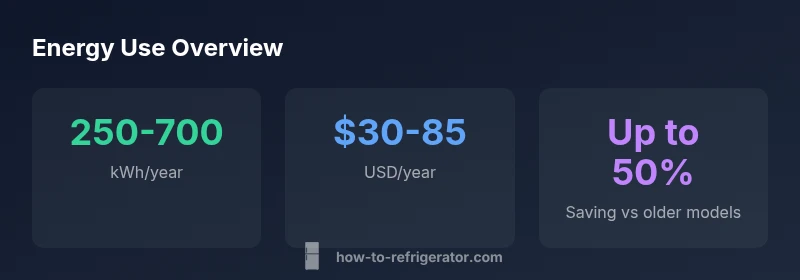
On average, a standard home refrigerator uses about 250-700 kWh per year, depending on size, efficiency, and climate. Newer, high-efficiency models with ENERGY STAR ratings typically fall toward the lower end of this range, while older or larger units use more. You can estimate your own usage by checking the energy label and calculating based on wattage and daily run time.
Understanding Refrigerator Energy Use
According to How To Refrigerator, the energy footprint of a refrigerator is driven by a combination of size, efficiency class, insulation, temperature settings, and usage patterns. In practice, two fridges of the same model can behave differently if one user keeps the door open longer, places the unit in a sunny kitchen, or streams through frequent defrost cycles. The key takeaway is that energy use is not fixed to the model alone; it is a product of how the appliance is operated and maintained. When homeowners understand these factors, they can target practical changes that reduce monthly bills without sacrificing freshness or food safety.
What Factors Drive Electricity Consumption
Energy use rises with larger capacity and older compressor technology. Core drivers include:
- Size and layout (compact vs. full-size, French door, side-by-side)
- Efficiency rating and insulation quality
- Temperature settings (recommended ranges help balance energy use and food safety)
- Frequency of door openings and how long doors stay ajar
- Condenser cleanliness and airflow around the unit
- Location (heat sources, indirect sunlight, or a vented closet can raise running costs)
- Defrost method (manual vs. automatic) and whether adaptive defrost is enabled
Remember: even small changes, like keeping doors closed and reducing warm-food blocks, can yield meaningful energy savings over a year.
How to Estimate Your Fridge's Annual Use
A practical estimate uses the appliance's rated power and its actual run time. If you know the compressor wattage (often listed on the energy label or a data plate on the back), you can approximate yearly consumption with this approach:
- Convert watts to kilowatts (divide by 1000).
- Estimate daily run hours (the compressor doesn’t run continuously; a typical figure is 6-20 hours/day depending on efficiency and usage).
- Multiply: kilowatts × hours per day × 365. Adjust for standby power and any defrost cycles if provided by the manufacturer. If you don’t have exact numbers, rely on the official energy guide (ENERGY STAR) for a modeled range and apply a conservative midpoint.
Typical Range by Model Size
- Small/Compact: 250-350 kWh/year
- Standard Top-Freezer: 350-450 kWh/year
- Standard Bottom/Side-by-Side: 450-700 kWh/year
- French Door/High-Efficiency: 350-600 kWh/year
These ranges reflect modern model variations and energy-labeling standards. Real-world use will drift toward one end of the spectrum depending on climate, usage, and maintenance. For homeowners, these numbers help benchmark your unit and identify opportunities for improvement.
Practical Tips to Lower Refrigerator Energy Use
- Set the temperature to 37-40°F for the fresh-food compartment and 0°F for the freezer. These are the sweet spots that preserve food while minimizing running time.
- Keep door seals clean and intact; replace gaskets if you notice condensation or cold air leakage.
- Clean condenser coils every 6-12 months (dust reduces efficiency). If accessible, clean the coils from dust and lint or vacuum carefully.
- Position the fridge away from heat sources (oven, dishwasher, sunny windows) to reduce the cooling load.
- Use energy-efficient features such as LED lighting, smart defrost, and better insulation when choosing a new model.
- Avoid overpacking; proper air circulation inside helps maintain stable temperatures without overworking the compressor.
Reading Energy Labels and Metering
Energy labels (including ENERGY STAR) provide a standardized basis for comparing models. Look for the annual energy consumption value, typically listed in kWh/year, and compare it to other units of similar size. If you want precise real-world data, consider measuring with a watt meter over a 7- to 14-day period to capture daily usage patterns across weekends and holidays.
In this guide, we emphasize using official labels as a baseline and supplementing with real-world measurements to tailor advice to your home.
Monitoring and Maintenance for Efficiency
Regular monitoring helps catch efficiency leaks early. Inspect gaskets for cracks, listen for unusual noises from a failing compressor, and ensure the condenser fan spins freely. Schedule annual maintenance if possible, especially before peak heat months. Small proactive steps—like relocating the fridge away from heat sources, sealing leaks, and cleaning coils—can preserve efficiency year after year.
Measuring Real-World Consumption with a Watt Meter
To measure actual usage, plug the fridge into a watt meter and record daily energy consumption for at least one full cycle (ideally 7–14 days). Take note of days with heavy door usage or temperature spikes, and calculate an average daily kWh. Multiply by 365 to estimate annual use, then compare against the energy label’s figure to gauge efficiency and identify saving opportunities.
Comparison of refrigerator energy use by model type
| Model Type | Estimated Annual Use (kWh/year) | Notes |
|---|---|---|
| Small/Compact | 250-350 | Best for apartments or spaces under 20 cu ft |
| Standard Top-Freezer | 350-450 | Common in many homes, mid-range efficiency |
| Standard Bottom/Side-by-Side | 450-700 | Larger capacity, higher potential use |
| French Door / High-Efficiency | 350-600 | Often most efficient per capacity |
FAQ
What is the typical annual electricity use for a household refrigerator?
Most refrigerators fall in the 250-700 kWh/year range, depending on size and efficiency. Newer models tend toward the lower end, especially when well-maintained. Use the energy label as your starting point and verify with real-world measurements if possible.
Most fridges use between 250 and 700 kilowatt-hours per year, with newer models usually at the lower end when properly maintained.
How can I estimate my fridge’s energy consumption at home?
Start with the energy label on your unit to get an annual kWh figure. If you want real-world data, measure usage with a watt meter over 7-14 days and calculate an annual average. Compare the measured value to the label for accuracy.
Use the energy label for a baseline, then verify with a watt meter over a week or two to refine your estimate.
Does using automatic defrost save or waste energy?
Automatic defrost can add a small energy burden, but it prevents frost buildup that reduces efficiency. Most modern units balance defrost cycles to minimize energy impact while preserving food safety.
Defrosting cycles are optimized in newer models to keep energy use reasonable.
Do newer models actually use less energy?
Yes. Modern refrigerators typically use substantially less energy per unit of capacity due to better insulation and efficient compressors. Expect lower kWh/year in newer ENERGY STAR-rated models.
New models usually use less energy because of better insulation and efficient parts.
How much impact do door openings have on energy use?
Every time a door opens, warm air enters and the compressor runs longer to restore temperature. While individual openings have small effects, numerous repeated openings can noticeably raise energy use over time.
Frequent door openings can add up; minimize openings to save energy.
Is ENERGY STAR certification a reliable predictor of energy cost savings?
ENERGY STAR indicates models meet efficiency standards, but real-world savings depend on usage and placement. Use ENERGY STAR as a baseline and validate with actual energy use measurements.
ENERGY STAR helps you compare efficiency, but measure real usage for true costs.
“Energy use is driven by usage patterns as much as by the model itself. Regular maintenance and mindful operation yield meaningful savings over time.”
Top Takeaways
- Estimate energy use from labeled ranges and your usage patterns
- Smaller, newer models tend to be more energy-efficient
- Maintenance and placement significantly affect consumption
- Reading labels helps compare models effectively
- Use a watt meter to get real-world data for your unit