Watts for Small Refrigerator: A Practical Guide
Discover watts for small refrigerators, how to measure running power, estimate annual costs, and select energy-efficient compact models for homeowners.


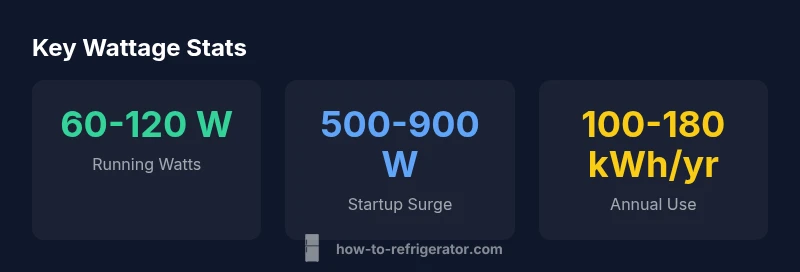
Typical running wattage for a small refrigerator is roughly 60–120 watts, with compressor startup surges commonly in the 500–900 watt range. This means a compact unit draws less power when idle, but can spike briefly when the compressor starts. For homeowners, understanding wattage helps estimate running costs and compatibility with power strips and backup power options.
Understanding Wattage and Energy Basics
Wattage is a measure of how much electrical power a device uses at a given moment. For a small refrigerator, the running wattage is the steady pull when the compressor cycles to maintain the set temperature. In practical terms, this is the power you can expect to see on a power meter during normal operation. Most compact fridges fall in a broad range of roughly 60 to 120 watts, depending on insulation, door seals, and internal components. Voltage varies by country; in the United States, a typical refrigerator operates off a 120-volt circuit, so you can translate watts into current with I = P/V. This means a 100-watt running load draws about 0.83 amps at 120 volts. While running watts give you a snapshot of ongoing energy use, the bigger energy impact often comes from startup surges whenever the compressor turns on after a door opening or a warm room. Understanding both numbers helps you compare models and forecast annual costs more accurately.
Running Watts vs Startup Surge: Why the Difference Matters
Running wattage describes the continuous energy draw as the refrigerator maintains cool temperatures. In contrast, startup surge (inrush current) is a brief spike when the compressor motor starts. That surge can be several times larger than the running wattage, which places temporary demands on circuits, outlets, and any power protection you use. For a typical compact unit, the running wattage may be around 60–120 watts, while startup surges often land in the 500–900-watt range. The exact figures depend on compressor design, ambient temperature, and how well the gasket minimizes heat gain when doors are opened. Because these surges happen in milliseconds, they may not show on a standard energy monitor unless you measure with an appropriate meter or your utility bills, but they still matter for circuit loading and for estimating the size of a backup power solution if you rely on one during outages. When shopping, compare both numbers rather than just the running wattage.
How to Measure Wattage at Home
Measuring wattage at home requires a plug-in power meter or a smart energy monitor. Start by selecting a representative sample of typical use times: a few hours during the day and a few hours at night. Plug the fridge into the meter and record the running wattage when it has stabilized after a door opening. Note the peak surge if the meter captures it—some meters display inrush wattage, others require you to observe the spike using the meter's data log. For convenience, many compact fridges list running wattage on the Energy Guide label, but this value is an estimate and depends on ambient conditions and usage patterns. If you rarely open the door, you might observe lower average watts. If you keep the door open longer or place the fridge in a hot kitchen, you may see higher numbers. Always measure with the unit on a dedicated circuit to avoid interference from other loads.
Estimating Yearly Costs from Wattage
This is where ranges come in handy. To estimate annual energy use, multiply the running wattage by the number of hours per day the unit operates, then multiply by 365, and divide by 1000 to convert to kilowatt-hours. For example, a fridge that runs at 100 W for 14 hours each day yields about 1.4 kWh per day, or roughly 511 kWh per year. If your local electricity price is 15 cents per kWh, annual costs would be around $76.50, though actual bills will vary with climate, door usage, and defrost cycle. For a compact unit with a lower running wattage (60 W), the same calculation yields around $46 per year at the same rate. Using a more energy-efficient model can reduce costs further. Keep in mind that standby power uses a small amount of watts even when the fridge is idle, and defrost cycles add sporadic energy usage.
Choosing an Efficient Small Refrigerator: Practical Tips
When selecting a compact fridge, prioritize low running watts, tight door seals, and excellent insulation. Look for an Energy Star rating where available, but verify the actual running wattage rather than relying solely on the label. Compare the Energy Guide or manufacturer data for both running wattage and annual energy consumption, if published. Check the gasket condition by closing the door on a piece of paper—if you can pull it out easily, the seal is weak. Place the unit in a cooler, shaded spot away from heat-generating appliances, and ensure adequate ventilation around the back and sides. If you only have a small kitchen, measure the space and pick a fridge that fits without overloading the circuit. Finally, consider models with modern compressors and variable-speed operation, which can maintain temperature with lower average watts.
Installation considerations: Outlets, Power Strips, and Backup Plans
Never run a refrigerator on a damaged cord or a lower-rated power strip. Use a dedicated, correctly grounded outlet, ideally with the fridge plugged directly into a wall outlet. If you have limited outlets, use a heavy-duty surge protector rated for refrigerator loads, but avoid stacking multiple devices on the same strip. Ensure the placement allows air to circulate around the condenser coils and doors can open fully without obstruction. In areas prone to outages, plan for backup power considerations; half an hour of refrigeration loss can spoil groceries, while larger offline durations may require coolers or a generator. Always locate the fridge where it can maintain a stable environment (cool, dry, away from sunlight).
Common Mistakes and Misconceptions
People often assume that smaller always means less energy. Size matters, but efficiency and usage patterns drive total cost. Reading the label matters; some units hide high startup surges behind a lower running wattage listing. Another mistake is ignoring defrost cycles, which can spike energy use periodically. Use a watt-meter to verify energy consumption rather than trusting marketing claims, and remember that installation location and ambient temperature can shift watts by a noticeable amount.
Wattage and energy-use ranges by fridge size
| Category | Running Wattage (W) | Startup Surge (W) | Typical Energy Use (kWh/yr) |
|---|---|---|---|
| Compact mini-fridge (under 1.5 cu ft) | 60-100 | 300-600 | 100-180 |
| Small apartment fridge (2-4 cu ft) | 90-150 | 500-800 | 150-250 |
| Standard apartment fridge (4+ cu ft) | 100-200 | 600-900 | 200-350 |
FAQ
What is the typical running wattage for a small refrigerator?
Most compact fridges run between 60 and 120 watts when actively cooling. Startup surges can reach 500-900 watts.
Most compact fridges run between sixty and one hundred twenty watts; startup surges may reach five hundred to nine hundred watts.
How can I measure the watts my fridge uses?
Use a plug-in power meter. Measure running watts once the temperature stabilizes, and capture the surge if your meter supports inrush logging.
Plug the fridge into a watt-meter and monitor running watts; check for surge if your meter logs inrush.
Do smaller fridges always use less energy?
Not always. Efficiency, insulation, compressor type, and usage patterns determine total energy use just as much as size.
Size isn’t everything—efficiency and how you use it matter for energy use.
What affects startup surges?
Compressor design, ambient temperature, and door-opening frequency influence startup surges more than running wattage alone.
Surges depend on compressor design, how warm the room is, and how often you open the door.
How many kilowatt-hours does a compact fridge use per year?
Typical compact fridges use about 100-180 kWh per year, depending on usage and model.
Most compact fridges consume roughly 100 to 180 kWh per year depending on use.
Should I use a power strip with a fridge?
Avoid relying on power strips for a fridge. Use a dedicated, properly grounded outlet and avoid daisy-chaining devices on one strip.
Don't plug a fridge into a power strip; use a dedicated outlet for safety and reliability.
“Energy efficiency in small refrigerators isn't just about running watts—it's about minimizing inrush and improving insulation. Even small increments in watts can translate into meaningful savings over a year.”
Top Takeaways
- Check running wattage first when comparing models
- Expect startup surges up to several hundred watts
- Estimate annual costs using wattage and local electricity rates
- Choose Energy Star or higher efficiency models to reduce power
- Measure wattage with a meter to verify real consumption