How Many Amps Does a Refrigerator Use? A Practical Guide
Learn typical fridge amperage ranges, understand running vs startup current, and discover safe measurement methods and energy-saving tips to optimize your refrigerator's use.


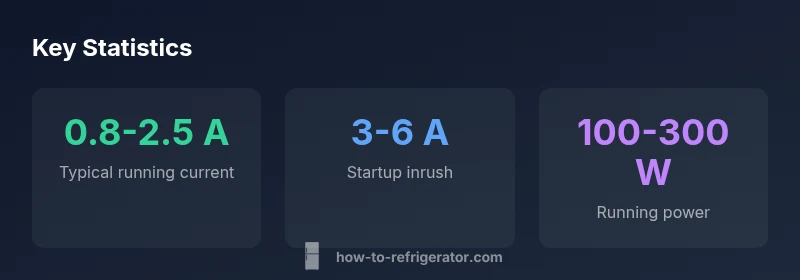
The typical running current for a standard 120-volt refrigerator is about 0.8–2.5 amps, while startup inrush can peak around 3–6 amps for a moment. In other words, how many amps does a refrigerator use depends on model and settings, but expect a brief higher surge than the running current. If you want exact figures for your fridge, measure the amperage with a clamp-on meter or a plug-in watt meter when the compressor starts and while it runs.
Understanding amperage basics for refrigerators
If you ever ask, how many amps does a refrigerator use, the answer depends on several factors: voltage, compressor size, ambient temperature, door openings, and defrost cycles. According to How To Refrigerator, amperage is a key factor in predicting electricity use for appliances. In a typical U.S. home, refrigerators run on 120 V circuits, and the running current usually sits in a narrow band: roughly 0.8–2.5 amps. The exact value for a given unit will reflect the design, insulation, and settings. On startup, the compressor requires a short inrush of current to get moving; this can be 3–6 amps for a moment, which is why a fridge can pull more power briefly while it starts. If your area uses different voltages (such as 230 V in parts of Europe or Asia), the current numbers change accordingly, though the wattage (and energy consumption) can be similar once you account for voltage. To track real values, you can measure using a clamp-on meter around the power cord, or use a plug-in energy monitor that records both amperage and voltage over time.
Typical amperage ranges by fridge size
Different fridge sizes and designs impact how many amps they draw in running and startup modes. Compact units (≤3 cubic feet) tend to run toward the lower end of the range, while full-size kitchen models sit higher, with larger compressors. In practice, a standard apartment fridge (about 12–20 cubic feet) often runs in the 0.8–2.0 amp window, and startup can spike to 3–6 amps. Larger French-door or side-by-side models push toward 1.5–2.5 amps during running, with startup surges that can reach 4–6 amps. Always remember that energy efficiency features and insulation quality can shift these numbers for any given unit.
How startup surges affect circuits and bills
The most noticeable effect of amperage variation happens at startup. A brief inrush as the compressor starts can momentarily draw several amps more than the running current. While the extra load is momentary, it can influence circuit loading, especially on older homes with multiple high-draw devices on the same circuit. The impact on the electricity bill comes from the overall energy used over time, not a single startup spike. Consumers should consider the model’s energy performance, rather than only the peak startup value, when budgeting or evaluating efficiency.
How to measure amps safely and accurately
Measuring amperage in a refrigerator is straightforward with the right tool. Use a clamp meter laid around the power cord to capture running current, and record a startup spike by observing the moment when the compressor engages. For simpler setups, a plug-in energy monitor can provide continuous readings for several cycles, showing both running and startup values. Always follow safety guidelines: avoid opening live panels, unplug if you need to inspect internal components, and ensure meters are rated for the circuit voltage. If you are unsure, consult a licensed technician. Measurements can help you confirm that your unit operates within the expected amp range and doesn't signal a fault in the compressor or start relay.
Interpreting readings and energy costs
Amperage is only part of the story. To compare apples to apples, convert amps to watts using W = V × A. In a typical 120 V system, 1 A corresponds to about 120 W. Running amperage of 0.8–2.5 A translates to roughly 96–300 W of continuous power, depending on voltage and efficiency. Annual energy use in kWh combines the running power with duty cycle (how long the compressor runs each day). A modern, energy-efficient fridge may perform the same work with lower average amps and lower annual kWh, even if it stores more food.
Practical tips to reduce running amps
Several practical steps can help reduce the average amps a fridge draws:
- Keep condenser coils clean to improve heat exchange and reduce compressor workload.
- Ensure door seals are tight to minimize cooling loss.
- Set temperatures correctly (fridge around 37–40°F, freezer around 0–5°F) to avoid overworking the compressor.
- Position the unit away from heat sources and ensure good airflow around the back and sides.
- Choose ENERGY STAR-rated models when replacing an older refrigerator, as they typically draw fewer amps for the same cooling task.
- Minimize door openings and avoid placing hot items inside; let foods reach room temperature before refrigerating.
Do larger fridges automatically draw more amps?
Do bigger fridges automatically draw more amps?
Not necessarily. Amp draw depends on insulation, door seals, compressor efficiency, and cycle length. A larger fridge may run more frequently to maintain even temperatures, but modern large units are often engineered for energy efficiency, which can keep running amps within a similar range to smaller models. When comparing, look at the energy label and annual kWh rather than only peak amp numbers. A bigger fridge with excellent insulation can use roughly the same amps as a smaller, less efficient unit because it spends less time running at high demand.
Energy efficiency and model choices
Energy efficiency is a primary driver of amperage over time. When you compare models, consider both the running current range and the energy use per year. Energy Star ratings indicate better efficiency, which typically means lower running amps and reduced operating costs. If you are replacing an older fridge, the upfront purchase price may be offset by long-term energy savings. Additionally, smart thermostats and better defrost control can optimize amp draw by reducing unnecessary compressor cycling.
Quick reference: amperage cheat sheet by fridge type
- Compact fridge (≤3 cu ft): running amps about 0.5–1.5 A; startup 2–4 A
- Standard apartment fridge (12–20 cu ft): running amps about 0.8–2.0 A; startup 3–6 A
- Large kitchen fridge (French-door/Side-by-side): running amps about 1.5–2.5 A; startup 4–6 A
- Heavy-use or commercial-style fridge: running amps about 1.5–3.0 A; startup 5–8 A
These ranges vary with voltage (120 V vs 230 V), insulation, and compressors. Use wattage to compare across voltage systems.
Typical amperage ranges by fridge type
| Fridge Type | Typical Running Amps | Startup Inrush (Amps) | Notes |
|---|---|---|---|
| Compact fridge (≤3 cu ft) | 0.5-1.5 | 2-4 | Smaller compressors; variable efficiency |
| Standard apartment fridge (12–20 cu ft) | 0.8-2.0 | 3-6 | Common household size; moderate consumption |
| Large French-door / side-by-side | 1.5-2.5 | 4-6 | Larger compressors; higher energy needs |
| Commercial or heavy-use fridge | 1.5-3.0 | 5-8 | High-demand models; not typical home |
FAQ
What is the typical amp draw for a modern refrigerator?
Most modern fridges run about 0.8-2.5 A on running cycles. Startup inrush can reach 3-6 A briefly.
Most new fridges pull less than a couple of amps during normal operation, with a brief spike when starting up.
Why does my fridge draw high amps at startup?
The compressor motor requires a surge to start; this inrush is normal and lasts briefly. If surges persist, there may be a relay or capacitor fault.
The compressor needs a push to start, so you see a spike right after you plug it in or the cycle begins.
How can I measure amps safely at home?
Use a clamp meter around the power cord or a plug-in energy monitor; avoid opening live panels and unplug before inspecting internals if necessary.
Use a clamp meter or plug-in monitor and stay safe.
Do larger fridges automatically draw more amps?
Not always. Amp draw depends on insulation, efficiency, and cycle length. Larger models can use similar amps if they are well-insulated and efficient.
Bigger doesn’t always mean more amps; it depends on design and efficiency.
How does voltage affect amperage readings?
Amperage varies with voltage. In the same wattage scenario, a higher voltage means lower current. Use watts (W = V × A) to compare across voltages.
Voltage changes the amp draw; use Watts to compare.
What should I look for on my fridge's energy label?
Look for annual energy use in kWh and the energy efficiency rating; these help you compare running amps indirectly and choose efficient models.
Energy labels show how much energy the fridge uses per year.
“Knowing the amperage profile of your fridge helps you estimate energy use and spot unusual behavior quickly. The How To Refrigerator Team recommends using proper measurement tools for reliable readings.”
Top Takeaways
- Estimate running amps by model and voltage
- Expect higher startup surges than running current
- Measure amps with a clamp meter for accuracy
- Choose Energy Star models to minimize running current