Why Did Refrigerator Stop Working? A Homeowners Troubleshooting Guide
If your fridge won’t start or stops cooling, learn a safe, step-by-step approach to diagnose common causes, perform quick fixes, and know when to call a professional. A practical guide for homeowners.


Most fridge failures come from power issues, thermostat faults, door seals, or dirty condenser coils. Start with safety — unplug, check the outlet and circuit breaker, and verify the thermostat setting. If the unit still won’t run, follow the diagnostic flow below for deeper causes and fixes.
why did refrigerator stop working
If you’ve ever asked yourself, why did refrigerator stop working, you’re not alone. In most homes the answer comes down to a small group of causes: power delivery problems, a failing thermostat or temperature control, leaky or misaligned door seals, or restricted airflow from dirty condenser coils. This section explains the core idea in plain terms and orients you to the safe, practical path ahead. According to How To Refrigerator, safety and basic troubleshooting are the first line of defense, helping you avoid unnecessary service calls and potential exposure to refrigerants. The goal isn’t to replace a professional, but to empower you to identify the simple fixes you can handle yourself.
Quick Checks You Can Do Safely
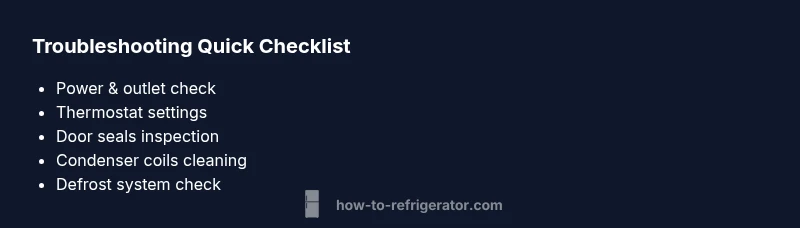
Before you dive into deeper diagnostics, run these quick checks that cover the vast majority of no-cool failures:
- Power and outlet: Confirm the fridge is plugged in and the outlet is delivering juice by testing with another device.
- Circuit protection: Check your home’s circuit breaker or fuse box for a tripped breaker or blown fuse.
- Thermostat setting: Make sure the temperature control is set correctly (not too warm) and that the display is active if you have a digital control.
- Door seals: Inspect gaskets for tears or gaps that let warm air in; a poor seal can make the compressor run longer without cooling.
- Condenser airflow: Look for dust buildup on the condenser coils (usually behind the grille or at the back) and clear obstructions nearby.
Steps
Estimated time: 60-90 minutes
- 1
Verify power and reset
Unplug the refrigerator, wait 60 seconds, and plug back in. Observe the interior light and compressor sound for a moment. If the outlet or circuit is tripping, address that electrical issue before proceeding.
Tip: If you’re unsure about your electrical panel, skip to the safety section and consult a professional. - 2
Check the thermostat and controls
Ensure the thermostat is set to a proper cooling range (usually around 37-40°F/3-4°C for the fresh food compartment). If the display shows an error, consult the manual or reset the control panel.
Tip: Don’t change multiple settings at once; adjust one parameter and test. - 3
Inspect door seals and gaskets
Close the door slowly and watch for gaps along the door frame. A loose seal allows warm air to enter, causing the compressor to run continuously.
Tip: Clean seals with mild soap and water; replace split or cracked gaskets promptly. - 4
Evaluate condenser coils and airflow
Locate the condenser coils and check for dust or pet hair; clean gently with a brush or vacuum. Ensure the fan can circulate air freely around the coils.
Tip: Do not use sharp tools that could damage delicate fins. - 5
Assess defrost system and drain
If you see frost buildup on the back wall or bottom of the freezer, the defrost system may be stuck. Check the defrost drain for clogs and clear any ice that blocks the flow.
Tip: Defrosting may take time; avoid forcing ice with sharp objects. - 6
When to call a professional
If the unit still won’t cool after these steps, a qualified appliance technician should diagnose refrigerant issues, compressor faults, or sealed-system leaks.
Tip: Keep a record of symptoms and steps you took to help the technician.
Diagnosis: Fridge not cooling or starting at all
Possible Causes
- highPower issue or tripped breaker
- highThermostat or temperature control failure
- mediumDefrost system fault (defrost timer or drain clogged)
- lowDirty condenser coils or restricted airflow
Fixes
- easyPlug the unit in and reset the circuit breaker if needed
- easyTest and adjust the thermostat setting; replace if readings are inconsistent
- mediumInspect defrost system and unclog the defrost drain; look for frost buildup
- easyClean condenser coils and ensure proper airflow around the compressor area
FAQ
What should I do first if my refrigerator won't start?
Start with safety: unplug the unit, check the outlet, and reset the circuit breaker if needed. Then confirm the thermostat is set correctly and inspect the door seals for leaks. These steps solve most early failures.
Safety first: unplug, check the outlet, reset the breaker, and verify the thermostat and seals.
Why is my fridge not cooling but the freezer seems fine?
This often points to airflow issues or defrost problems. Check the condenser coils, vents between compartments, and defrost system for frost buildup. If frost blocks airflow, you’ll need to address the defrost path.
If the freezer is cold but the fridge isn’t, check airflow and defrost components.
Can a dirty condenser coil cause poor cooling?
Yes. Dirty coils reduce heat rejection, forcing the compressor to work harder and may stop cooling efficiently. Clean coils gently and ensure there’s space around the unit for air to move.
Dirty coils can stop cooling well; clean them and leave enough space for air.
Is thermostat replacement easy or should I call a pro?
Thermostat replacement can be straightforward on some models but varies by make. If you’re unsure, contact a professional to avoid wiring hazards or inaccurate temperature control.
Thermostats can be DIY on simple models, but get a pro if you’re unsure about wiring.
What if the defrost drain is clogged?
Unclogging the defrost drain typically involves warm water or a thin, flexible tool to clear the path. Re-check after a few hours to ensure it drains properly.
Clogged defrost drains are common; gently clear the path with warm water and check later.
When should I replace my refrigerator entirely?
If your fridge is old, inefficient, or requires frequent repairs with diminishing returns, replacement might be the cost-effective option in the long run.
Consider replacement if repairs are frequent and efficiency has declined.
Watch Video
Top Takeaways
- Power and safety first; reset and verify outlets
- Check thermostat and seals before expensive fixes
- Clean coils to restore airflow and cooling
- Document symptoms to guide service calls
- Call a pro if refrigerant, compressor, or sealed-system issues are suspected