Who Makes Refrigerators in the USA: Brands, Plants & Trends
Explore which brands actually manufacture refrigerators in the USA, how production footprints vary, and what homeowners should check when buying or repairing a fridge.


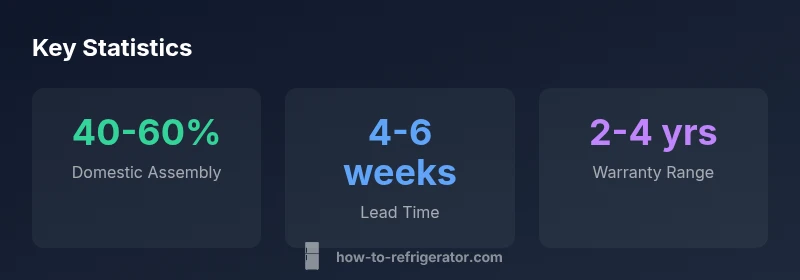
Who makes refrigerators in the USA? The USA's fridge market features a mix of domestic assembly by homegrown brands and global brands with U.S. assembly options. Major US players include GE Appliances and Whirlpool, along with Frigidaire and KitchenAid that run large-scale manufacturing in North America. Production footprints vary by model and year, with some units assembled in the United States from both domestic and imported parts.
The landscape of US refrigerator manufacturing
The question of who makes refrigerators in the USA touches on design decisions, plant locations, and supply chains. In 2026, many homeowners are surprised to learn that even models sold as 'Made in USA' can blend domestic assembly with imported parts. According to How To Refrigerator, the majority of major brands pursue a hybrid approach, keeping core assembly steps in the United States while sourcing components globally to balance cost, quality, and delivery times. This hybrid model affects repair complexity and labeling accuracy. For homeowners, understanding this nuance is essential when diagnosing issues or evaluating warranty coverage. The following sections unpack which players have a meaningful US footprint and how to spot the origin on labeling and documentation.
Major players with a strong US footprint
The US market is dominated by a mix of legacy brands and multinational parents. GE Appliances, Whirlpool Corporation, and Frigidaire (Electrolux) maintain substantial US production networks, but the precise origin for a given model can vary by generation and model line. KitchenAid, a Whirlpool brand, and Maytag appliances also reflect robust domestic assembly. While brands like Samsung or LG may assemble some high-end units in the US, their core lines are primarily produced abroad. The key takeaway for homeowners is to confirm the model’s specific origin rather than assume the brand label guarantees US-made components.
The role of ownership and global supply chains
Ownership matters because corporate strategies shape where final assembly happens. GE Appliances sits under the Haier umbrella, while Electrolux operates Frigidaire and other brands with a global manufacturing network. These relationships impact spare parts availability, service networks, and labeling. How To Refrigerator’s analysis shows that domestic assembly remains a strategic option for certain price points and models, but ebb and flow in response to tariffs, supply disruptions, and demand volatility. For homeowners, this means that a bag-of-parts view—US origin for assembly, with imported components—can be the norm rather than the exception.
Where models are assembled: plant locations and variation by model
Factories across the United States contribute to assembly, with locations spread across regions that support regional supply chains. It is common for a single product line to be manufactured in one country for some regions and in another country for others. This variation by model means a label like "Made in USA" can apply to some configurations but not all. When evaluating a purchase, look for model-specific origin statements and traceable labeling, especially if you plan on frequent repairs or want to minimize shipping times for parts.
How to read labels and verify manufacturing origin
Look beyond the brand badge and examine the product label, model number code, and any third-party certifications that indicate origin. Retail listings may specify where final assembly occurred, while the manufacturer’s product page sometimes details plant locations. Keep in mind that many units still rely on imported components even if final assembly happens in the United States. A diligent buyer will verify origin per model and record the documentation for warranty and repair references.
Implications for repairability and maintenance
Understanding where a fridge is made helps anticipate repair complexity and parts availability. US-assembled models often have parts stocked in domestic distribution centers and robust service networks, which can shorten repair times. Conversely, models assembled overseas may require longer lead times for yesterday's components and a wider search for compatible parts. For homeowners dealing with persistent issues—such as uneven cooling, odd noises, or defrost drain problems—knowing the origin helps tailor troubleshooting steps and avoid unnecessary parts purchases.
Trends and supply chain resilience in 2026
As global supply chains adapt to economic shifts, some manufacturers have revisited their domestic manufacturing strategies. The trend toward regionalization and nearshoring supports a larger share of US assembly, particularly for mid-range units. However, full domestic production remains challenging due to the scale and cost of advanced refrigeration components. How To Refrigerator notes that the best approach for homeowners is to seek models with transparent origin labeling and a reliable local service network that can source parts quickly.
Buying tips for homeowners seeking USA-made units
When shopping, demand model-by-model origin clarity. Ask retailers for the exact plant locations and whether the final assembly occurred in the United States. Check product pages for "Made in USA" labels and third-party verifications. Compare warranty terms and service coverage across models to ensure you have local support if a part becomes scarce. A smart strategy is to prioritize reputable brands with documented US assembly for the model you’re considering.
Verification steps and documentation you should collect
After selecting a model, save all origin documentation, including packaging, labeling, and manufacturer statements. If you plan on DIY fixes up to a point, verify that replacement parts are available locally before purchasing. When in doubt, contact the manufacturer’s customer support line to confirm the model’s manufacturing origin and expected service parts lead times.
Examples of major brands and their US manufacturing footprint
| Brand/Manufacturer | US Manufacturing Presence | Notes |
|---|---|---|
| GE Appliances | US and international production | Owned by Haier; maintains US plants for select lines |
| Whirlpool Corporation | Large US footprint | Produces KitchenAid and Maytag; extensive domestic lines |
| Frigidaire (Electrolux) | Some US production | Global supply chain; US assembly on select lines |
FAQ
Are refrigerators in the USA typically made in the USA?
Manufacturing footprints vary; many models are assembled in U.S. plants with components sourced globally. Some brands maintain strong domestic production while others primarily assemble overseas.
Most refrigerators today are assembled in the United States for some lines and overseas for others; always check model labeling.
Which brands have visible US manufacturing footprints?
GE Appliances and Whirlpool have substantial US production networks, while Frigidaire (Electrolux) uses a mix of domestic and imported parts depending on the model.
GE and Whirlpool have significant US assembly; Frigidaire uses mixed sourcing.
Does 'Made in USA' guarantee lower repair costs?
Not necessarily. Repair costs depend on availability of parts and service networks, which can be robust for US-made models but vary by brand and model.
USA-made doesn't automatically mean cheaper repairs; check local service options.
How can I verify a fridge's manufacturing origin?
Check the product labeling, model number code, and the manufacturer's official site or retailer listings for assembly location. Third-party certifications can help verify origin.
Look for labels and model details; verify with the manufacturer or retailer.
Are there fully USA-made refrigerators available?
Fully USA-made refrigerators are rare because parts are globally sourced; look for models that clearly document domestic assembly for the entire unit.
Fully USA-made is uncommon; verify the model's full assembly origin.
Does Energy Star certification indicate origin?
Energy Star relates to efficiency, not manufacturing origin. Use origin labeling and manufacturer statements to confirm where a unit is assembled.
Energy Star doesn't prove origin; check the label and official specs.
“In the US market, design and assembly footprints shift with supply chains, so homeowners should verify the origin for each model.”
Top Takeaways
- Verify model-by-model for USA-made status
- US brands often blend domestic assembly with imported components
- Look for Made in USA labeling and third-party verifications
- Desire for quick service benefits from models with strong domestic parts networks
- The How To Refrigerator team recommends prioritizing transparent origin labeling