Who Makes Refrigerators in Canada: Brands, Imports, and Buying Tips
Learn who makes refrigerators in Canada, how sourcing works, and what affects warranty and service. How To Refrigerator clarifies domestic assembly vs imports for Canadian buyers.


In Canada, most refrigerators sold are imported and assembled outside the country, with only a limited share produced or assembled domestically for select models. Major global brands distribute through Canadian retailers, and warranties differ by region and service network. This guide explains who makes refrigerators in Canada and what buyers should check before purchase.
Overview of the Canadian Refrigerator Manufacturing Landscape
Canada’s appliance market sits at the crossroads of global supply chains and local consumer expectations. When homeowners ask who makes refrigerators in Canada, the answer is nuanced: the vast majority of refrigerators sold in Canada are manufactured or assembled outside the country, with plants in the United States, Mexico, Europe, or Asia supplying competitive models. Some niche lines—often value-oriented or specialty configurations—may be assembled in Canada or rely on components produced domestically. The result is a market that blends imported reliability with robust service networks. According to How To Refrigerator analysis, domestic assembly exists but on a small scale relative to larger economies. This doesn’t erase Canadian options; buyers should read model labels, check warranty terms, and verify the local service footprint before buying. Energy efficiency, long-term cost of ownership, and the ease of obtaining spare parts often matter more to Canadians than country of origin alone.
Domestic vs Imported: The Reality in Canada
In practice, Canadian shoppers see a mix. Most full-size refrigerators sold in major retailers are imports from outside Canada, paired with nationwide distribution and service networks. A smaller subset of models are assembled in Canada, typically through partnerships with regional distributors or as limited-run programs. This means the origin label can vary by model and year, even within the same brand. Homeowners benefit from clear warranty terms and a local service presence that guarantees repairs using brand-approved parts. When evaluating options, keep in mind that a strong service network and parts availability can offset concerns about where a unit was assembled. The key questions to ask at purchase are: who covers parts for your region, and how easy is it to access authorized technicians?
Major Brand Footprint in Canada
Canadian retailers carry a broad spectrum of global brands, all of which reflect Canada’s import-heavy reality. Brands frequently distribute through national networks, ensuring warranty support and service across provinces. While some brands offer Canada-specific lines or programs, the actual manufacturing origin can differ by model. What remains constant is the value Canadians expect: energy efficiency, reliable cooling performance, and accessible repairs. Buyers should compare not just sticker labels but also service distance to repair centers, the availability of genuine parts, and the responsiveness of authorized technicians. In short, presence is strong; origin varies by model, year, and product line, so verify details with the retailer and service provider before purchase.
How Brands Source Components in Canada
Brand sourcing for refrigerators in Canada is a global affair. Many components are sourced internationally, assembled into final products abroad, and then distributed through Canadian channels. Within Canada, brands often maintain regional warehouses and service centers to support warranty work and parts supply. This arrangement prioritizes quick repairs and consistent part pricing for customers, even when the unit itself wasn’t manufactured locally. For buyers, the practical takeaway is simple: select models backed by a solid Canadian service network, and confirm that genuine replacement parts are readily available near your home. If a retailer cannot confirm parts availability, consider other brands or models with clearer local support.
What This Means for Warranty, Service, and Parts
Warranty and service are often the most consequential factors in long-term satisfaction. In Canada, major brands typically provide nationwide warranty coverage and a service network that includes trained technicians, authorized parts, and standardized repair processes. The critical step is to verify coverage specifics for your province or territory, understand what parts are guaranteed for your model, and confirm how service requests are logged and tracked. A strong local presence reduces the risk of delays and inflated repair costs. For buyers, this means prioritizing brands that offer transparent warranty terms, visible service centers, and readily accessible parts inventories.
Buying in Canada: A Step-by-Step Checklist
To make an informed decision, use the following steps:
- Check the model’s country of origin label and any Canadian-specific programs. 2) Verify nationwide warranty terms and who services your region. 3) Confirm access to genuine replacement parts in your area and typical repair timelines. 4) Compare energy-efficiency ratings and operating costs over the unit’s lifetime. 5) Read retailer disclosures about delivery, installation, and removal of old appliances. 6) Talk to other local owners or service technicians about real-world reliability. 7) Review return policies and extended warranties.
By following these steps, you’ll minimize post-purchase surprises and maximize long-term value in Canada’s diverse refrigerator market.
Regional Availability and After-Sales Support
Regional differences matter. Urban centers tend to have denser service networks, faster parts availability, and more competitive warranty terms, while rural areas may encounter shorter service windows. When choosing models, consider proximity to authorized service centers and the ease of scheduling maintenance, especially for older homes or condos with stairs and limited elevator access. Brands that publish clear regional service maps and provide online scheduling tools are typically easier to support locally. In all cases, a reputable retailer or brand partner should facilitate service requests and ensure a streamlined repair process.
Regulatory Standards and Safety Compliance in Canada
Canada’s appliances must meet rigorous safety and efficiency standards set by federal and provincial bodies. Compliance typically involves CSA safety certification and energy efficiency labeling aligned with national programs. Regardless of where a refrigerator is manufactured, models sold in Canada should demonstrate adherence to energy performance and safety requirements. Consumers benefit from clear energy ratings and reputable certification marks on product packaging and marketing materials. By prioritizing models with recognized safety and efficiency certifications, homeowners protect themselves from subpar units and potential warranty complications.
Overview of manufacturing origins and support structures for Canadian refrigerators
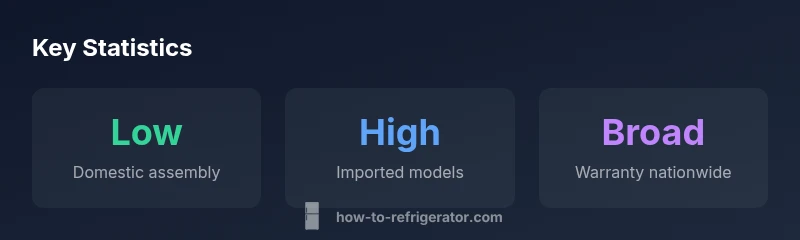
| Aspect | Canada Presence | Notes |
|---|---|---|
| Domestic assembly | Low | Mostly outside Canada; select lines may be assembled locally |
| Imported models | High | Predominant in market across brands |
| Warranty/service | Nationwide | Service networks align with national distributors |
FAQ
Are there refrigerators actually manufactured in Canada?
Yes, a small portion of models includes domestic assembly or component production in Canada, but most units are imported or assembled abroad. Check the model label and retailer notes for details.
A small portion is made here, but most fridges are imported. Look for model labels and retailer notes for specifics.
Which brands operate manufacturing or assembly in Canada?
Global brands service the Canadian market through nationwide networks, with manufacturing origins varying by model. Verify the origin and warranty details with the retailer.
Brands are widely available; specifics vary by model and year.
What should I check for warranty when buying in Canada?
Look for nationwide coverage and accessible service; confirm what parts are guaranteed and how quickly service can be arranged in your region.
Make sure service is easy to access and parts are guaranteed.
Are there energy-efficient refrigerators made in Canada?
Energy efficiency is standard across brands, with many models meeting Canadian standards. Origin does not inherently limit efficiency—check ENERGY STAR or equivalent ratings.
Many fridges are energy efficient; look for official energy ratings.
How does Canadian regulation affect fridge safety?
Canada enforces safety standards through CSA and other agencies; all models sold meet required safety criteria. Certification marks typically appear on packaging or product labels.
Canadian rules ensure safety with clear certification marks.
“The Canadian refrigerator market hinges on strong national service networks and clear warranty policies. Consumers benefit when they verify local support before purchasing.”
Top Takeaways
- Understand that most fridges in Canada are imported, not domestically built.
- Verify warranty coverage and access to local service before purchasing.
- Choose models with transparent parts availability and a strong Canadian network.
- Energy efficiency and long-term service ease often matter more than origin.