What Refrigerator Brands Are Made in the USA? A Homeowner Guide
Explore which refrigerator brands manufacture in the USA, how to verify domestic production, and practical buying tips for homeowners seeking American-made cooling.


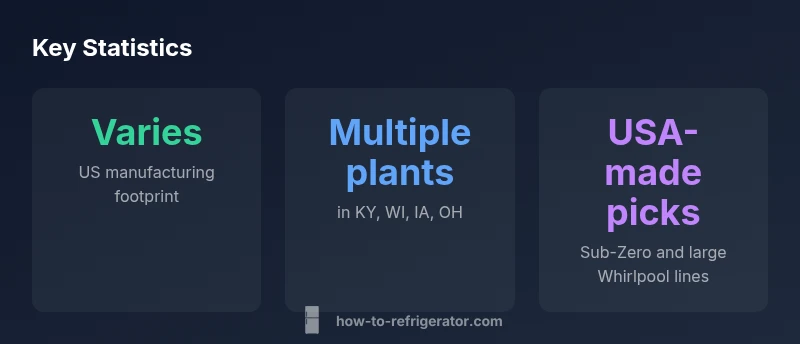
what refrigerator brands are made in the usa? Domestic production for fridges varies by model and year, but a handful of major brands maintain U.S. manufacturing footprints. Whirlpool (KitchenAid/Maytag) and GE Appliances lead in many mid-range lines, while Sub-Zero focuses on premium units with dedicated U.S. plants. Always verify your chosen model’s country of origin on the product page or Energy Guide label to confirm domestic production.
What counts as 'Made in the USA' for refrigerators?
For many homeowners, the origin question isn't just about where a label appears; it's about the entire supply chain. The phrase can mean the shell, the core components, or final assembly happens in the United States—a nuance that matters for warranties, service availability, and support networks. In official terms, the FTC uses a set of guidelines; however, appliance industry practices often blur lines because brands source components globally while keeping assembly in U.S. facilities. When you see a claim like 'Made in USA' on a brochure, you should check: Is the major refrigeration unit assembled in the United States? Are essential components manufactured domestically? Does the product page specify the country of origin for the model you want? For the query what refrigerator brands are made in the usa, the short answer is that a handful of major brands maintain U.S. manufacturing footprints, but there is variation by model and year. Always verify with the latest model-specific labels and retailer information.
A look at brands with visible U.S. manufacturing footprints
Several large brands publish domestic production footprints for a portion of their lineup. The Whirlpool family (which includes KitchenAid and Maytag) has a broad U.S. manufacturing presence across multiple lines, particularly in mid-range models. GE Appliances maintains significant U.S. production in key facilities, though some models may be sourced or assembled elsewhere depending on the line. Sub-Zero/Wolf operates dedicated U.S. plants focused on premium refrigeration, emphasizing domestic assembly and parts. It’s important to read each model’s origin information on the retailer page and the manufacturer site because the country of origin can vary within the same brand. How To Refrigerator’s analysis highlights that the landscape shifts with new plant investments and corporate reorganizations, so model-by-model verification remains essential.
How to verify origin before you buy
Verification starts before you set foot in a showroom. First, check the model page on the manufacturer’s site for explicit country of origin statements. Second, inspect the Energy Guide label and any country-of-origin notes found on the product data sheet or packaging. Third, examine the retailer listing—many retailers include origin details in the specifications section or in downloadable PDFs. Fourth, contact customer support or a sales specialist if origin details aren’t readily visible. Finally, keep a copy of the product brochure and the Energy Guide for your records. In all cases, the model-by-model origin check helps avoid surprises after purchase, aligning with How To Refrigerator’s guidance for homeowners who want a domestic footprint where it matters.
Practical buying paths: budget, mid-range, and premium USA-made options
If you’re shopping with a USA-made goal, you’ll find options across price bands. In the budget to mid-range space, brands with robust U.S. assembly capabilities tend to offer better in-person service networks and longer spare-parts availability. For premium models, domestic plants are more common, particularly among Sub-Zero and related luxury lines where many components are manufactured in the U.S. Consumers should compare not just the sticker origin but the long-term cost of ownership, including energy use, warranty terms, and service accessibility. Your choice should balance desire for domestic production with practical needs like size, finish, and feature set.
Trade-offs and real-world considerations
The promise of USA-made refrigerators often comes with trade-offs. Domestic production can coincide with a higher upfront price, though the price delta varies by model and brand. Availability can be uneven, particularly for popular sizes or configurations. Parts availability and service accessibility tend to be stronger when a model is domestically produced, but this hinges on the brand’s service network and regional support. Always weigh energy efficiency and warranty coverage alongside origin. If a model has excellent service support and favorable energy scores, the extra cost may be justified.
Energy efficiency and performance in USA-made models
Domestic manufacturing does not guarantee higher efficiency, but many U.S.-made lines emphasize energy-smart engineering due to stringent efficiency standards at the point of design and testing. Look for Energy Star ratings and the annual energy consumption figure in the Energy Guide. Compare similar models across brands to gauge whether a USA-made option provides real savings over non-domestic counterparts. In addition, verify compressor technology, insulation, and door seal quality, which can influence performance more than provenance alone. How To Refrigerator’s review notes that the best performance comes from a well-matched system—consider cabinet design, compressor type, and insulation when evaluating options.
Maintenance, warranties, and what to expect long-term
Maintenance and warranty expectations can vary based on where a fridge is assembled and where replacement parts are manufactured. Domestic plants often coincide with stronger regional service coverage and easier access to spare parts, which can shorten repair times. Read warranty terms carefully; many manufacturers offer separate warranties for sealed system components and for the cabinet. If you plan to stay in your home for many years, prioritize models with robust service networks and readily available parts. The How To Refrigerator team emphasizes that a strong service ecosystem is a practical proxy for long-term reliability when origin alone is not the sole determinant.
Representative snapshot of US manufacturing footprints by brand
| Brand | US Manufacturing Footprint | Notes |
|---|---|---|
| Whirlpool family (KitchenAid, Maytag) | Extensive US footprint across several lines | Broadest domestic presence in mid-range to premium |
| GE Appliances (Haier) | Significant US production in KY/LA | Mixed origins by model, check label |
| Sub-Zero/Wolf | Dedicated US plants in Wisconsin | Premium segment with strong domestic focus |
| Other brands (varied) | Origins vary; verify model label | Check country of origin on product page |
FAQ
Do all Whirlpool brands manufacture in the USA?
Many Whirlpool lines are produced in U.S. plants, especially in mid-range to premium models, but some components or sublines are produced abroad. Always check the specific model’s origin information before purchasing.
Whirlpool has many U.S. plants for its lines, but not every model is made here.
Are premium brands more likely to be USA-made?
Some premium models are produced in U.S. facilities, but origin varies by line and model. Look for explicit origin statements on the product page for clarity.
Some premium models are built in the USA, but it’s not universal.
How can I verify a model's country of origin before buying?
Check the manufacturer’s site for explicit country-of-origin statements, review the Energy Guide, and cross-check retailer specifications. If in doubt, contact support for confirmation.
Check the model page, Energy Guide, and retailer details to confirm origin.
Does 'Made in USA' mean the whole unit is built here?
Not necessarily; many refrigerators assemble in the USA with components sourced globally. Always verify whether the core components are domestically produced.
Not always—the entire unit may not be built in the USA.
What should I pay attention to besides origin when buying USA-made?
Look at energy efficiency, warranty terms, service network, and availability in your area. A strong domestic footprint plus solid support often yields better total value.
Energy, warranty, and service matter as much as origin.
Where can I find a list of USA-made refrigerator brands?
Check manufacturer pages, retailer guides, and How To Refrigerator’s buying guides for up-to-date information on which brands maintain domestic production footprints.
Manufacturer pages and retailer guides list USA-made options.
“Domestic manufacturing is a moving target, with model-specific origin statements. Always verify the country of origin on the model you intend to buy.”
Top Takeaways
- Verify origin model-by-model before buying.
- USA-made options exist across budget to premium ranges.
- Always read Energy Guide labels and manufacturer information.
- Warranties and service networks depend on domestic production.