What's Your Refrigerator Temperature Supposed To Be: A Homeowner's Guide
Learn official fridge and freezer temperatures, how to measure them, adjust settings, and maintain food safety. The How To Refrigerator guide covers safe ranges, testing methods, and maintenance tips for homeowners.


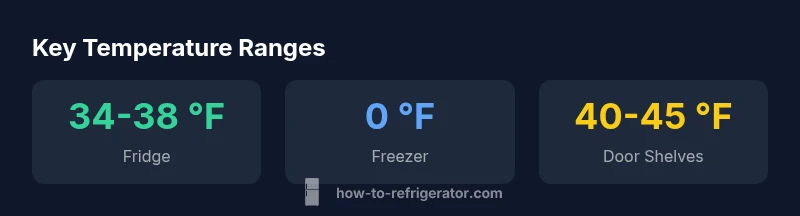
According to current guidelines, your refrigerator should operate at 34-38 °F (1-3 °C) and your freezer at 0 °F (-18 °C). Keeping the fridge near 37 °F minimizes spoilage and foodborne risk. Use a calibrated thermometer and check temperatures regularly to maintain safety and efficiency. For broader guidance, note that door openings can swing temps by several degrees.
What the temperature ranges mean
If you're wondering what's your refrigerator temperature supposed to be, you're not alone. Temperature control is fundamental to food safety, energy use, and overall appliance performance. In practical terms, refrigerators are designed to keep the main compartment just above the freezing point of water but cold enough to slow bacterial growth. Standard guidance uses Fahrenheit, with an accepted range of 34-38 °F (1-3 °C) for the fridge and 0 °F (-18 °C) for the freezer. Staying within this window minimizes spoilage and reduces the risk of foodborne illness, while avoiding temperatures that can damage textures or encourage condensation. It's common to prefer 37 °F as a comfortable middle-ground, but your exact setting may vary with load, door openings, and whether you have a sensitive dairy mindset or a lot of produce. How your fridge responds to changes matters more than any single number.
How to measure accurately at home
Accurate measurement starts with a quality thermometer and correct placement. Follow these steps for reliable readings:
- Place the thermometer in the center of the main fridge compartment, away from the door gaskets and vents.
- Avoid measuring food or the coldest shelf to prevent skewed results.
- Keep the door closed for 30 seconds after placing the thermometer, then record the temperature.
- Check at the same time each day for a week to account for daily fluctuations.
- For pressure-free benchmarking, take multiple readings over 24 hours and average them.
- Calibrate your thermometer if possible, following the manufacturer’s instructions.
- If your fridge has a vibrating motor or noisy operation, verify that the temperature sensor is not impacted by mechanical vibration.
Zone-by-zone temperature guidelines
The fridge is not a single uniform box; different zones behave slightly differently:
- Refrigerator compartment: aim for roughly 34-38 °F (1-3 °C). Dairy and meat should stay toward the back and lower shelves where air is cooler.
- Produce drawers: produce tends to tolerate slightly higher temperatures but should still stay above freezing to prevent ice formation.
- Door shelves: temperature here can swing due to every open, so try to keep most perishables away from the door.
- Freezer compartment: maintain at 0 °F (-18 °C) for safety and longer storage life.
- If you have a separate freezer, note any added compartments or frost-free features that influence stored items.
Practical steps to adjust and verify
If you need to adjust temperatures:
- Use the control dial or digital panel and change in small increments (1-2 °F or 0.5-1 °C).
- Wait at least 24 hours before rechecking, as the system needs time to stabilize after a change.
- Verify with a thermometer placed in the fridge and another in the freezer.
- Record readings for a week and ensure they sit within target ranges consistently.
- If readings drift or never stabilize, consider checking door seals, level surface, or potential airflow obstructions.
Common fridge maintenance for stable temps
Maintenance helps your fridge stay within safe ranges:
- Inspect door gaskets for cracks or gaps and clean them with mild soap; replace if they don’t seal properly.
- Clean condenser coils (usually at the back or bottom) to improve efficiency.
- Ensure the fridge is level; an unlevel unit can cause door misalignment and poor sealing.
- Check the evaporator fan for dust or obstruction and clean as needed.
- Avoid overloading shelves, which can block airflow and create temperature pockets.
- If you notice frost buildup, it may indicate a defrost issue that needs attention.
Seasonal and usage considerations
Temperature performance can vary with season and usage:
- In hot months or when doors are opened frequently, temperatures can drift upward; keep an eye on readings and adjust if needed.
- During holidays or large gatherings with heavy food loading, consider temporarily lowering the fridge temperature slightly or using separate coolers for perishables.
- If you have a modern smart fridge, use its built-in sensors as a supplement to a dedicated thermometer for cross-checking.
- If your kitchen is small or the fridge sits near a heat source, you may experience higher ambient temperatures impacting performance.
Troubleshooting temp problems without a pro
Before calling for service, run through a quick checklist:
- Verify door seals are intact and clean; replace if torn.
- Check for warm air leaks behind the unit or in cabinetry and seal as needed.
- Confirm condenser coils are clean and airflow is unobstructed.
- Reinstall the thermometer after ensuring sensor placement is correct.
- Test the thermostat by adjusting in small steps and observing if the temperature stabilizes after 24 hours.
- If temperatures remain out of range, document readings and settings and arrange professional evaluation.
Case studies and examples
Example A: A family notices the fridge reads 42 °F on the door shelf. After inspecting the gasket, cleaning coils, and repositioning items to improve airflow, the main compartment stabilizes at 36-37 °F within 48 hours. The freezer remains at 0 °F.
Example B: A newer model with a digital thermostat drifts to 33 °F in the main compartment during a heat wave. A 2 °F increase in ambient temperature triggers a test: after adjusting by +2 °F and rechecking 24 hours later, the readings settle around 35-37 °F. No mechanical repair is needed.
Quick-start checklist for new fridges
- Place a thermometer in the center of the fridge and in the freezer.
- Set fridge to 37 °F (3 °C) and freezer to 0 °F (-18 °C).
- Check readings after 24 hours; adjust if needed.
- Inspect door gaskets; clean and replace if they leak.
- Keep coils clean and ensure proper airflow.
- Avoid overloading shelves; allow air to circulate freely.
- Re-test weekly after any adjustment.
- If persistent issues occur, contact a repair professional.
Temperature guidelines by zone inside a standard refrigerator
| Area | Recommended Temperature | Notes |
|---|---|---|
| Refrigerator compartment | 34-38 °F | Target around 37 °F |
| Freezer compartment | 0 °F | Maintain for safe storage |
| Door shelves | 40-45 °F | More variable due to frequent opening |
FAQ
What should I do if my fridge is reading too warm?
First verify with a second thermometer and check door seals. Clean condenser coils, ensure proper airflow, and avoid overloading shelves. If the temperature remains above 38 °F after 24 hours of adjustments, consult a technician.
First verify with a second thermometer and check seals, then clean coils and ensure airflow. If it stays warm after a day, contact a technician.
Can a fridge be too cold?
Yes. If the fridge reads near or below 32 °F, you risk freezing foods and damaging textures. Adjust upward in small increments and re-check after 24 hours.
Yes, fridge temperatures can be too cold and freeze foods. Adjust a little warmer and re-check after a day.
Is 32 °F safe for refrigerator temperature?
32 °F is near freezing and not ideal for most fridge zones. Keep the fridge above 34 °F to avoid freezing items and ensure safe storage.
32 degrees is too close to freezing for a fridge—keep it above to avoid freezing foods.
How often should I check fridge temperatures?
Check temperatures at least weekly after any change and monthly for ongoing monitoring. Use a thermometer in both fridge and freezer.
Check weekly after changes and monthly for routine monitoring with a thermometer.
Do I need a dedicated thermometer?
A simple analog or digital refrigerator thermometer works. Place it away from vents and doors to get an accurate read.
Yes—an external thermometer is best for accurate readings and consistent checks.
What maintenance helps temperature stability?
Keep coils clean, seals intact, and ensure the unit is level. Regular cleaning and door seal checks prevent energy waste and temperature drift.
Keep coils clean, seals tight, and the unit level to prevent drift.
“Maintaining temperatures within recommended ranges is the cornerstone of food safety and appliance efficiency. Consistent testing and small, gradual adjustments prevent spoilage and energy waste.”
Top Takeaways
- Define target ranges: fridge 34-38 °F, freezer 0 °F.
- Use a reliable thermometer and verify regularly.
- Account for door openings and load when setting temps.
- Perform routine maintenance to sustain stability.
- If in doubt, adjust slowly and re-test after 24 hours.