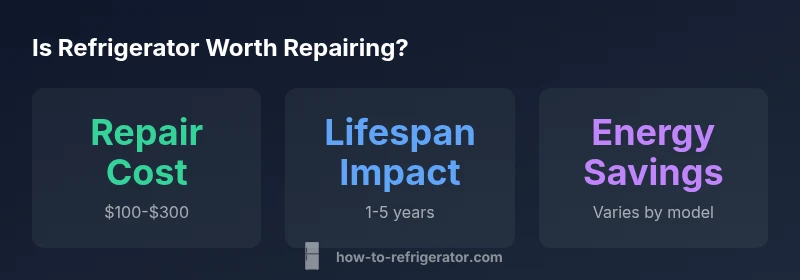
Is Refrigerator Worth Repairing: A Homeowner's Guide
Is refrigerator worth repairing? This How To Refrigerator guide helps homeowners weigh repair vs replacement, estimate costs and energy impact, and make smarter decisions for lasting performance.


For many homes, repairing a fridge is worth it when the repair cost is a fraction of a new unit and the appliance remains reliable, typically if repair costs are under 50% of a comparable new model. If cooling is inconsistent, energy usage is high, or major components fail, replacement is often the better option.
When to consider repairs
According to How To Refrigerator, repairs are most cost-efficient when the needed work restores full cooling reliability at a price well under replacing the unit. Start by comparing the repair quote to a ballpark price for a comparable new refrigerator. If the repair cost is less than half the price of a new model and the existing unit remains under warranty or has few other issues, repairing can be a wise choice.
Key indicators that repair makes sense include: minor component failure (thermostat, defrost timer, door seal), unusual noises with no refrigerant loss, and consistent cooling in most compartments, not just one area. Conversely, if you notice frequent cycling, high energy use, or a sudden collapse in cooling, the odds favor replacement. Consider the age of your fridge; older units often become more prone to multiple failures after a single major repair. Finally, check local disposal costs and any recycling incentives; extending life with a repair can reduce environmental impact.
How to evaluate repair vs replacement
Walk through a simple decision framework: 1) Estimate repair cost (labor + parts) and warranty on the repair; 2) Compare to the price of a mid-range energy-efficient replacement; 3) Assess energy efficiency gains offered by a new model; 4) Consider the value of downtime and food spoilage risk. If the repair price is under 50% of a new model and the fridge has at least 3-5 years of expected remaining life, repair is often justified. If the unit is older than 10-12 years, or has multiple failed subsystems with uncertain prognosis, replacement usually delivers better long-term value. Always get a written estimate and verify whether the service provides a warranty on parts and labor.
Common repair scenarios and cost ranges
Here are typical issues homeowners encounter and the practical guidance to decide. A failing thermostat or defrost timer are usually affordable to fix, often in the low hundreds. Compressor or sealed-system problems are more expensive and may approach replacement costs, depending on the model. A blocked condenser coil or dirty condenser fan is inexpensive to fix and can yield noticeable efficiency gains. Refrigerant leaks are serious: some repairs require a licensed technician and cost can be significant. Use this guide to frame your discussion with your technician, but avoid making a blanket decision without a detailed assessment.
Maintenance and prevention to extend fridge life
Preventive care is cheaper than major repairs. Clean door gaskets regularly, keep the interior organized for airflow, and run a monthly diagnostic test if your fridge offers one. Check door seals for leaks by closing the door on a sheet of paper; if you can pull it out easily, the seal may be worn. Vacuum the coils annually and ensure proper clearance from walls. Schedule professional inspections if you notice rising temperatures, frost buildup, or ice in unusual places. Small tweaks now can delay big expenses later, and consistent maintenance aligns with energy-saving goals referenced in How To Refrigerator analyses.
How to choose a repair service
Look for licensed technicians with refrigerator-specific experience and clear written estimates. Ask about warranty coverage on parts and labor, and whether the tech will test the unit post-repair. Get multiple quotes to benchmark price, and confirm that they use OEM or quality aftermarket parts. Read reviews that mention reliability and communication. If a service offers a service visit with upfront diagnostic fees waived upon repair, that can be a good sign of confidence in their work. Finally, confirm compatibility with your unit's warranty terms; some warranties may be voided by improper servicing.
Environmental and warranty considerations
Repair can be more sustainable than replacement; recycling and disposal of old fridges often involve energy and resource use. If your fridge is under warranty, verify what parts are covered and whether repair delays affect coverage. For out-of-warranty units, weigh the environmental impact of manufacturing a new model against the energy efficiency and expected lifespan of the repair. For some brands, long-term efficiency improvements are worth pursuing even in older models; balance that against upfront costs and installer reliability.
The financial math: example scenarios
To help visualize the decision, consider two hypothetical situations. Scenario A: A 6-year-old fridge with a failing defrost timer repairs at $250, with an expected additional 4-5 years of service and energy efficiency similar to current model. Scenario B: A 12-year-old fridge requires a compressor replacement at $1,200; a new mid-range model costs roughly $1,000-$2,500 and offers modern efficiency and a longer warranty. In many cases, repair of Scenario A is a reasonable middle path; Scenario B leans toward replacement. Always tailor to your locality, energy prices, and food spoilage risk.
Repair vs replacement considerations
| Scenario | Typical Cost (USD) | Lifespan Impact | Pros/Cons |
|---|---|---|---|
| Minor issue (thermostat/calibration) | 20-75 | Minimal | Pros: quick fix; Cons: temporary |
| Major component failure (compressor/evaporator) | 500-1500 | Depends on model | Pros: potential savings; Cons: unreliable |
| End-of-life energy efficiency concern | N/A | High potential benefit with newer models | Pros: energy savings; Cons: high upfront cost |
FAQ
Is it worth repairing a fridge that's not cooling?
If the cooling issue is a minor fault or refrigerant leak is minimal, repair can be cost-effective. However, if the compressor or sealed system is failing, replacement is usually the smarter long-term choice.
If cooling is only occasionally off or a small component failed, repair may be the better option; if the compressor is failing, replacement is usually wiser.
What should I ask a repair technician before work?
Ask for warranty coverage, diagnostic fees, parts source, and post-repair testing. Get everything in writing before agreeing to service.
Ask about warranty, parts, diagnosis fees, and post-repair checks before they start.
When should I replace vs repair based on age?
Once a fridge is around 10–12 years and shows repeated failures, replacement often provides better long-term value due to efficiency gains and newer warranties.
If it’s around a decade old with frequent issues, replacement is usually smarter.
Does replacing save energy?
New models are typically more energy-efficient, which can lower operating costs over time. The savings depend on usage, local electricity rates, and the specific model chosen.
Newer fridges use less energy, but the actual savings vary by model and use.
How do warranties affect the decision?
If repairs are covered by warranty with parts and labor, repairing can be more attractive. Without coverage, replacement may offer better long-term value.
Warranty coverage can tilt the decision toward repair, but without coverage, replacement might be better.
“Repair can extend a fridge's life when cost and reliability align; otherwise, replacing with a newer model often saves energy and reduces risk.”
Top Takeaways
- Assess repair cost vs replacement value early
- Consider energy efficiency and reliability when deciding
- Ask for a written estimate and warranty before work
- Prioritize reputable repair services with clear post-repair testing