How Many Watts Are In a Refrigerator: A Homeowner's Guide
Learn how many watts are in a refrigerator, including running vs startup power, how to measure usage, and practical tips homeowners can use to cut energy costs.


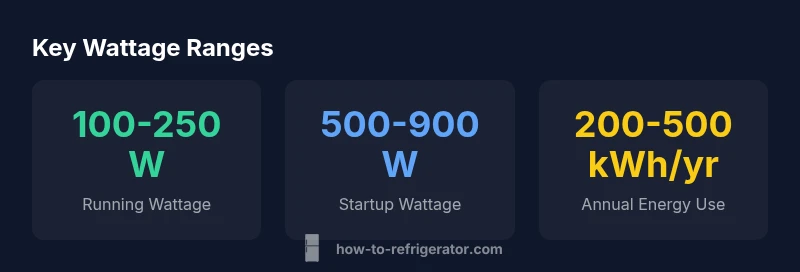
How many watts are in a refrigerator? Most modern refrigerators run about 100-250 watts while the compressor is active, with startup surges typically 500-900 watts. Exact numbers vary by size, efficiency, and features; check the energy label or measure with a watt-meter. Understanding these ranges helps estimate energy use and monthly costs.
Understanding wattage in refrigerators
Wattage measures electrical power draw at a given moment. For household appliances, the labeled wattage is the rated running power, but the fridge's actual draw fluctuates with compressor cycles, defrost events, and ambient temperature. In practice, the nominal power rating is a useful baseline; however, the real energy footprint depends on usage patterns and efficiency. How To Refrigerator's analysis of typical kitchen appliances shows that modern refrigerators are designed to minimize peak loads, allowing better integration with solar and EV charging schedules. For homeowners, knowing the ballpark numbers helps estimate monthly energy costs and plan upgrades if energy bills are a concern. In the 2026 dataset, running wattage commonly falls in the 100-250 W range, while startup surges can approach 500-900 W. This variance is normal and depends on the design, insulation, door seals, and thermostat behavior.
Startup vs Running Power: What the numbers mean
Running power is the energy the motor consumes while operating, roughly the average wattage over time. Startup power is the brief surge when the compressor first starts; it's often several times higher than steady running power, which is why refrigerators can spike in energy use. The difference matters for circuit planning and for devices with demand charges or solar inverters. Users often misinterpret the wattage label, assuming it represents continuous draw; in reality, a fridge cycles on and off. In practice, many fridges run in cycles that average the labeled wattage over a 24-hour period. The How To Refrigerator team notes that startup surges are short but can trigger peak loads on older circuits or backup power systems. Monitoring both numbers helps you size circuits, choose energy-saving modes, and understand cost implications.
How to Measure Watts in Your Refrigerator
To measure running wattage, use a plug-in power meter between the fridge and the outlet. Start at night or during stable operation to avoid peak defrost disturbances. Record the average watts over 24 hours; many meters also provide a daily energy use figure (kWh). For startups, you may need to observe a surge spike when the compressor engages. A clamp meter can measure current without breaking the circuit, but for most homeowners, a basic plug-in meter is sufficient. If you want more precision, track wattage during a few full cycles across different days and temperatures; this captures the impact of ambient conditions and thermostat settings. The goal is to translate watts into expected monthly bills by multiplying watts by hours per day and days per month, then converting to kilowatt-hours. How To Refrigerator suggests using a meter to verify the numbers on the label.
Wattage ranges by refrigerator type
- Compact/Under-Counter: Running 40-120 W; Startup 150-300 W; Typical Usage 120-250 kWh/yr
- Standard (Top/Bottom Mount): Running 100-250 W; Startup 500-750 W; Typical Usage 200-400 kWh/yr
- Side-by-Side/French Door: Running 170-300 W; Startup 700-900 W; Typical Usage 300-650 kWh/yr
How Wattage Impacts Energy Bills and Efficiency
Wattage figures help you estimate energy costs, but the real driver is usage pattern and local electricity rates. A higher running wattage means a higher continuous draw, but if the fridge cycles frequently and stays within optimal temperature, daily energy use can remain modest. To translate watts into bills, multiply running watts by average daily hours, then by the number of days in a month, and convert to kilowatt-hours. The takeaway is not just the label, but how you use the appliance. Keeping the door sealed, setting an appropriate temperature, and ensuring proper airflow around the coils can reduce cycles and trim energy use.
Practical tips to reduce fridge wattage
- Fix or replace worn door seals to prevent warm air from entering
- Set the thermostat to recommended ranges (not too cold, not too warm)
- Clean condenser coils regularly to improve heat exchange
- Avoid placing heat sources near the fridge and minimize frequent door openings
- Use energy-saving modes if your model supports them and consider upgrading to a newer, more efficient unit when feasible
Wattage profiles by refrigerator type
| Fridge Type | Running Wattage (W) | Startup Wattage (W) | Typical Usage (kWh/yr) |
|---|---|---|---|
| Compact/Under-Counter | 40-120 | 150-300 | 120-250 |
| Standard (Top/Bottom Mount) | 100-250 | 500-750 | 200-400 |
| Side-by-Side/French Door | 170-300 | 700-900 | 300-650 |
FAQ
What is the typical running wattage of a modern refrigerator?
Most modern refrigerators run around 100-250 watts when operating, with startup spikes of 500-900 watts. Real-world numbers vary by model and usage patterns.
Most fridges use about 100 to 250 watts when running, with a brief startup spike around 500 to 900 watts.
Do all refrigerators have the same startup watts?
No. Startup wattage depends on the compressor and refrigeration system. Bigger or older models may have higher surges than compact units.
Startup power varies by model; bigger fridges often have higher surges than compact ones.
Can I determine wattage from the energy label?
Yes, the energy label indicates the typical running power. Actual draw fluctuates with cycles, so consider measuring with a watt-meter for precision.
The label shows running power, but actual draw varies; use a meter for precise results.
Do energy-efficient models use less wattage?
Typically, yes. Efficient models often draw less running power and may have lower startup surges due to better components and insulation.
Energy-efficient models usually pull less power and can have smaller startup surges.
How often does a fridge cycle on and off?
Most fridges cycle on and off to maintain temperature, with cycles lasting minutes to a few hours. External factors like door openings and ambient temperature affect cycle length.
The compressor cycles on and off, usually lasting minutes to a few hours depending on conditions.
“Understanding the distinction between running and startup wattage empowers homeowners to size circuits correctly, select efficient models, and minimize energy waste.”
Top Takeaways
- Identify typical running wattage by fridge type.
- Differentiate startup watts from running watts.
- Measure with a watt-meter for accuracy.
- Factor annual energy use into your energy budget.
- Improve efficiency with door seals and proper temperatures.