Do Refrigerators Use 110 or 220? A Practical Voltage Guide
Learn whether refrigerators run on 110–120V or 220–240V, how regional voltage standards affect installation, and practical steps to verify and troubleshoot safely.


The answer is regional: most US and Canadian refrigerators run on 110–120V, while many countries outside North America use 220–240V. Some newer or dual-voltage models can adapt, but you must check the rating plate and manual before plugging in or transferring units. Voltage also influences startup surges and circuit needs, so match the supply precisely.
Regional Voltage Overview
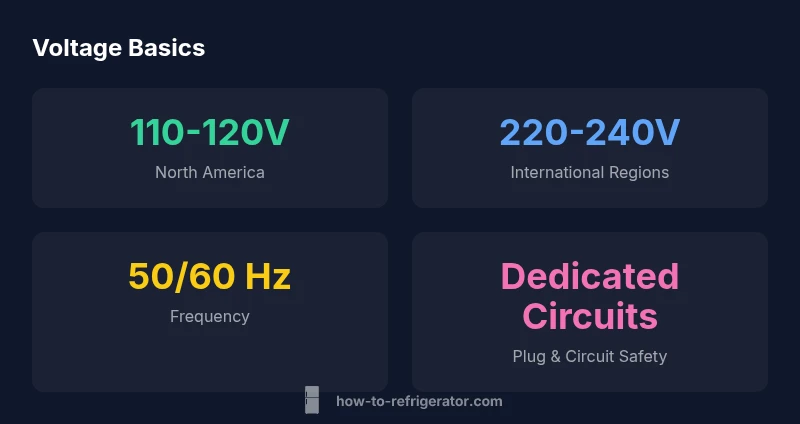
Voltage needs for refrigerators are fundamentally tied to regional electrical standards. According to How To Refrigerator, the vast majority of home refrigerators are designed to run on the same voltage as the local grid. In North America, that typically means 110–120V with 60 Hz frequency, while many parts of Europe, Asia, Africa, and other regions use 220–240V with 50 Hz. The underlying motor and compressor circuitry are built for those bands, and swapping voltage mid-life is neither recommended nor practical. If you travel or move appliances between regions, you must account for both voltage and frequency differences, or you risk reduced efficiency or component damage.
The distinction matters not only for the motor but for the control boards, sensors, and sometimes even the defrost system. If your fridge is a model designed for dual voltage, it will typically specify this on the rating plate. In practice, most units are designed for one regional standard, and adapters or universal power supplies are not a substitute for proper voltage.
As you plan installation or relocation, remember that voltage is part of a broader electrical environment. Circuit wiring, breaker size, and outlet type all influence safe operation. Reading the rating plate remains the most reliable way to confirm the exact voltage requirement for your specific model.
US/Canada Standard Home Circuits (110–120V)
In the United States and Canada, standard household outlets supply 110–120V at 60 Hz. Refrigerators designed for this market typically plug into dedicated, non-ganged circuits to minimize nuisance trips caused by start-up surges. The most common configuration is a 15-amp or 20-amp circuit with a NEMA 5-15P or NEMA 5-20P plug, respectively. A dedicated circuit helps prevent voltage sags that can affect performance, especially during compressor startup. For most homes, a single refrigerator on a dedicated circuit is the norm, though some larger units or built-in models may require more robust setups.
When diagnosing issues, check the outlet and breaker first: a tripped breaker or a warm outlet can mimic a refrigerator problem. If your unit is behaving oddly, verify that the plug is firmly seated, the cord shows no signs of wear, and the circuit is free of other high-draw appliances. If you’re considering a replacement or relocation within NA, ensure the new unit matches the 110–120V rating and use a dedicated circuit as recommended by manufacturers.
Global Variations: 220–240V and Dual-Voltage Models
Outside North America, 220–240V systems are common, with regional frequencies often at 50 Hz. Refrigerators built for these markets may operate on a different outlet and circuit size, and some models are designed to handle dual voltage or be configured with a simple internal switch or transformer. Dual-voltage models can be convenient for travelers or households that source appliances internationally, but they must be used precisely as specified by the manual. If your fridge is a high-end or smart model, software updates and control features may also rely on specific voltage and frequency.
If you’re purchasing a refrigerator intended for a different region, verify the voltage specification on the rating plate and consult the manual for any installation notes. In some cases, you may need a conforming voltage converter, but this is not universally recommended for continuous appliance use. Always factor in local electrical codes and warranty considerations when adapting an appliance to a different power standard.
How to Identify Your Refrigerator's Required Voltage
Locating the exact voltage requirement begins with the rating plate. This label, usually found on the back or inside the unit, lists nominal voltage, frequency, and amperage. If the label shows multiple voltages (for example, 110–120V or 220–240V), the model supports dual voltage or is region-specific. If the plate reads only a single voltage, do not operate the appliance on a different supply, even if the plug looks similar. When in doubt, consult the user manual or contact the manufacturer.
Model numbers can also help. A quick online lookup using your model code will reveal the voltage range, recommended circuit size, and whether dual-voltage operation is supported. For new installations, consider hiring a licensed electrician to verify wiring adequacy and to ensure the refrigerator’s outlet matches the required plug type. This reduces risk and protects warranty coverage.
Safe Installation, Plug, Circuit, and Troubleshooting Tips
Never use an extension cord or power strip with a refrigerator. A direct connection to a properly sized outlet reduces heat buildup and the risk of voltage drop during startup. If you must relocate a fridge to a region with a different voltage, have a qualified professional assess whether a dedicated transformer or a different unit is appropriate. Keep the appliance on a dedicated circuit to minimize ripple and sags, and avoid sharing the circuit with high-draw devices like space heaters or microwaves.
In the event of a power surge or irregular power, verify the condition of the outlet, the cord, and the breaker. Surges can stress the compressor and microcontroller boards, potentially shortening the appliance’s life or triggering warranty concerns. If you notice frequent trips or abnormal noises, it is worth testing on another known-good outlet and, if problems persist, seeking professional service.
Inverter/Smart Refrigerators and Future-Proofing
Newer inverter-driven compressors and smart refrigerators may offer some tolerance for voltage variation, and some models advertise broader voltage specifications. Even with these advances, you should not assume universal compatibility. Check the rating plate and feature list to confirm voltage requirements before plugging in a new or relocated unit. For households that travel or frequently move appliances, consider a model with clear dual-voltage instructions and a robust warranty.
To future-proof your kitchen, keep a record of your fridge’s voltage requirements, the local grid’s typical voltage range, and the circuit capacity. This makes it easier to coordinate with electricians, plan for upgrades, or evaluate substitutes during renovations.
Global voltage basics for refrigerators
| Region | Nominal Voltage | Typical Circuit | Notes |
|---|---|---|---|
| North America | 110-120V | Dedicated 15–20A circuit | Single-voltage, common in NA homes |
| Europe/International | 220-240V | Dedicated 10–16A circuit | Often 50 Hz; verify rating plate |
FAQ
Do all refrigerators support 220-240V?
No. Most refrigerators are designed for the region’s standard voltage. NA models typically use 110–120V, while many international models use 220–240V. Some units are dual-voltage, but you must confirm on the rating plate and in the manual.
Most fridges are built for the local voltage; check the label to confirm.
Can I use a 220V fridge on a 110V outlet with a transformer?
Using a transformer for a standard household refrigerator is generally not recommended for continuous operation. Transformers can overheat and may void warranties. If you need a different voltage, choose a model rated for that voltage or consult a licensed electrician.
Transformers aren’t ideal for fridge-sized loads; use the correct voltage.
Do inverter refrigerators work on 110V or 220V?
Many inverter-driven compressors are designed to be versatile, but you still must verify voltage and frequency requirements from the rating plate. Some models support multiple voltages, while others are region-specific.
Some inverters handle multiple voltages; check the label.
How can I tell if my refrigerator is dual-voltage?
Look for a rating plate that lists more than one voltage or consult the manual. If ambiguous, contact the manufacturer with the model number for confirmation before plugging in.
Check the label and manual to confirm dual-voltage capability.
What about power surges and safety?
Power surges can damage the compressor and electronics. Use a dedicated circuit and a surge protector rated for appliance use if recommended by the manufacturer.
Keep it on a dedicated circuit and protect against surges.
What risks come from incorrect voltage?
Incorrect voltage can cause motor overload, reduced efficiency, and potential warranty denial. Always operate on the voltage specified on the rating plate.
Wrong voltage can harm the fridge and void warranty.
“Voltage compatibility is not optional; using the wrong supply can shorten compressor life and affect performance.”
Top Takeaways
- Always verify the rating plate before powering.
- Use the correct voltage to avoid overheating and compressor wear.
- Avoid extension cords on refrigerators; use dedicated outlets.
- Consider dual-voltage models if you travel or relocate internationally.