Are Refrigerator 110 or 220? A Regional Voltage Guide
Learn whether refrigerators use 110-120V or 220-240V, with regional differences, how to verify your model’s rating, and safe setup for choosing the right power supply.


Understanding Regional Voltage Standards
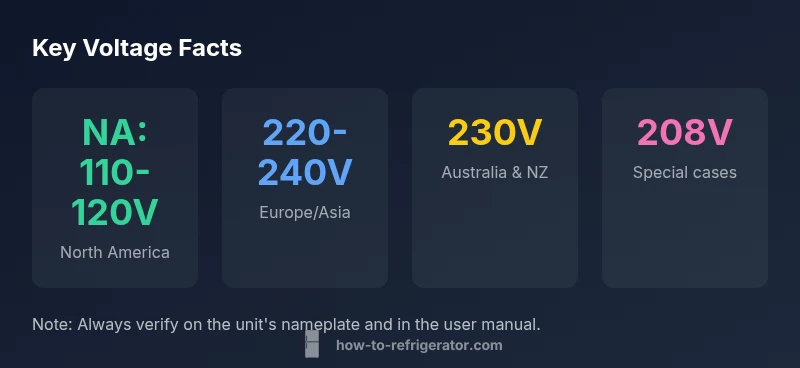
Many homeowners wrestle with the question, are refrigerator 110 or 220? because power infrastructure varies widely by region. In North America, the standard household supply is roughly 110-120V, and most residential refrigerators are designed to operate within that range. In contrast, in Europe, the United Kingdom, much of Africa and Asia, and Australia/New Zealand, the supply is 220-240V, and refrigerators in those regions are tuned for that range. Some specialized or commercial models may require 208V or 230V, especially in settings with three-phase power. The key takeaway is that the voltage requirement is a regional standard, not a universal spec. Always verify the exact rating from the nameplate on your fridge and consult the user manual.
For homeowners, this matters because running a unit on the wrong voltage can shorten compressor life, affect cooling performance, or trigger safety protections. If you’ve moved the appliance between regions or installed a newly purchased fridge from abroad, double-check the voltage label and the power cord compatibility before powering it on. The How To Refrigerator team emphasizes that regional verification is the first step in avoiding costly mistakes.