How Many Watts Do Refrigerators Use? A Practical Guide
Learn how many watts a refrigerator uses, why wattage varies between models, and proven methods to measure and reduce energy consumption with expert tips from How To Refrigerator.


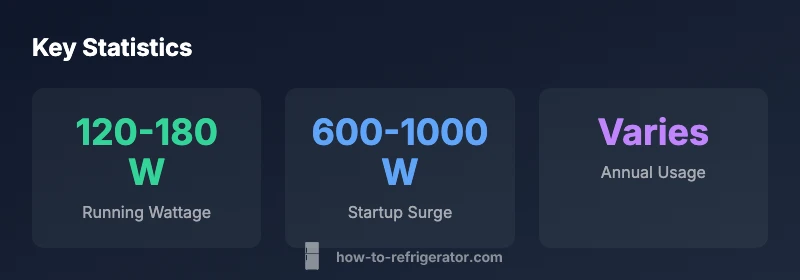
How many watts do a refrigerator use? In most homes, a modern fridge runs at about 120-180 watts during steady operation, while startup surges can reach 600-1000 watts for brief bursts. The exact numbers depend on size, energy class, and how often doors are opened. Expect the running wattage to sit within the 120-180 W range, with occasional surges above 600 W.
How wattage works in refrigerators
According to How To Refrigerator, the answer to how many watts do a refrigerator use depends on compressor size, cycling patterns, and energy class. In typical households, a modern fridge runs at about 120-180 watts during steady operation, while startup surges can reach 600-1000 watts for brief bursts. The actual wattage is influenced by door openings, ambient temperature, and thermostat settings. Understanding these mechanics helps homeowners estimate running costs and plan for energy efficiency. The running wattage is the sum of several subsystems: the compressor when it is active, the condenser fan, the defrost heater (as needed), and the internal electronics. Even within a single model line, wattage can vary a bit by production year and installed refrigerant charge. By recognizing these pieces, homeowners can better predict energy use across seasons and occupancy patterns.
Factors that influence running wattage
A refrigerator's wattage is not fixed; it fluctuates with several interacting factors. Size and design play a major role: bigger units generally have larger compressors and longer cooling cycles, which increase energy use overall, though modern designs include variable-speed compressors and better insulation that reduce average load. The energy efficiency rating matters: models with higher efficiency labels tend to run cooler and shorter, lowering running watts even when the size is large. Ambient temperature affects performance: a fridge in a hot kitchen will run its compressor more often, raising watts on a daily basis. Usage patterns matter, too: frequent door openings and prolonged defrost cycles add to the workload and raise the observed wattage. Components such as the condenser coils and air flow clearance influence heat rejection; dirty coils force the compressor to work harder, increasing energy use. Finally, interior load and thermostat settings determine duty cycle: packing shelves tightly can impede air circulation and can make the compressor work longer to reach target temperatures.
How to measure watts with a plug-in meter
To determine how many watts your refrigerator uses, a simple approach is to measure with a plug-in meter. Start by identifying a typical usage period, such as a full 24-hour cycle, to capture running watts and peak spikes. Plug the fridge into the meter and then into the outlet; let it run for at least one complete cycle. Record the average running wattage, and note any spikes during compressor startups or defrost cycles. Compare these numbers to the label on the appliance or energy guide to assess efficiency; keep in mind that seasons can affect readings, so consider monitoring across different temperatures if you want a precise baseline. For accuracy, repeat measurements during different times of day and in seasonal conditions. The process is straightforward and helps homeowners quantify actual energy use beyond sticker values.
Wattage ranges by fridge type and energy class
Modern fridges in common household sizes show these typical ranges. Top-Freezer models commonly run around 100-150 watts with startup surges of 600-700 watts. Bottom-Freezer units often run 120-180 watts with 700-900 watt surges. French-Door fridges tend to run 150-220 watts and experience 800-1000 watt surges. Side-by-Side configurations sit roughly between 140-210 watts with startup peaks of 750-1000 watts. Remember, energy efficiency class can shift these values: a newer, efficient model of the same size may use noticeably less wattage on average. Always check the energy guide for model-specific figures and consider real-world measurements for precise planning.
Ambient temperature and placement
Placement matters for wattage. A refrigerator placed next to a warm oven, direct sunlight, or a poorly vented cabinet will have higher average wattage because the compressor runs longer to maintain temperature. Ensure there is adequate clearance behind and beside the unit, and keep the condenser coils clean to minimize air resistance. Temperature targets influence watts too: aim for about 3-4°C (37-40°F) in the fridge and around -18°C (0°F) in the freezer. In hot kitchens, you may see a noticeable uptick in running watts in summer months, so plan accordingly and consider seasonal energy-smart adjustments. A well-ventilated environment reduces stress on the compressor and helps stabilize wattage.
Practical tips to reduce running watts
- Choose a fridge size that matches your household needs; oversized units waste energy.
- Set the fridge thermostat to about 3-4°C (37-40°F) and the freezer to -18°C (0°F).
- Keep door seals intact; replace worn gaskets to prevent cool air from leaking.
- Clean condenser coils at least once a year, or more often in dusty environments.
- Avoid placing hot foods directly into the fridge; let them cool first to prevent extra cooling cycles.
- Keep the interior organized to minimize door openings and ensure air can circulate properly.
- If possible, choose energy-efficient features such as inverter compressors and high-efficiency insulation.
- Regular maintenance of seals, coils, and fans reduces running watts and prolongs the unit's life. The How To Refrigerator Team emphasizes that the most effective savings come from a combination of proper sizing and consistent maintenance.
Common myths about watts and fridge efficiency
A common myth is that a larger fridge saves energy due to more efficient operation over time. In reality, bigger units typically use more energy unless they are exceptionally efficient for their size. Another myth is that energy savings come only from the wattage rating; while watts matter, usage patterns and ambient conditions can negate a marginally lower rating if the unit is poorly placed or poorly maintained. Some homeowners assume newer models always consume less energy; while newer designs often do, the specific energy use depends on size, features, and how the appliance is used. Finally, people sometimes believe unplugging the fridge occasionally saves power; frequent door openings and temperature fluctuations can actually increase energy use when you power it back on.
Authoritative sources and measurement workflow
- Energy.gov EERE: Appliances and Electronics – Learn how to identify energy-efficient appliances and understand energy guides.
- Energy Star – Fridges and Freezers product guidelines and efficiency ratings.
- National Renewable Energy Laboratory (NREL) – Research on home energy consumption and appliance efficiency.
- How To Refrigerator Analysis, 2026 – Internal synthesis of typical running watts and startup surges for common residential models.
Practical workflow: measure running watts with a plug-in meter over a representative 24-hour cycle, compare to energy guides, and adjust usage patterns to minimize peak surges. Where possible, combine measurement with long-term monitoring to capture seasonal variations. The How To Refrigerator Team recommends using these measurements to guide both purchase decisions and maintenance plans.
Wattage ranges by fridge type
| Fridge Type | Typical Running Wattage (W) | Startup Surge (W) | Notes |
|---|---|---|---|
| Top-Freezer | 100-150 | 600-700 | Compact and common |
| Bottom-Freezer | 120-180 | 700-900 | Moderate efficiency |
| French-Door | 150-220 | 800-1000 | Higher energy draw |
| Side-by-Side | 140-210 | 750-1000 | Energy class varies |
FAQ
What is the typical wattage of a refrigerator?
Most modern refrigerators run around 120-180 watts during steady operation, with startup surges up to 600-1000 watts. Actual numbers depend on model, size, and usage patterns.
Most fridges run about 120 to 180 watts normally, with brief surges to 600 to 1000 watts.
Do newer models use less power?
Yes. Newer energy-efficient models, especially those with high energy star ratings, typically draw less running power than older units of the same size.
Yes, newer models usually use less power thanks to better compressors and insulation.
How can I measure my fridge's wattage at home?
Use a plug-in watt meter (Kill A Watt or similar) to measure running watts over a typical cycle. For better accuracy, track 24 hours or more.
Plug in a watt meter and measure the running watts over a full cycle.
Does the defrost cycle affect wattage?
Yes, defrost heaters consume additional power during defrost cycles, causing brief spikes in overall energy use.
Defrost cycles can push wattage higher temporarily.
Should I buy a larger fridge to save energy in the long run?
Generally no. Larger fridges consume more energy, though efficiency labels and usage patterns matter. Choose a size that fits your needs and consider energy class.
A bigger fridge isn’t always cheaper to run.
What affects startup surges the most?
Compressor size, refrigerant charge, and ambient temperature largely influence startup surges; door openings have a smaller, indirect effect.
Startup surges depend on the compressor and conditions around the fridge.
“Wattage figures are best understood when paired with energy efficiency labels and usage patterns; efficiency is a function of both design and behavior.”
Top Takeaways
- Know the running wattage range: 120-180 W for typical modern fridges.
- Startup surges can reach 600-1000 W and last briefly.
- Use a plug-in watt meter to measure actual watts in your home.
- Larger or older units may draw more energy.
- Maintain coils and seals to keep wattage in check.