Refrigerator vs Beverage Cooler: A Practical Buyer's Guide
A detailed, objective comparison of refrigerators and beverage coolers, covering use cases, design, energy, and buying tips to help homeowners decide which appliance best fits their kitchen and lifestyle.


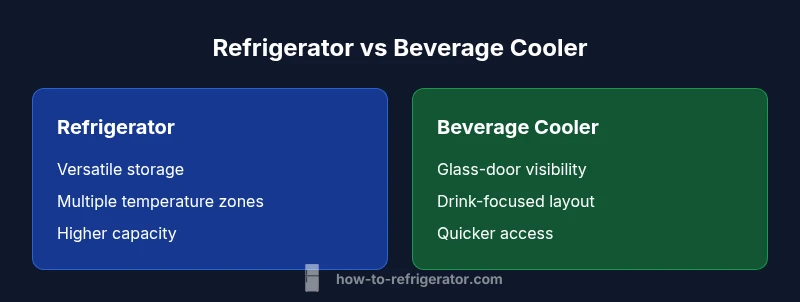
Refrigerator vs Beverage Cooler: The two appliances share storage goals, but they serve different duties. A fridge provides versatile, multi-food storage with precise temperature control, drawers, and shelves for perishables. A beverage cooler prioritizes drinks, visibility, and quick access, often at a smaller footprint. For homeowners, the choice hinges on use‑case, space, and budget. The How To Refrigerator team notes this as a core decision driver.
Understanding the core difference: purpose and environment
Storage behavior defines the day-to-day reality of your kitchen. A refrigerator is built to handle a broad range of perishables, from dairy to leftovers, with adjustable shelves, crispers, and multiple compartments. A beverage cooler focuses on drinks, often with a glass door and dedicated shelves for bottles and cans. According to How To Refrigerator, refrigerators offer versatile storage for a wide range of foods, while beverage coolers are tailored for beverages and entertaining spaces. For most families, the fridge remains the all-purpose workhorse; the cooler shines in entertaining areas or in homes with limited kitchen space. The key is to map your typical shopping and hosting patterns to these core roles. If you frequently shift between storing raw meat, produce, and ready-to-eat meals, a fridge will better protect safety and quality. Beverage coolers are great for weekend parties or small apartments where beverages need quick access.
Temperature management and humidity control
Temperature management is a defining difference between these two appliance classes. Refrigerators commonly offer multiple temperature zones, drawers with adjustable humidity, and flexible shelving that supports a variety of foods from dairy to deli items. This multi-zone design helps separate odors and maintains safety for different perishables. Beverage coolers, on the other hand, emphasize consistent chilling for drinks and easy visibility through glass doors. Not all models provide tight humidity control, and some beverage coolers have limited or single-zone configurations. How To Refrigerator notes that control granularity matters: if you store raw meats, dairy, and produce, a fridge with dedicated compartments and precise thermostats is advantageous. If your focus is beverages, a cooler with adjustable shelves and a front-facing glass door can be ideal, but you may trade off some versatility. Always verify thermostat accuracy and inspect door seals when evaluating models.
Energy efficiency and operating costs
Energy efficiency is a major consideration, since both appliances run year-round. Refrigerators in broader home use typically balance large storage capacity with modern efficiency standards, often delivering strong performance for a range of foods while minimizing waste. Beverage coolers tend to be smaller, and energy use per cubic foot can vary widely by design, with some high-efficiency beverage-centric models delivering surprisingly good performance for their footprint. How To Refrigerator analysis shows that efficiency is highly model-dependent: look for solid insulation, door seals, and compressor technology rather than relying on size alone. In general, a well-maintained fridge will offer better long-term value for mixed storage; beverage coolers can be cost-effective for dedicated beverage storage in entertaining spaces.
Capacity, layout, and everyday usability
Capacity and interior layout drive how you actually store items. Refrigerators typically offer full-width shelves, multiple crisper drawers, and bins that adapt to meats, produce, and leftovers. The layout supports bulk groceries, weekly meal prep, and bulk freezing when needed. Beverage coolers optimize drink storage, with shelves tailored to bottles and cans and often a transparent door for quick selection. The trade-off is that beverage-focused units can constrain non-beverage items and limit the ability to store bulky groceries. When evaluating capacity, consider your typical inventory, whether you freeze items regularly, and how you arrange items for family meals. In homes where beverages are a staple, a cooler can provide quick access; in homes that cook daily and store a variety of perishables, a refrigerator wins on versatility.
Buying considerations: when to choose each
Your decision should align with your lifestyle and kitchen footprint. If your household stores a wide variety of groceries, prepares meals daily, and requires meat, dairy, and produce to stay separate, a refrigerator is generally the safer bet. If your space is limited, you entertain often, or you primarily store beverages and ready-to-serve items, a beverage cooler can be a smart fit. Budget considerations matter: while both can be cost-effective over time, the upfront price per cubic foot is often different, and long-term energy costs vary by model. Look for features that match your use case—shelves that reconfigure, door seals that stay airtight, and quiet operation for living spaces. How To Refrigerator recommends evaluating your current shopping patterns and future needs to determine which appliance aligns best with your goals.
Design variations: units, sizes, features
Design variety matters for fit and aesthetics. Refrigerators come in single-door, top-freezer, bottom-freezer, and side-by-side configurations, with options for built-ins and customized finishes. They typically prioritize flexible interiors, adjustable shelves, and advanced temperature tech. Beverage coolers offer glass doors, compact dimensions, and beverage-focused storage features like wide shelves for bottles, cradles for cans, and visibility-enhancing lighting. Some models include dual or multiple temperature zones, which expands their usefulness but can complicate control. When choosing, balance architectural fit with interior adaptability, energy performance, and maintenance needs. Aesthetics matter for open kitchens and entertaining spaces, while practical interior layouts win in busy family homes.
Placement scenarios in homes and businesses
Placement strategy influences performance and convenience. In a standard kitchen, a fridge is typically placed near prep zones for quick access to ingredients. Beverage coolers are popular in entertainment spaces, home bars, or garages where beverages should be visible and accessible. In small apartments, a compact beverage cooler next to a seating area can reduce trips to the main fridge, freeing kitchen space for cooking. For households with dietary restrictions, a refrigerator’s multi-zone design helps keep foods at appropriate temperatures and seals. In business settings, beverage coolers may be used in break rooms or stores that require ready-to-serve beverages. Consider room layout, door swing, and power availability when planning placement to maximize efficiency and reduce energy waste.
Maintenance, defrost, seals, and common issues
Maintenance affects performance and longevity for both appliances. Regularly cleaning interior shelves and drawers helps prevent cross-contamination and odors. Check door seals for signs of wear and ensure hinges operate smoothly; a sloppy seal can cause energy loss and temperature instability. For frost-free refrigerators, occasional defrosting is usually not required, but blocks in the drain can cause overflow if ignored. Beverage coolers with glass doors require careful cleaning to maintain visibility and prevent condensation. If you notice temperature fluctuation, unusual noise, or increased frost, consult a repair guide or service professional. Following a maintenance routine helps extend appliance life and preserves energy efficiency.
Real-world scenarios and decision trees
In practice, a homeowner balancing space, budget, and food storage will often start with an assessment of use-case weight: is the need primarily for beverages or broad groceries? A decision tree may begin with: Do you need meat, dairy, and produce storage? If yes, start with a refrigerator; if beverages and entertaining storage are prioritized, consider a beverage cooler. Factor space availability, whether you desire glass doors for display, and any energy or noise constraints. The decision becomes more precise when you map your weekly shopping patterns, hosting frequency, and kitchen layout. The outcome should align with your household routine and comfort with appliance maintenance.
Comparison
| Feature | Refrigerator | Beverage Cooler |
|---|---|---|
| Temperature Control | Precise, multi-zone (often required for meat/dairy) | Typically single-zone or limited multi-zone; focus on drinks |
| Humidity Control | Adjustable humidity drawers and vents | Limited humidity control in many models |
| Energy Efficiency | Large capacity with modern efficiency features | Smaller footprint; efficiency varies by design |
| Capacity & Interior Layout | Flexible shelves, drawers, larger overall capacity | Beverage-focused shelves; fewer large bins |
| Visibility & Access | Versatile access for a broad set of foods | Glass door and open access for beverages |
| Design & Aesthetics | Wide range of finishes and built-in options | Typically more compact and modern bar-style looks |
| Price Range | Higher upfront cost per cubic foot; long-term value depends on use | Lower upfront cost per cubic foot; space-dependent value |
| Best For | Families needing versatile daily storage and bulk groceries | Entertaining spaces, beverage-focused storage, small kitchens |
Strengths
- Versatile storage for a wide range of foods and meals
- Greater overall capacity and flexible interior layouts
- Broad model availability and feature options
- Typically better long-term value for mixed-use households
Cons
- Higher upfront cost per cubic foot in some cases
- Larger footprint may not fit tiny spaces
- Some energy costs rise with large capacity if not properly managed
- Beverage-focused units may underperform for non-beverage storage
Refrigerator is generally the better all-around storage solution; beverage cooler excels for drinks and entertaining spaces
Choose fridge for versatility and bulk storage; beverage cooler for drinks-focused setups and entertaining spaces.
FAQ
What is the main practical difference between a refrigerator and a beverage cooler?
The main practical difference is purpose: refrigerators are multi-purpose storage for groceries with multiple temperature zones, while beverage coolers are optimized for drinks with glass doors and beverage-focused shelving. This affects capacity, organization, and how you use the space daily.
Refrigerators are for a range of foods; beverage coolers are for drinks and quick access.
Can a beverage cooler handle meat or dairy?
Most beverage coolers are not designed to safely store raw meat or dairy long-term. They are primarily designed for beverages and snacks. For meat and dairy, a standard refrigerator is the safer choice with dedicated shelves and temperature zones.
Be wary: drink-focused coolers are not ideal for meat or dairy.
Are beverage coolers more energy efficient than refrigerators?
Energy efficiency varies by model and size. In general, refrigerators with variable-temperature zones tend to offer flexible use and can be efficient for mixed storage, while some beverage coolers deliver strong efficiency for beverages but may not be optimized for general food storage.
Energy use depends on the model; compare specs for each unit.
What size should I choose for a small kitchen?
In small kitchens, a compact beverage cooler can free up space while still providing accessible drink storage. If you need broader food storage, a compact refrigerator with adjustable shelves may be a better overall fit. Measure available width, height, and door clearance to avoid fit issues.
Measure space carefully; pick based on room for shelves and door swing.
Do beverage coolers require special maintenance?
Beverage coolers require regular cleaning of shelves and door seals. Glass doors should be wiped to prevent fogging and ensure visibility. If condensation appears, check that doors seal properly and vents are not blocked.
Clean shelves regularly and check the door seals.
Is it better to buy a refrigerator with beverage storage features?
A refrigerator with beverage storage features can combine flexibility with drink-friendly access, which is convenient for entertaining and family life. If you anticipate needing both groceries and drinks accessible in one unit, this can be a practical compromise.
A fridge with beverage features can be a good compromise.
Top Takeaways
- Assess your primary storage needs before buying
- Prioritize interior layout that matches your shopping habits
- Consider energy efficiency and long-term running costs
- Account for kitchen space and door swing when choosing
- Look for features that support safety and easy maintenance