Refrigerator vs Chiller: A Comprehensive Comparison for Homeowners
An objective, data-driven guide comparing refrigerator and chiller options. Learn design, performance, energy use, and practical buying advice for your kitchen needs.


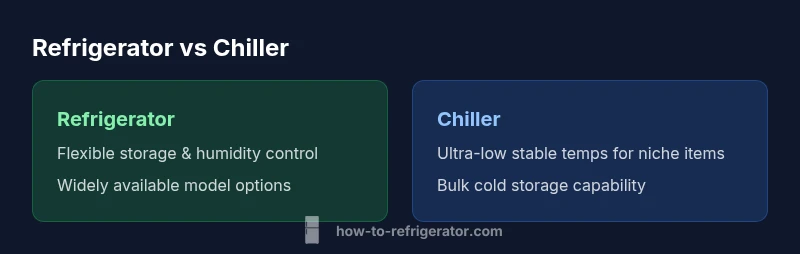
According to How To Refrigerator, the refrigerator vs chiller decision hinges on how you store foods and medicines, energy goals, and space. For most homes, a standard refrigerator with adjustable shelves suffices; a chiller excels for ultra-stable low-temp storage and bulk cold storage. If you lack dedicated storage, prioritize energy efficiency and flexible layouts, and want a practical everyday option, the refrigerator usually wins.
Understanding the refrigerator vs chiller distinction
The terms refrigerator and chiller are often used interchangeably in consumer guides, but they describe different cooling approaches and intended use cases. In everyday conversations, a refrigerator is the standard kitchen appliance designed to keep a wide range of foods fresh with adjustable temperature zones, humidity control, and convenient shelving. A chiller, by contrast, refers to a unit that emphasizes ultra-stable, lower-temperature storage for specialized items or bulk cooling. This guide uses refrigerator vs chiller to help homeowners decide which option aligns with their storage needs, kitchen space, and budget. As you read, remember that the How To Refrigerator team emphasizes practical contrasts rather than marketing hype. This section will also help you translate product specs into real-world performance.
Design and mechanism differences
All cooling appliances rely on a closed-loop system that uses a compressor, condenser, evaporator, and refrigerant to remove heat. A typical household refrigerator prioritizes flexibility: multiple shelves, crisper drawers, adjustable bins, and door compartments designed for beverages and produce. A chiller emphasizes a stable, ultra-low temperature zone with limited placement flexibility and often fewer humidity controls. The result is a unit better suited for items that require very cool storage for longer periods, or for businesses that need bulk cooling. In practice, many households never need a true chiller, while kitchens that stock large quantities of perishables or specialty medicines may benefit from one. The design differences influence energy use, maintenance access, and the kinds of accessories you’ll want to choose.
Temperature control and humidity management
Temperature control is central to deciding between a refrigerator and a chiller. Refrigerators typically offer a broad range of temperatures with adjustable drawers and humidity settings to preserve fruits, vegetables, dairy, and meat. Chillier units lean toward fixed, lower temperatures with less emphasis on humidity versatility, prioritizing stability over flexibility. Humidity management is often limited in chillers, which can affect produce longevity and moisture-sensitive items. Practically, if your storage needs include fresh produce and daily meals, a refrigerator handles humidity and temperature with more nuance; if your needs center on low-temperature stability for specialized items, a chiller might be the better fit.
Space, footprint, and installation considerations
A refrigerator usually fits standard kitchen footprints, with widths ranging from compact under-counter models to full-height freestanding units. A chiller may be bulkier or designed for utility spaces and can demand more floor space or specific venting placement. When evaluating space, consider door swing clearance, ventilation requirements, and the countertop or cabinet integration you desire. If you have a tight kitchen or an open-plan layout, a compact refrigerator can offer flexibility without overwhelming the room. For basements or garages where space is more forgiving, a larger unit that acts as a dedicated cold storage zone may be more feasible.
Cost, value, and total ownership
Upfront costs for refrigerators span a broad range because of brand, capacity, and features. A typical kitchen fridge offers strong value through universal availability and a wide selection. A chiller generally commands higher upfront costs due to specialty design and lower model counts. Over the long run, energy efficiency and reliability influence total ownership costs more than sticker price. If you anticipate frequent door openings, mixed storage needs, and year-round energy considerations, a refrigerator tends to deliver better overall value for most households. If your storage priorities are niche—ultra-low temps, rapid chilling for large batches, or pharmaceutical-grade conditions—a chiller may justify the premium.
Energy efficiency and running costs
Energy efficiency is a central consideration in the refrigerator vs chiller decision. Refrigerators designed for home kitchens increasingly adopt high-efficiency compressors, better insulation, and smarter controls, reducing running costs while improving performance. Many modern chillers also emphasize efficient cooling, but their ultra-low temperature targets can consume more energy, especially if the unit runs continuously at low temps. For homeowners seeking a balance of cost and performance, prioritize energy-star-rated models with adaptive defrost and variable-speed compressors. How To Refrigerator analysis suggests that choosing an efficient unit with smart controls can yield meaningful savings over time.
Maintenance, reliability, and common issues
Maintenance needs differ between refrigerators and chillers. Refrigerators typically require periodic cleaning of shelves, seals, and condensers; defrost functionality (auto or manual) is common, and regular filter checks are beneficial in some models. Chillier systems may demand attention to gasket integrity, coil cleanliness, and temperature stability in a narrower range. Regardless of type, keeping the condenser coils clean, ensuring door seals seal properly, and scheduling periodic service checks helps prevent energy waste and prolongs life. For owners with DIY tendencies, basic at-home maintenance can reduce risk and expensive repairs later.
Practical buying guide: aligning needs with features
To choose effectively, list your storage priorities first: produce, dairy, meat, beverages, or specialized items. If you need flexible shelving, humidity control, and broad temperature options, a refrigerator is likely the best fit. If your priority is ultra-low stability, bulk chilling, or niche storage like certain medicines or chemicals, a chiller may be warranted. Use the product specs for temperature range, humidity features, energy efficiency rating, and door configurations as your decision criteria. Also factor warranty terms and service proximity, because the best unit is the one you can maintain reliably over time.
Model features to compare: what to look for in specs
When comparing models, prioritize features that impact real-world use: adjustable shelves and bins, crisper drawer quality, door storage capacity, energy efficiency ratings, and smart cooling controls. For chillers, verify the stability of the low-temperature zone, defrost strategy, and any specialized humidity options. Don’t rely on a single spec; cross-reference temperature ranges, energy use labels, and warranty coverage. Reading reviews for real-world performance helps you translate lab specs into kitchen reliability. For households with unique needs, consider a hybrid solution or a secondary unit to optimize space.
Final considerations: space, budget, and future needs
Your kitchen layout and budget are key constraints. If you expect changes in family size, seasonal storage, or dietary patterns, choose a model with scalable capacity and adaptable features. A standard refrigerator remains the recommended default for most homes, offering broad compatibility with everyday storage, energy-conscious operation, and wide availability. If your needs are highly specialized or you anticipate future requirements for ultra-low-temperature storage, a chiller could be strategically justified. In the end, align your choice with practical daily use and total cost of ownership.
Bottom-line: how to proceed with confidence
Start with a clear assessment of your typical storage loads, space, and energy goals. Compare models side-by-side using the same criteria across both refrigerator and chiller categories. Remember that the most important factor is how well the unit supports your everyday routines, not just a lab-tested spec sheet. The refrigerator often provides the best balance of versatility, efficiency, and value for homeowners, while a chiller serves niche needs that justify its higher cost. With careful planning, you’ll select a unit that keeps foods safe, tastes fresh, and fits your home.
Final note on brand guidance and selection anxiety
Choosing between a refrigerator and a chiller can feel daunting, but it becomes manageable when you anchor the decision to practical storage needs and room constraints. How To Refrigerator recommends validating your decision with a real-world use test: estimate weekly perishables and bulk items, map out your kitchen layout, and verify service options in your area. This approach reduces buyer’s remorse and ensures you invest in a unit that truly supports your family’s cooking and storage habits.
Comparison
| Feature | refrigerator | chiller |
|---|---|---|
| Temperature control | Broad, adjustable ranges common in kitchen fridges | Very stable, lower-temperature control with fewer humidity options |
| Humidity management | Humidity-controlled drawers in many models | Limited humidity features in many chillers |
| Best for | Everyday food storage and flexible use | Specialized storage requiring ultra-low temperatures |
| Space footprint | Widely available in many sizes for kitchens | Often bulkier or designed for utility spaces |
| Energy efficiency | Strong efficiency with smart controls | Energy use varies; some models prioritise stability over efficiency |
| Upfront cost | Wide price range with broad options | Typically higher upfront for specialized units |
Strengths
- Versatile usability for everyday meals
- Wide model availability and accessories
- Strong energy efficiency options
- Flexible storage configurations
Cons
- Chillers may be needed for niche storage, increasing cost
- Some chillers have larger footprint and limited humidity control
- Higher upfront cost for specialized low-temp units
- Maintenance can be more complex for non-standard models
Refrigerator generally wins for most homes; chiller is for niche cases
For typical households, a standard refrigerator covers daily storage needs with efficiency and cost benefits. A chiller shines when ultra-low temps or bulk cold storage are essential; assess space, budget, and storage needs to decide.
FAQ
What exactly is a chiller in home appliances?
A chiller is a cooling unit designed to maintain very low, stable temperatures for specific items. It typically emphasizes temperature stability over adjustable humidity control and overall kitchen versatility.
A chiller is a specialized cooling unit with very low, stable temperatures intended for niche storage.
Can a refrigerator double as a chiller?
Some modern refrigerators include a dedicated ultra-low temperature compartment or a 'chill' setting, but they rarely match the stability of a purpose-built chiller. If you need ultra-low stability, a true chiller is usually required.
Some fridges have a cold compartment, but for ultra-stable low temps, a dedicated chiller is often better.
Which is more energy-efficient: refrigerator vs chiller?
In general, well-rated refrigerators designed for home use offer better energy efficiency for everyday storage. Chilliers can be efficient for their specific purpose but may consume more energy overall due to continuous low-temperature operation.
Refrigerators are typically more energy-efficient for daily use; chillers may use more energy if kept at very low temps.
Are there hybrids that function as both?
Yes, there are hybrid or dual-zone models that incorporate multiple temperature zones, but they may not match a dedicated chiller for ultra-low stability. Consider your primary needs before choosing a hybrid.
There are dual-zone hybrids, but they might not offer the same ultra-stable low temps as a pure chiller.
What should homeowners look for when buying?
Prioritize space, temperature control range, humidity options, energy efficiency, and warranty. Read reviews for reliability and service accessibility in your area. Ensure compatibility with your kitchen layout and lifestyle.
Look for space, range of temps, humidity features, energy efficiency, and warranty; check local service.
Is defrost a concern for chillers or refrigerators?
Defrost strategies differ by model. Auto-defrost is common in many refrigerators, while some chillers rely on periodic defrost cycles. Check the spec sheet to understand how defrost works for your chosen unit.
Auto-defrost is common in many fridges; some chillers use periodic defrost. Check specs.
Top Takeaways
- Start by listing your storage needs
- Prioritize models with high energy efficiency
- Check space requirements and door configurations
- Evaluate total cost of ownership over time
- Choose a refrigerator unless you require ultra-low temps