Difference Between a Refrigerator and a Heat Pump: An Analytical Homeowner's Guide
A rigorous comparison of how refrigerators and heat pumps differ in purpose, operation, energy use, and installation—helping homeowners decide which system fits their needs.


TL;DR: A refrigerator and a heat pump are thermodynamic systems, but they serve different goals. A refrigerator removes heat from an insulated interior to keep food cold. A heat pump moves heat between indoors and outdoors to provide heating or cooling, depending on mode. For homeowners, the main distinction is purpose and operation, not just efficiency.
What is a refrigerator? Core function and design
A modern refrigerator is a cooling appliance designed to remove heat from an insulated interior to preserve perishable foods. Inside, a sealed refrigeration cycle uses a compressor, evaporator, condenser, and expansion device to move heat from the interior to the surrounding environment. The result is a stable, low-temperature interior that slows microbial growth and preserves freshness. According to How To Refrigerator Team, this dedicated approach minimizes energy waste by focusing on precise cooling rather than broad climate control. The key design element is insulation and door seals that minimize heat ingress; good gaskets and proper door alignment can significantly cut energy use. In terms of efficiency, most home refrigerators prioritize steady cooling and humidity control for produce, beverages, and frozen goods, with newer models incorporating variable-speed compressors and smart sensors to adjust operation based on usage patterns. Maintenance is often simple: clean condenser coils, replace worn door seals, and ensure drip pans and defrost drains remain clear. The challenges are linked to ambient temperatures, door openings, and improper organization that reduces airflow inside; all these can lead to uneven cooling and higher energy consumption. For families with large grocery loads, a wider interior with adjustable shelves can improve organization and performance. In short, a refrigerator is a targeted, cold-storage tool rather than a climate-control system, and its efficiency depends on design, usage, and routine maintenance. This matters for the difference between a refrigerator and a heat pump, and sets the baseline for evaluating energy use and scheduling service.
wordCount":210},"## What is a heat pump? Core function and design
A heat pump is a versatile thermal transfer system designed to move heat from one place to another. In cooling mode, it works like a refrigerator, extracting heat from indoors and expelling it outside. In heating mode, it reverses the flow and concentrates heat from the outdoors to warm interior spaces. The physics behind a heat pump relies on a refrigerant cycle similar to a refrigerator, but with an emphasis on moving energy rather than simply creating cold. The coefficient of performance (COP) describes how many units of heat are moved per unit of electrical energy consumed, and several factors influence COP, including outdoor temperature and system design. In practice, a modern residential heat pump is paired with air handlers or a dedicated indoor unit to condition air without combustion or costly fuel sources. For homeowners, the operational flexibility is a major advantage, especially in moderate climates where heating demand is not extreme. However, heat pumps can require larger upfront capital for outdoor equipment, proper clearance for airflow, and a professional installation to ensure correct refrigerant charging and defrost functionality. Maintenance typically involves clearing outdoor coils, inspecting the refrigerant lines, and ensuring that air filters and zones are properly balanced. While a heat pump is not just a heater, its efficiency improves when paired with well-sealed homes and sensible thermostat controls. As a result, many households pursue heat pumps to reduce fossil-fuel use while maintaining year-round comfort.
wordCount":230}
How the two systems compare at a glance: purpose, design, and use
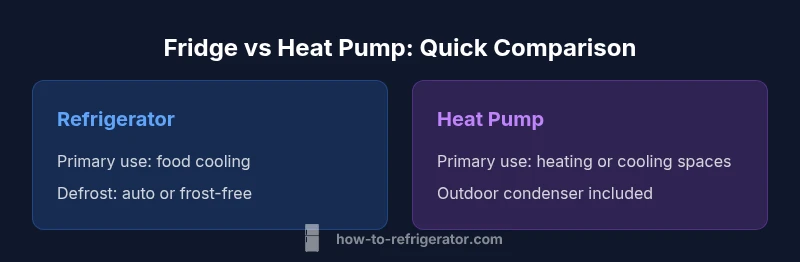
The refrigerator and heat pump share core thermodynamics but diverge in purpose and typical environments. A refrigerator is a sealed, insulated cabinet with one primary mission: keep food and drinks cold. A heat pump is a climate-control device capable of heating or cooling a space by transferring heat between indoors and outdoors. This fundamental difference informs every other variable, from energy efficiency metrics to installation considerations. When homeowners evaluate these systems, they should consider: the intended role in daily life, space constraints, climate, and energy priorities. Beyond the obvious function, the design choices reflect those priorities: interior temperature stability vs. outdoor heat exchange, short-term food safety vs. long-term room comfort, and simple maintenance vs. more complex system balancing. Understanding these distinctions helps prevent misaligned expectations, such as buying a device whose strongest feature (e.g., cooling capacity) is not the actual need in a given home. How To Refrigerator Team emphasizes that clarity on function leads to better purchase decisions and more reliable performance over time.
wordCount":220}
Energy efficiency considerations and practical impacts on bills
Energy efficiency is central to both technologies, but it expresses differently. Refrigerators optimize for low standby energy use and consistent cooling, often through advances like inverter compressors, better insulation, and smarter defrost cycles. In contrast, heat pumps optimize energy input relative to heating or cooling output, and their efficiency is highly sensitive to ambient conditions. This means a heat pump may outperform a conventional air conditioner or furnace in moderate climates, while extremely cold or hot conditions can reduce its relative efficiency. For homeowners, this translates into planning around climate and comfort goals. The How To Refrigerator analysis suggests evaluating seasonal energy patterns and the total energy budget for your home rather than focusing on a single device rating. If your priority is year-round climate control with minimal fossil-fuel use, a well-mated heat pump can offer meaningful efficiency benefits; if your priority is reliable, long-term food preservation with minimal maintenance, a high-quality refrigerator remains the best fit. In either case, routine maintenance, sealing air leaks, and proper sizing are crucial to maximizing efficiency and comfort.
wordCount":260}
Installation considerations, space planning, and lifecycle costs
Placement matters for both appliances, but the constraints differ. A refrigerator’s footprint is largely indoor and kitchen-centric, with power and drainage considerations primarily around the location and ventilation behind the unit. A heat pump system introduces outdoor components and mechanical rooms, requiring access for service, appropriate clearance, weather protection, and noise considerations. From a lifecycle perspective, upfront costs for a heat pump include the outdoor condenser and related distribution equipment, which can be substantial, while refrigerating units tend to have lower initial cost but can incur higher energy-related expenses if not properly maintained. Operational costs depend on cycle efficiency, thermostat settings, and home insulation. How To Refrigerator Team notes that total cost of ownership should account for maintenance intervals, potential replacement cycles, and energy prices over time. Homeowners should also consider climate resilience, seasonal demand, and potential incentives or rebates for energy-efficient systems when weighing options.
wordCount":260}
Decision framework: choosing based on real needs and climate realities
In practice, selecting between a refrigerator and a heat pump cannot be reduced to one best option for all homes. The decision should center on the role you want the device to play: dedicated cold storage or flexible climate control. For a home where food preservation is paramount and climate control is adequate via other means, a high-quality refrigerator is the workhorse. If you require heating and cooling capacity integrated into a single system, especially in climates with moderate heating needs, a heat pump can simplify the mechanical footprint while reducing fossil-fuel use. Weather patterns, energy costs, and available space will tilt the balance. It’s also wise to assess integration with existing HVAC systems, ductwork, and smart home controls. The goal is to align device capabilities with your real-life usage, not to chase the latest technology for its own sake. For many households, a combination approach—reliable refrigeration plus a dedicated, efficient heat pump for climate control—offers the best overall value and comfort. This balanced view reflects the nuanced truth behind the difference between a refrigerator and a heat pump and supports informed decisions.
wordCount":260}
Myths, tips, and best practices for homeowners
There are several common myths worthy of debunking. One is that a heat pump automatically handles all heating needs everywhere; performance depends on climate and home insulation. Another is that more complex means better efficiency; simplicity can improve reliability and serviceability. Practical tips include ensuring proper insulation, sealing ducts, and scheduling regular professional checks for refrigerant lines and electrical connections. For maintenance, keep coils clean, replace filters, and verify door seals or weather-stripping as appropriate. When evaluating new equipment, ask for efficiency ratings appropriate to your climate, and request real-world performance data from suppliers. Finally, remember that the best solution is tailored to your home. The How To Refrigerator Team emphasizes that homeowners should translate technical specifications into practical outcomes—comfort, energy bills, and dependability—rather than chasing marketing claims alone.
wordCount":210}
Comparison
| Feature | Refrigerator | Heat Pump |
|---|---|---|
| Primary purpose | Cooling food and preserving perishables | Heating or cooling spaces (climate control) |
| Operating principle | Dedicated vapor-compression cooling cycle | Reverses or modulates a refrigerant cycle for heating/cooling |
| Defrost/defense mechanisms | Automatic defrost options; frost-free models common | Defrost cycles for outdoor components; sometimes auxiliary controls |
| Energy efficiency focus | Optimized for interior stability and humidity control | Optimized for energy per unit of heat moved; climate-dependent |
| Installation space | Indoor cabinet space in kitchen or pantry | Outdoor condenser or mechanical room; requires airflow |
| Maintenance needs | Coil cleaning, door seals, occasional compressor check | Outdoor unit maintenance, refrigerant checks, air filtration |
| Typical upfront emphasis | Food safety, storage density | Year-round comfort and space conditioning |
| Noise profile | Low to moderate, cabinet-contained noise | Moderate to low but depends on outdoor unit location |
| Cost context (relative) | Lower to mid-range upfront; monitoring energy use critical | Higher upfront due to outdoor unit and integration but potential energy savings |
Strengths
- Clarifies purpose with straightforward maintenance
- Heat pumps provide dual heating/cooling versatility
- Shared refrigerant tech can simplify servicing
- Good matches for energy-conscious homes when climate supports
Cons
- Heat pumps require proper outdoor space and professional installation
- Not always cost-effective if only cooling or refrigeration is needed
- System complexity can increase maintenance needs
Refrigerator remains essential for dedicated cold storage; heat pumps offer climate-control versatility that can reduce fossil-fuel use when used for space heating/cooling.
If your priority is steady food preservation, a high-quality refrigerator is the best fit. If you want integrated heating and cooling in a moderate climate, a well-designed heat pump can deliver greater efficiency and comfort. The How To Refrigerator Team recommends aligning your choice with your primary needs and home configuration.
FAQ
What is the fundamental difference between a refrigerator and a heat pump?
A refrigerator is designed to remove heat from a sealed interior to keep food cold, while a heat pump moves heat between indoors and outdoors to heat or cool a space. They share the same basic refrigeration cycle, but their primary goals and environments differ significantly.
A fridge cools your food; a heat pump controls your home's temperature by moving heat in or out. Both use a similar cycle, but their main job is different.
Can a heat pump function as a refrigerator, or vice versa?
Most heat pumps aren’t designed to serve as dedicated refrigerators. Some appliances blend features, but a true refrigerator is optimized for food safety and stable interior temperatures; a heat pump is optimized for climate control. Using one device for the other's primary purpose can compromise performance.
A heat pump isn’t a fridge, and a fridge isn’t a heater. Each is optimized for a specific main job.
Are heat pumps energy efficient for cooling as well as heating?
Heat pumps are generally energy efficient for both heating and cooling, especially in climates with moderate temperature ranges. Their efficiency depends on outdoor conditions, insulation, and system design. In extreme climates, performance can vary, so sizing and installation matter.
Heat pumps can be very efficient for both heating and cooling when sized and installed correctly.
Which is cheaper to install upfront and operate over time?
Upfront costs tend to be lower for a standard refrigerator, while heat pumps involve higher initial investment due to outdoor components. Over time, operating costs depend on energy prices and usage patterns; a well-maired heat pump may offer savings, particularly for climate control.
Fridge is cheaper to install; heat pumps may save money over time if used for heating and cooling.
What maintenance is typically required for each device?
Refrigerators require periodic coil cleaning, door seal checks, and defrost drain care. Heat pumps require outdoor-coil maintenance, refrigerant checks, and system balancing; air filters should be serviced regularly. Regular professional inspections help prevent efficiency loss.
Keep fridge seals in good shape and clean coils; heat pumps need outdoor maintenance and system checks.
Are there safety considerations homeowners should know?
Both systems involve electrical and refrigerant components; professional installation and service are recommended. Proper ventilation, clearance for outdoor units, and routine checks reduce safety risks and ensure reliable operation.
Have a pro handle installation and service to keep things safe and efficient.
Top Takeaways
- Define your primary need: food storage vs climate control
- Assess installation space and climate suitability before choosing
- Consider lifecycle costs and maintenance requirements
- Look for energy-efficient features aligned with your climate
- Use this guide to match device capabilities with real home usage