Difference Between Refrigeration and Air Conditioning
Explore the difference between refrigeration and air conditioning, covering purpose, operation, efficiency, maintenance, and practical homeowner guidelines for choosing and using each system.


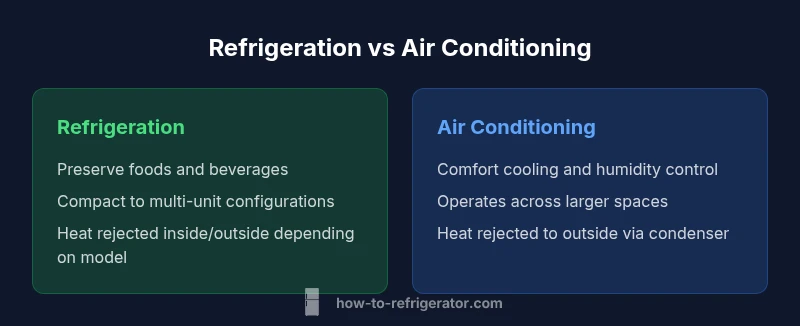
At a high level, the difference between refrigeration and air conditioner is their purpose and design. Refrigeration focuses on preserving food and beverages by removing heat from enclosed spaces, while air conditioners concentrate on cooling and dehumidifying inhabited spaces. This quick comparison highlights core distinctions in operation, typical installations, and maintenance needs, helping homeowners decide which system fits their needs.
Core distinctions: purpose and scope
According to How To Refrigerator, the difference between refrigeration and air conditioner is a fundamental distinction that goes beyond temperature settings. Refrigeration devices are designed to preserve perishable foods by maintaining low, stable temperatures inside sealed compartments, while air conditioners focus on cooling indoor air and managing humidity for comfortable living spaces. Understanding this split helps homeowners decide what equipment is necessary, how to size it, and what maintenance each system requires. In practical terms, refrigeration systems protect food safety and extend shelf life, whereas air conditioners prioritize occupant comfort and energy efficiency for homes and offices. This section outlines the core purpose, typical locations, and how each system handles heat and moisture. Recognizing these differences clarifies when a single device can meet multiple needs and when separate appliances are appropriate, especially in kitchens, garages, or dedicated storage rooms. The discussion also addresses common misconceptions that arise from everyday language, where terms like “cooling” or “climate control” are used interchangeably.
How the basic cycle works
Both refrigeration and air conditioning rely on the same fundamental physical principle: a refrigerant circulates in a closed loop to absorb heat at a low temperature and reject it at a higher temperature. In a typical vapor-compression cycle, an evaporator absorbs heat inside the unit, the compressor raises the refrigerant’s pressure, the condenser rejects heat to the outside, and an expansion device lowers the refrigerant’s pressure again. The difference lies in scale, heat load, and how the cycle is integrated into the rest of the building. Refrigeration systems often place the evaporator inside cabinets or rooms with insulation, focusing on rapid heat removal from a small volume. Air conditioning systems package the cycle with outdoor condensers, designed to handle larger, variable heat loads across occupied spaces. Some appliances combine both functions in a single shell, such as compact refrigerators with integrated freezer compartments, but the underlying cycle remains refrigeration-grade. For homeowners, this means that closing doors and maintaining proper seals in a fridge or freezer is as important as keeping an AC unit’s filters clean. In both cases, refrigerant choice and proper lubrication influence efficiency and longevity, reinforcing the need for routine servicing.
Design and use-case differences
The two systems differ in typical installation contexts and intended outcomes. Refrigeration units are built to operate within small volumes—cabinetry, cold rooms, or standalone beer and wine coolers—where the goal is stable, precise temperatures with minimal variability. Air conditioning, by contrast, targets human comfort in rooms or whole houses, where rapid response to changing outdoor conditions matters. This leads to differences in insulation quality, door/drawer seals, and overall system footprint. Humidity control is a distinctive feature of air conditioning, often requiring moisture removal mechanisms to prevent dampness; refrigeration systems prioritize preventing condensation inside storage spaces and maintaining product quality. Homeowners should consider where heat enters the space, how often items are opened, and whether humidity management is required when choosing between or combining these technologies.
Size, load, and space planning
Refrigeration systems come in compact forms for kitchens, pantries, and garages, plus larger reach-ins and walk-ins for food service settings. Air conditioning scales from window units to centralized systems that service entire homes or buildings. The heat load addressed by refrigeration is localized to the stored goods, whereas air conditioning must manage ambient heat from people, lighting, appliances, and outside weather. Space planning matters in both cases: insufficient clearance around condensers or poor ventilation reduces efficiency in AC units, while crowded or poorly insulated storage can force a fridge or freezer to work harder. When planning a retrofit or new installation, consider room geometry, door traffic, and access for maintenance to ensure optimal performance for either system.
Efficiency metrics and cost considerations
Energy efficiency plays a central role in all cooling decisions. Air conditioning programs use metrics such as SEER or EER to rate seasonal and peak performance, while refrigeration typically relies on appliance-specific efficiency ratings and compressor technology. How To Refrigerator analysis shows that energy use is sensitive to heat load patterns, door/drawer seals, insulation quality, and proper maintenance. In practice, small improvements—tight seals, regular coil cleaning, and correct temperature settings—can yield meaningful energy savings without compromising performance. When budgeting, also consider ownership costs, required replacements, and potential rebates for energy-efficient appliances.
Maintenance, common issues, and long-term care
Maintenance demands differ between refrigeration and air conditioning. Refrigeration maintenance emphasizes door seals, defrost systems where applicable, condenser and evaporator coil cleanliness, and interior lighting checks to prevent heat intrusion. Air conditioning maintenance focuses on air filters, condenser coil cleanliness, refrigerant checks, and ductwork integrity for centralized systems. Regular servicing minimizes temperature fluctuations, noise, and moisture-related problems. A practical habit is scheduling yearly check-ins with a technician and performing simple monthly inspections of seals and filters. These steps help ensure long-term reliability for both systems while preserving energy efficiency.
Real-world scenarios and decision guidelines
Consider scenarios such as a small apartment with limited space, where a compact fridge and window AC might be the most practical solution, versus a family home that benefits from a central AC system and separate upright or chest freezers. In homes where food storage is a priority, a high-quality refrigerator/freezer combo with reliable defrost capabilities can prevent waste and spoilage. In spaces lacking dedicated cold storage, professionals might recommend dedicated refrigeration units with proper ventilation. When humidity control is a priority, investing in a capable air conditioning system with humidification control becomes sensible. Ultimately, the decision hinges on your primary cooling goals and your available space.
Planning for upgrades, retrofits, and integrated solutions
If your home requires both food preservation and climate comfort, explore integrated or modular solutions that meet both needs efficiently. Zoning strategies can help tailor temperature and humidity levels by area, reducing overall energy use. When upgrading, select appliances with verified efficiency ratings, good insulation, and reliable warranties. In some cases, upgrading one system and pairing it with a smart thermostat or advanced sensors yields the best balance of comfort, preservation, and cost control. The goal is to maximize reliability while minimizing wasted energy and heat intrusion.
Practical guide: quick checks you can perform
- Inspect door seals on refrigerators and freezers for wear and replace if necessary.
- Clean condenser coils and ensure proper airflow around outdoor AC units.
- Check for unusual frost buildup in refrigeration units and address promptly to avoid efficiency losses.
- Review thermostat settings to ensure they match recommended ranges for storage vs living spaces.
- Schedule an annual professional inspection to catch refrigerant leaks or component wear early.
Final notes on choosing the right approach
The key is to evaluate the primary cooling need: storage vs comfort. In many homes, both systems operate independently, delivering optimized performance when sized correctly and maintained on a sensible schedule. A thoughtful plan based on real usage patterns helps avoid overbuilding or underperforming equipment, while keeping energy costs predictable.
Comparison
| Feature | Refrigeration (Food Preservation) | Air Conditioning (Climate Control) |
|---|---|---|
| Primary purpose | Preserve perishable foods by removing heat from enclosed spaces | Cool indoor air and control humidity for comfort |
| Typical location | Kitchen appliances, pantries, cold rooms, or dedicated storage | Living areas, bedrooms, offices, or whole-building installations |
| Heat rejection | Condenser housed in the unit or outside depending on model | Condenser usually outdoors or in a dedicated outdoor unit |
| Cooling load pattern | Relatively steady with door openings and stored food load | Variable with occupancy, lighting, and outdoor temperature |
| Temperature targets | Low, stable temperatures for fridge/freezer compartments | Comfort-range indoor temperatures with humidity control |
| Maintenance focus | Door seals, defrost systems, coil cleanliness | Air filters, condenser coil, refrigerant checks |
| Energy metrics | Appliance efficiency ratings and compressor technology | SEER/EER and seasonal efficiency metrics |
Strengths
- Clarifies distinct use-cases to prevent misapplication
- Helps homeowners plan energy budgets more accurately
- Improves maintenance planning by category
- Aids decision-making for upgrades or retrofits
Cons
- Requires learning two domains which can feel complex
- No single device covers all cooling needs in a home
- Professional consultation may be needed for installations or retrofits
Both systems have specific roles; neither is universally better.
Choose refrigeration for food preservation and air conditioning for space cooling. In many homes, a combination tailored to usage patterns yields the best balance of comfort, preservation, and energy efficiency.
FAQ
What is the primary difference between refrigeration and air conditioning?
The primary difference is purpose: refrigeration preserves food by removing heat from enclosed spaces, while air conditioning cools and dehumidifies occupied spaces for comfort.
The main difference is purpose: refrigeration is for food storage, air conditioning is for comfort cooling.
Do refrigeration and air conditioning use the same basic cycle?
Both rely on a vapor-compression cycle, but they are scaled and configured for different loads and use cases. The core process is similar, with different emphasis on heat removal locations.
They use similar cooling cycles, but scaled for different needs.
Can a fridge cool a room like an air conditioner?
A refrigerator is not designed to cool a room uniformly and will have limited effect on ambient temperatures. For room cooling, an air conditioner or dedicated cooling unit is needed.
A fridge won’t reliably cool a room like an AC unit.
Which is more energy-efficient, refrigeration or air conditioning?
Efficiency depends on the specific model, usage patterns, and climate. In general, both have efficiency ratings, but the metrics differ (SEER/EER for AC, appliance efficiency for refrigeration).
It depends on the model and usage; both have efficiency ratings but different metrics.
What maintenance tasks are common to both systems?
Both benefit from regular filter/coil cleaning, sealing integrity checks, and professional inspections to prevent leaks and ensure proper refrigerant levels.
Regular cleaning, sealing checks, and professional inspections help both.
When should I upgrade or replace my cooling system?
Consider upgrading when the system no longer maintains stable temperatures, energy bills rise despite proper maintenance, or you’re expanding living or storage space.
Upgrade when performance drops or energy costs rise despite maintenance.
Top Takeaways
- Define cooling goals: storage vs comfort
- Expect different temperature and humidity requirements
- Compare energy metrics relevant to each system
- Prioritize regular maintenance to sustain efficiency
- Consider zoning or modular solutions for efficiency