Difference Between Refrigerator and Refrigerant: A Guide
Explore the key differences between a refrigerator and refrigerant. Practical explanations, safety tips, and maintenance guidance for homeowners, focused on clear terminology and practical steps.


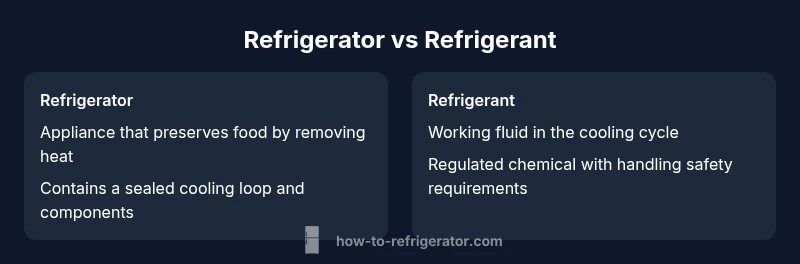
The difference between refrigerator and refrigerant is fundamental: a refrigerator is the appliance that uses a sealed cooling cycle, while refrigerant is the working fluid circulating inside that system to absorb heat and release it elsewhere. They are related but not interchangeable, and misusing terms can hinder safe maintenance. Understanding this distinction helps homeowners diagnose issues accurately and communicate with service pros.
What is a refrigerator? Definition, function, and typical components
A refrigerator is a household appliance that uses a sealed cooling cycle to remove heat from the interior and keep food and drinks cold. Inside, a loop of components—compressor, evaporator, condenser, expansion device, and insulation—works with a working fluid (the refrigerant) to transfer heat. When homeowners discuss the difference between refrigerator and refrigerant, the distinction is practical: the former is the device you own, the latter is one of its essential parts. The term refrigerator is generic across models and brands, while refrigerant refers to the chemical mixture circulated within the sealed system. Understanding this helps explain why a leak is not just a 'broken fridge' problem, but a refrigerant issue that requires specialized attention. In most households, regular maintenance—defrosting (where applicable), door seal checks, and occasional coil cleaning—keeps the appliance functioning efficiently. The How To Refrigerator team notes that the everyday user rarely needs to handle refrigerant directly, but knowing where the refrigerant lives helps you read service notes accurately.
What is refrigerant? Chemistry, properties, and role in the cooling cycle
Refrigerant is the working fluid that absorbs heat inside the evaporator and releases it in the condenser as it cycles through phase changes. Modern refrigerants are chemically designed to move heat efficiently while minimizing environmental impact, and they are stored in a sealed loop within the appliance. The exact formulation of a refrigerant determines pressure, temperature behavior, and compatibility with materials inside the fridge. For homeowners, recognizing that refrigerant is a crucial, regulated substance helps frame discussions about leaks, repairs, and safety. Refrigerants are subject to environmental and safety regulations, which means technicians must use proper recovery and handling procedures. The relationship between the appliance and the fluid it uses is essential: without refrigerant, the refrigerator cannot remove heat; without the appliance, the refrigerant has no closed loop to function within. Reading a service sheet often mentions the required refrigerant type or charge, which is not something the average user should tamper with.
Interplay of concepts: how the cooling system relies on both terms
The cooling cycle depends on the seamless interaction of the refrigerator’s mechanical components and the refrigerant’s thermodynamic properties. When the compressor compresses refrigerant, its temperature rises; the hot gas then travels to the condenser, where it releases heat to the surroundings. The refrigerant cools and condenses into a high-pressure liquid, moves through the expansion device, and cools again as it evaporates in the evaporator, absorbing heat from the interior. This loop is the physical basis of the term refrigeration, linking the appliance to the working fluid. Understanding this interplay clarifies why a damaged seal, a clogged condenser, or an improper refrigerant charge can degrade cooling performance. Homeowners who grasp that refrigerator and refrigerant are distinct but connected are better prepared to interpret service notes and ask informed questions during repairs.
Common misunderstandings and clarifications about terminology
A frequent mistake is treating the words as interchangeable. The refrigerator is the device you plug in; refrigerant is a substance contained within that device’s sealed system. Some people misinterpret “refrigerant” as a type of oil, coolant, or additive found outside the system, which can lead to dangerous assumptions. Another myth is that refrigerants disappear; in reality, leaks reduce performance and may require professional recovery rather than simple refilling. The key clarification is that while a fridge relies on refrigerant to transfer heat, the two terms describe different things: one is a piece of equipment, the other a regulated chemical within a closed loop. This distinction improves how you talk to technicians and how you interpret warranty language and service documentation.
Safety, regulation, and handling of refrigerants
Refrigerants are regulated chemicals with potential health and environmental risks if mishandled. Leaks can pose inhalation hazards and contribute to environmental concerns if released improperly. For this reason, many jurisdictions require licensed technicians and approved recovery equipment for any service involving refrigerants. Homeowners should avoid attempting to repair or recharge refrigerants themselves. Instead, focus on safe practices such as not puncturing the refrigerant circuit, avoiding exposure to refrigerant when a leak is suspected, and scheduling a professional inspection if cooling performance suddenly declines. The distinction between refrigerator and refrigerant underscores why some service calls involve both component repair and refrigerant handling.
Maintenance implications for homeowners
Maintenance for the refrigerator as an appliance includes door seals, interior cleaning, thermostat calibration, and periodically cleaning condenser coils (if accessible). Most issues related to refrigerant are not user-serviceable; they require a licensed professional to locate leaks, recover the old refrigerant, and recharge with the correct type. Homeowners can help prevent refrigerant-related problems by keeping the unit level, ensuring good ventilation around the condenser, and reporting any unusual frost buildup, odd smells, or oily residue around fittings promptly. By recognizing the difference between refrigerator and refrigerant, you can separate routine maintenance tasks from professional interventions and avoid attempting hazardous DIY fixes.
Reading manuals and service sheets: decoding the language around refrigerators and refrigerants
Service manuals often distinguish between components and fluids. Look for sections labeled “refrigerant type,” “refrigerant charge,” or “recovery procedure.” The language can be technical, but the core idea is simple: the manual is telling you which refrigerant the model requires and how the system should be serviced within safety guidelines. This is where the difference between refrigerator and refrigerant becomes practical: you’ll see whether a note refers to the appliance’s parts (shelving, door seals, compressor) or to the sealed cooling loop (pipes, fittings, refrigerant). Understanding this helps you communicate clearly with technicians and reduces the risk of misinterpretation during service.
Practical decisions: repair vs replacement and when knowledge matters
Decisions about repairing or replacing a unit hinge on several factors: the age of the refrigerator, the severity of the failure, and the estimated cost of repairs versus replacement. The critical factor is to consider the overall energy efficiency and ongoing running costs rather than fixating on a single faulty component like the refrigerant. By understanding the difference between refrigerator and refrigerant, homeowners can ask targeted questions: Is a refrigerant leak involved, and does the shop have the right recovery equipment? Is the cooling problem due to a faulty thermostat, a dirty condenser, or a refrigerant issue that would require specialized service? This knowledge supports a more informed, safer, and cost-conscious decision.
Comparison
| Feature | Refrigerator | Refrigerant |
|---|---|---|
| Definition | Household appliance that uses a cooling cycle to preserve food by removing heat from the interior | Working fluid circulating in a sealed system to absorb heat and transfer it to the outside |
| Primary function | Preserve perishables and provide controlled storage | Enable the cooling cycle by absorbing and releasing heat |
| Where it is used | Inside the appliance's sealed refrigeration system | Within the closed loop of the compressor, evaporator, condenser, and expansion device |
| Common failures/risks | Door seal wear, frost buildup, thermostat or compressor failure | Leaks, pressure imbalances, regulatory/misuse hazards if mishandled |
| Maintenance considerations | Regular defrosting (where applicable), coil cleaning, door gasket checks | Safe handling and recovery by licensed technicians; not user-serviceable |
| Safety concerns | Electrical safety, food safety risks if the fridge fails | Refrigerant handling hazards; regulatory controls apply |
| Best for | Homeowners seeking food preservation and convenience | Understanding cooling systems and service needs |
Strengths
- Improved clarity during repairs and maintenance
- Enhanced safety by distinguishing parts and fluids
- Better budgeting for service and replacements
- Helps explain why failures occur and when to call a professional
Cons
- Terminology confusion persists for non-experts
- Requires some HVAC knowledge to apply effectively
- Overemphasis on terms might obscure practical troubleshooting
Refrigerator vs refrigerant: clearly distinct; recognize the appliance vs the working fluid; this knowledge reduces risk and guides proper maintenance.
Know the appliance is the fridge; the refrigerant is the heat-transfer fluid inside. Use precise language when diagnosing problems and when speaking with technicians to avoid unsafe handling and miscommunication.
FAQ
What is the difference between refrigerator and refrigerant?
A refrigerator is the appliance that preserves food by removing heat from its interior. Refrigerant is the circulating fluid inside the sealed cooling loop that enables that heat transfer. They are connected but serve different roles in the cooling system.
A refrigerator is the appliance, and refrigerant is the heat-transfer fluid inside the sealed cooling loop.
Can I recharge refrigerant myself?
No. Handling refrigerants is regulated for safety and environmental reasons and should only be performed by a licensed technician with proper recovery equipment.
No. Refrigerants must be handled by a licensed technician with the proper equipment.
Is a refrigerant leak the same as a fridge failing to cool?
Not exactly. A leak means refrigerant may be escaping and cooling efficiency drops, which is a refrigerant issue. A fridge failing to cool could be a range of problems, including thermostat, compressor, or defrost issues.
A leak is a refrigerant issue; cooling failure could be several problems, some appliance-related.
What safety steps should I take if I suspect a refrigerant leak?
Avoid contact with leaked refrigerant and turn off the appliance if safe to do so. Do not attempt to seal or vent refrigerant. Call a licensed technician.
Stay away from leaks and call a pro right away.
Are there different types of refrigerants?
Yes, there are several refrigerant families used in different models. The exact type is specified by the manufacturer and regulated due to environmental impact.
There are several refrigerant families, and the right type is specified by the model and regulations.
How can I tell if my manual references refrigerant correctly?
Look for terms like 'refrigerant type' and 'refrigerant charge' in the maintenance or service sections. These indicate it is referring to the cooling fluid, not a component.
Check for refrigerant type or charge notes in the service section.
Top Takeaways
- Know the appliance vs the fluid to avoid confusion
- Refrigerants require licensed handling and recovery
- Read manuals for refrigerant type and service notes
- Keep routine fridge maintenance separate from refrigerant issues
- Ask technicians to confirm whether a problem is appliance-related or refrigerant-related