Is Refrigerator and Heat Pump the Same? A Practical Guide
Explore whether a refrigerator and a heat pump are the same. This guide clarifies differences, similarities, and practical advice for homeowners navigating appliance choices.


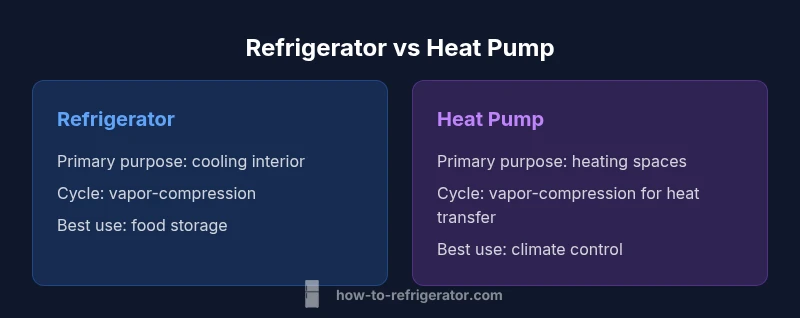
Answer to 'is refrigerator and heat pump same'? No. Refrigerator technology is a specialized heat-pump device designed to remove heat from a defined interior to keep foods cold, while a heat pump is a general mechanism used for heating or cooling spaces. They share the same fundamental cycle, but they serve different purposes and are not interchangeable.
Is refrigerator and heat pump same: Key Clarifications
In practical terms, the answer to 'is refrigerator and heat pump same' is nuanced. A refrigerator is a small-scale, specialized device that uses a heat-pump cycle to remove heat from its interior and keep food cold. A heat pump is a broader technology used for space heating, cooling, or water heating. The overlap is real, but the applications are distinct. According to How To Refrigerator, the confusion arises from sharing the same core cycle, even though their goals differ. Understanding these differences helps homeowners avoid misapplied fixes or wasted energy. In most homes, a refrigerator operates as a dedicated cooling unit within a kitchen, while a residential heat pump is part of the home’s heating and, in some cases, hot-water system. By distinguishing purpose, you’ll better assess upgrades, repairs, and energy use, and you’ll know when to pursue a dedicated appliance versus a broader climate-control solution.
Understanding the Core Concepts
Both refrigerators and heat pumps rely on the same fundamental vapor-compression cycle. They use the four essential components—a compressor, evaporator, condenser, and expansion valve. The refrigerant absorbs heat at the evaporator and releases it at the condenser as it circulates through these parts. The primary difference is scale and control intent: a refrigerator targets a small, insulated interior, whereas a heat pump manages larger spaces or fluid streams. How To Refrigerator analysis shows that this shared physics enables both devices to transfer heat efficiently when correctly integrated into a system.
Are Refrigerators Technically Heat Pumps?
Technically, a refrigerator is a heat pump tuned for cooling. It moves heat from the interior to the outside, achieving low temperatures inside the cabinet. However, calling a fridge a heat pump or a heat pump a refrigerator is imprecise because a heat pump is a broader system used for heating or cooling across a building. The key takeaway is that refrigerators are specialized heat-pump applications, while heat pumps are versatile climate-control solutions that can heat, cool, or both depending on the setup. This nuanced view helps homeowners avoid overgeneralizing the capabilities of each device.
How the Thermodynamic Cycle Works
The vapor-compression cycle starts with the compressor raising the pressure of the refrigerant. It then travels to the condenser, where heat is released to the outside environment. The high-pressure liquid refrigerant expands through the expansion device, cooling as it enters the evaporator. In the evaporator, it absorbs heat from the interior (or from a space in the case of a heat pump), continuing the loop. Whether cooling a cabinet or heating a room, the cycle relies on the same physical principles, with controls adjusting when and how heat moves. The practical lesson is that the cycle is a common tool—its impact depends on application and control.
Real-World Differences in Purpose and Design
Design choices reflect purpose. Refrigerators prioritize tight insulation, precise temperature control for perishable foods, and defrost cycles to manage frost buildup. Heat pumps emphasize outdoor/indoor coil layout, defrost management for climate conditions, and integration with home heating systems. Materials, airflow, and refrigerants are selected to optimize energy use for their intended service. The similarity in the cycle does not negate the differences in zoning, capacity, safety features, or maintenance needs that arise from distinct applications.
Energy Efficiency and Running Costs
Both technologies benefit from efficient components and proper sizing. COP-based efficiency is common in heat-pump contexts, while refrigerators emphasize steady-state cooling performance and insulation. Climate, usage patterns, and system design significantly influence energy use for both devices. How To Refrigerator analysis shows that energy savings hinge on appropriate controls, regular maintenance, and choosing the right model for the intended task. Homeowners should evaluate efficiency ratings, but remember that apples-to-apples comparisons require comparing devices serving the same purpose.
Common Misconceptions: The 'is refrigerator and heat pump same' Question
- They are interchangeable in all homes. (Not true: refrigerators are for cold storage; heat pumps are for heating/cooling spaces.)
- All refrigerators operate like heat pumps. (While they use a similar cycle, design goals differ.)
- Heat pumps cannot provide cooling. (Most heat pumps also offer cooling modes; some models can.)
- Refrigerants and components are always identical. (Different configurations reflect use-case and safety standards.)
Practical Guidance: How to Choose Based on Your Needs
- Define your primary goal: cold storage vs space heating.
- Assess climate and home layout; consider seasonality of heating demand.
- Check efficiency and compatibility with existing systems.
- Evaluate maintenance needs and availability of service.
- If you need both tasks, explore integrated or dual-function solutions with professional advice.
- Factor installation costs and long-term energy savings over initial purchase price. For a homeowner, distinguishing the primary function helps you pick the right technology and avoid overestimating capabilities.
Maintenance Tips Related to Both Technologies
- Keep coils clean and ensure proper airflow around outdoor units or condenser elements.
- Check seals and insulation to minimize unwanted heat exchange and energy loss.
- Schedule routine inspections for refrigerant levels, leaks, and thermostat calibration.
- Follow manufacturer guidance for defrost cycles and refrigerant handling to maintain safety and efficiency.
- Record energy usage to identify trends and optimize performance over seasons.
Regular maintenance can preserve efficiency and prolong the life of both refrigeration and heating systems.
Authoritative Sources and Further Reading
For deeper reading, consult official energy and research sources. How To Refrigerator references established guidance from national energy agencies and research labs to support explanation of the is refrigerator and heat pump same topic.
- https://www.energy.gov/eere/buildings/heating-and-cooling
- https://www.energy.gov/energysaver/heat-pumps
- https://www.nrel.gov/
Comparison
| Feature | Refrigerator | Heat Pump (Residential Heating) |
|---|---|---|
| Primary function | Keep interior cold for food storage | Provide heating/cooling for living spaces or water |
| Core cycle | Vapor-compression cycle focused on cooling | Vapor-compression cycle adapted for heat transfer |
| Typical components | Compressor, internal evaporator, external condenser, expansion device | Compressor, outdoor/indoor coils, expansion device, refrigerant |
| Controls | Thermostat maintains cabinet temperature | Thermostat and controls for climate zones and flow |
| Best use case | Food preservation in homes | Efficient space heating or hot water in homes |
Strengths
- Shared thermodynamic basis simplifies learning
- High efficiency possible when properly sized and installed
- Clear application boundaries help planning upgrades
- Maintenance patterns overlap, enabling cross-learning
Cons
- Not interchangeable despite common cycle
- Performance depends on climate and usage patterns
- Differences in installation complexity may affect cost
- Specialized components can limit retrofit options
Not the same; refrigerators are specialized heat-pump applications, while heat pumps are broader climate-control systems
Refrigerators apply heat-pump principles to keep food cold inside a cabinet. Heat pumps use the same cycle for heating or cooling larger spaces. Choose based on the primary task—cooling food vs heating spaces—and consider climate, efficiency, and installation requirements.
FAQ
Is a refrigerator a type of heat pump?
Not exactly. A refrigerator uses a heat-pump cycle to remove heat from its interior, cooling food. A heat pump is a broader system designed to move heat for space heating or cooling. The fridge is a specialized application of heat-pump technology, not the other way around.
A fridge uses the heat-pump cycle for cooling, while a heat pump handles heating or cooling larger spaces.
Can a heat pump replace a refrigerator?
No. While the underlying cycle is related, a heat pump is designed for climate control, not precise cabinet cooling required for food safety. A dedicated refrigerator is optimized for cold storage and defrost management.
A heat pump isn’t a substitute for a fridge; they serve different tasks.
What is the main difference between these devices?
The main difference is purpose: a refrigerator cools a small interior for food preservation, while a heat pump moves heat to heat or cool a space. Both share the same cycle, but their design constraints and controls reflect different goals.
They share the cycle but have different jobs: cooling small interiors vs heating spaces.
Are refrigerators and heat pumps energy efficient?
Yes, both can be highly efficient when properly sized and maintained. Efficiency depends on climate, usage patterns, and system design. Look for energy labels and performance data from reputable sources to guide choices.
Efficiency depends on design and usage; check labels and testing data.
Do they share components?
They share fundamental components like a compressor, evaporator, condenser, and expansion device. However, the way these parts are arranged and controlled differs to suit cooling a cabinet versus heating a building.
They use similar parts, but arranged for different tasks.
Top Takeaways
- Differentiate core purpose before purchasing or repairing
- Both rely on the same vapor-compression cycle
- Size, insulation, and controls drive efficiency
- Plan for maintenance and professional guidance