Why Refrigerator Won't Get Cold: Step-by-Step Troubleshooting
Learn fast, practical steps to diagnose why your refrigerator won t get cold. This How To Refrigerator guide covers common causes, safe checks, diagnostic flow, and actionable fixes to restore cooling quickly for homeowners.


Most fridge cooling issues start with simple checks you can do safely. The top culprits are airflow restrictions, dirty condenser coils, a gasket leak, or an incorrect thermostat setting. Start by verifying power and door seal, then inspect coils and vents. If the problem persists, follow the diagnostic flow for targeted fixes.
What does it mean when your fridge won t get cold?
Understanding why refrigerator won t get cold helps pinpoint the fixes quickly. When the interior remains warm while the freezer appears normal, you’re likely dealing with airflow or temperature control issues rather than a failed ice maker. Common signs include frost buildup, louder operation, improper cooling in one compartment, and increased condensation around seals. This problem is almost always solvable with careful checks and safe maintenance. The How To Refrigerator team emphasizes starting with power, seals, and airflow before exploring more complex components. By framing the issue through simple symptoms, you avoid unnecessary part replacements and speed up recovery.
For homeowners, the goal is to restore stable temperatures without prolonging downtime. Begin with the easiest steps and progress to more involved diagnostics only if necessary. This approach minimizes risk and helps you feel confident handling the repair. If you follow the steps methodically, you’ll usually see cooling return within an hour or two in most standard residential models.
Common causes of a non-cooling fridge
A refrigerator that won t get cold can be caused by several issues, ranging from simple to complex. Here are the most frequent culprits, listed from simple to more involved. Always start with the low-effort checks before moving to parts that require tools or expertise:
- Power and settings: A tripped breaker, a unplugged cord, or a thermostat set too high can prevent cooling.
- Door seals and gaskets: Cracked or loose seals let warm air seep in, reducing efficiency and cooling performance.
- Condenser coils: Dusty or blocked coils impede heat removal, causing poor cooling.
- Evaporator fan or condenser fan: A failing fan stifles airflow to the freezer and fridge compartments.
- Defrost system: A malfunctioning defrost timer or heater can cause frost buildup that blocks airflow.
- Thermostat and control board: Inaccurate readings or electrical faults can keep the compressor from cycling correctly.
If the coil temperature stays high or you hear unusual noises, prioritize coil cleaning and airflow checks as your first actions. The How To Refrigerator analysis notes that many non-cooling issues are resolved by addressing airflow and door seals rather than replacing major components.
Safe, quick checks you can perform today
These checks are designed to be performed without opening sealed refrigerant lines or disassembling critical components. They focus on user-serviceable items you can safely inspect and adjust:
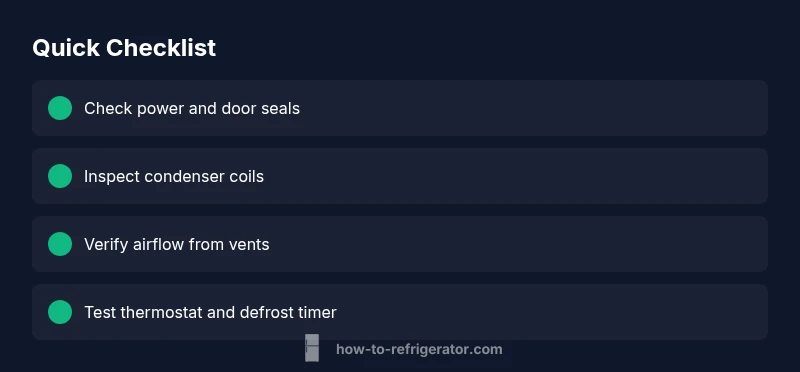
- Verify power: Ensure the outlet is live, the cord is plugged in securely, and the circuit breaker hasn t tripped.
- Check thermostat settings: Confirm the temperature dial is within the recommended range (usually around 37-40°F for the fridge, 0°F for the freezer).
- Inspect door seals: Look for cracks or gaps; perform a simple paper test by closing the door on a sheet of paper. If you can pull it out easily, the seal isn t tight.
- Clean condenser coils: Unplug the fridge, locate coils (usually under or behind the rear grille or beneath the unit), and gently remove dust with a brush or vacuum.
- Ensure proper airflow: Do not block vents inside the fridge or freezer; leave space around the unit for air to circulate.
- Listen for the fans: When the door is open, you should hear the evaporator fan kick in after a moment. If it doesn t, that may signal a motor issue needing professional service.
If these checks don t restore cooling, proceed with the diagnostic flow to identify the right fix.
Diagnostic flow: symptom to solution (flowchart-style)
Symptoms guide your diagnosis. Start with the simplest checks and move to component-specific tests:
- Symptom: Fridge warm, freezer cold: Likely airflow or damper issue; check seals and vents, then test the damper if accessible.
- Symptom: No noise, no compressor hum: Power issue, thermostat, or failed start relay; verify power first.
- Symptom: Frost build-up on evaporator: Defrost system failure; inspect defrost timer, heater, and defrost thermostat.
- Symptom: Condenser coils dirty: Clean coils and ensure adequate airflow; re-check after cleaning.
- Symptom: Persistent not-cold condition after checks: Consider professional assessment for compressor, refrigerant, or sealed system issues.
For each symptom, run the corresponding checks in order and document results. If a check eliminates a cause, proceed to the next probable issue. The diagnostic flow is designed to minimize unnecessary part replacements and speed up a safe repair.
Step-by-step fix for the most common issue (defrosting and coil cleaning)
In many homes, the most common cause of not getting cold is dirty condenser coils blocking heat removal. This section walks you through a safe, thorough coil cleaning and basic defrost verification:
- Unplug the unit and pull it away from the wall to access coils. 2) Use a coil brush or vacuum to remove dust; be gentle to avoid bending fins. 3) Re-seat the grille and allow air to circulate freely. 4) Plug back in and monitor for cooling over the next 1–2 hours. 5) If frost is present in the freezer and blocks airflow, perform a controlled defrost cycle by temporarily unplugging for 15–20 minutes and then plugging in again. 6) Re-check temperatures and adjust the thermostat if necessary.
Tip: Use a soft brush and avoid metal tools that could damage fins. If you hear unfamiliar noises after cleaning, switch off power and contact a professional.
Safety and prevention: maintain cooling and avoid future issues
To keep your refrigerator running efficiently, implement simple preventive habits. Clean the coils every 6–12 months, check door seals monthly, and ensure proper ventilation around the unit. Refrain from stacking items tightly around vents and avoid placing hot foods directly into the fridge. If the unit has frost buildup or you notice ongoing temperature fluctuations, address the issue promptly to prevent compressor strain. Finally, use manufacturer-approved shelves and avoid DIY refrigerant handling, as handling refrigerants requires certified expertise.
Steps
Estimated time: 45-60 minutes
- 1
Check power and basic settings
Confirm the fridge is plugged in, the outlet is live, and the thermostat is set within the recommended range. If the outlet is dead, reset the circuit breaker and try another outlet to isolate the issue.
Tip: Always unplug before handling any internal components. - 2
Inspect door seals and gaskets
Close the door on a sheet of paper; if it slides out easily, the seal is worn. Replace damaged seals or adjust doors to ensure a tight seal.
Tip: A proper seal saves energy and improves cooling quickly. - 3
Clean condenser coils
Power off the unit and locate the coils (usually behind a grille or at the back). Use a soft brush or vacuum to remove dust without bending fins.
Tip: Do not use metal tools that can puncture coils. - 4
Check airflow and vents
Ensure air can circulate from the freezer to the fridge and that internal vents aren’t blocked by containers.
Tip: Rearrange shelves to promote even airflow. - 5
Test thermostat and defrost components
If temperatures remain off after power and airflow checks, test or replace the thermostat or defrost timer as needed.
Tip: Defrost issues can cause frost buildup that blocks airflow.
Diagnosis: Refrigerator not cooling adequately or not cooling at all
Possible Causes
- highPower issue
- highDoor gasket leak
- highCondenser coils dirty/blocked
- mediumEvaporator/Condenser fan failure
- lowThermostat or defrost timer failure
Fixes
- easyCheck outlet, plug, and circuit breaker; reset if tripped
- easyInspect door seals and tighten or replace as needed
- easyClean condenser coils and ensure airflow around the unit
- mediumTest evaporator/condenser fan operation; replace if noisy or not spinning
- mediumTest thermostat settings and defrost timer; replace defective parts if needed
FAQ
What is the first thing to check when a fridge won't get cold?
Begin with power, thermostat, and door seals. If these pass, inspect coils and vents. This sequence quickly isolates common causes without unnecessary parts replacement.
First, check power, thermostat, and door seals. Then inspect coils and vents to isolate the issue.
Can a dirty condenser coil cause not cooling?
Yes. Dust buildup on condenser coils makes it hard to reject heat, reducing cooling efficiency. Cleaning coils often restores proper cooling.
Yes. Dirty condenser coils reduce cooling efficiency; cleaning them often fixes the problem.
Is it safe to unplug a fridge for defrost?
Yes, briefly unplugging a fridge for defrost is safe. Do not leave it unplugged for extended periods; monitor temperatures when you plug back in.
Yes, you can defrost briefly by unplugging, but don t leave it unplugged too long.
When should I call a professional?
If you suspect a faulty compressor, refrigerant issue, or intermittent cooling that you can’t safely diagnose, contact a licensed appliance technician.
Call a professional if you suspect the compressor or refrigerant, or if cooling remains inconsistent after basic checks.
Can a faulty thermostat cause not-cold conditions?
Yes, a malfunctioning thermostat can prevent the compressor from cycling correctly, leading to insufficient cooling.
A bad thermostat can stop the compressor from cycling properly, causing not-cold conditions.
Is this safe to attempt on a newer frost-free model?
Most maintenance is safe if you follow the manual and avoid opening sealed refrigerant lines. If frost-free failure persists, professional service is advised.
Most maintenance is safe if you follow the manual; if frost-free problems persist, call a pro.
Watch Video
Top Takeaways
- Start with power and seals before parts replacement
- Clean condenser coils to restore airflow
- Use the diagnostic flow to target issues
- Call a pro for compressor or refrigerant problems