When Was the Refrigerator Invented? A Timeline of Cooling History
Explore the invention timeline of the refrigerator, from 1830s vapor‑compression concepts to mid‑20th‑century home models, and see how this history informs modern repairs and maintenance.


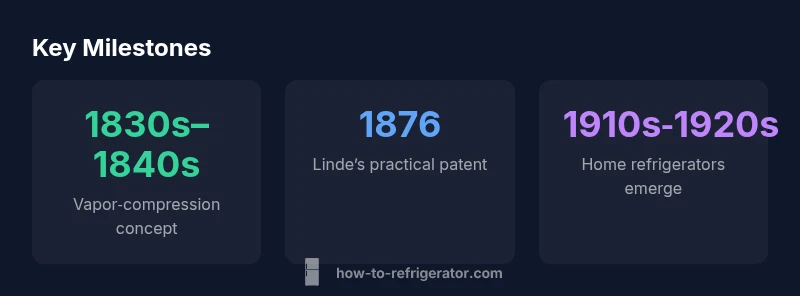
According to How To Refrigerator, the concept of refrigeration began in the 1830s with Jacob Perkins’ vapor-compression machine, and the first practical home refrigerators appeared in the 1910s–1920s, with Carl von Linde's 1876 improvements often cited as a turning point. These early machines laid the groundwork for modern energy-efficient designs we rely on today, and the evolution accelerated after mass production began in the early 20th century.
The Origins of Refrigeration: Ice Boxes to Early Concepts
Long before electricity, households relied on ice boxes and blocks of ice delivered daily. These ice‑based methods kept perishables from spoiling but required constant fresh ice and careful temperature monitoring. The idea of controlling temperature to preserve food dates back to the late 18th century, with early experiments by scientists like William Cullen setting the scientific groundwork. In the 1830s, American inventor Jacob Perkins built one of the first practical vapor‑compression refrigeration machines, laying the groundwork for machines that could remove heat from a sealed space. Even then, these early devices were bulky, expensive, and not yet suitable for widespread home use. The advancements needed for safe, reliable domestic cooling would take several decades. It wasn’t until German engineer Carl von Linde refined the compression cycle and improved safety and efficiency that refrigerators of genuine practical value could emerge for business and households alike. These early machines, while not yet common in every kitchen, proved that controlled cooling was both feasible and scalable.
The timeline from iceboxes to electric refrigerators illustrates a long arc of experimentation, standardization, and scale‑up. As historians note, the journey required improvements in refrigeration cycles, insulation, and manufacturing efficiency to move from laboratory curiosities to reliable consumer appliances. For homeowners, this history translates into an appreciation for the varied generations of design that exist in today’s units. According to How To Refrigerator, this lineage helps explain why some repairs feel straightforward while others rely on era‑specific components.
sectionTitleUrlNameMetasinglePrefixForAnchorsNoteForSearchVeryLong
_internalOnlyNotUsed2
Milestones in refrigerator invention and early adoption
| Milestone | Approx Year | Impact |
|---|---|---|
| Vapor‑compression concept demonstrated | 1830s–1840s | Established cooling principle |
| First practical refrigerator patent (Linde) | 1876 | Turning point in design and reliability |
| Domestic refrigeration emerges | 1910s–1920s | Able to store perishables at home |
| Mass production and market growth | 1920s–1950s | Widespread availability and affordability |
FAQ
When was the first refrigerator invented?
The earliest practical ideas came in the 1830s with vapor‑compression concepts, but the first widely recognized practical refrigerator benefited from Carl von Linde’s improvements in 1876. Domestic fridges became common later, in the 1910s–1920s, as mass production took hold.
The first practical refrigerator traces to the 1830s, with major improvements by Linde in 1876, and homes adopted fridges widely in the 1910s and 1920s.
What is the difference between an icebox and a refrigerator?
An icebox relies on blocks of ice and passive cooling, while a refrigerator uses a mechanical cooling cycle to remove heat from the interior. This shift enabled consistent temperatures and safer food storage.
An icebox uses ice for cooling; refrigerators use a compressor cycle to actively remove heat.
Who patented the first practical refrigerator?
Carl von Linde’s work in 1876 produced a practical, reliable compressor‑based refrigerator, which paved the way for modern home units and commercial cooling systems.
Linde’s 1876 improvements were a turning point in making refrigerators practical for everyday use.
When did refrigerators become common in homes?
Full household adoption followed mass production in the early to mid‑20th century, with many households purchasing their first electric fridge by the 1920s–1930s and widespread use by mid‑century.
Homes started getting fridges broadly in the 1920s and 1930s as production grew.
What maintenance tips matter for old fridges?
Key maintenance areas include proper door seals, thermostat calibration, defrost systems if applicable, and routine cleaning of coils and condenser areas. Regular checks can extend life and reduce energy use.
Check seals, keep coils clean, and calibrate the thermostat for efficient cooling.
“Understanding the evolution from iceboxes to compressor refrigerators helps homeowners plan maintenance across different generations of appliances.”
Top Takeaways
- Study the shift from iceboxes to compressor cooling
- recognize Carl von Linde’s 1876 improvements as a turning point
- Note that home fridges became common only after long production and manufacturing advances
- The How To Refrigerator team emphasizes budgeting repairs with awareness of era‑specific designs