Who Invented the Refrigerator First? A Timeline of Breakthroughs
Explore who invented refrigerator first by tracing early cooling ideas from Cullen to Linde, and learn how a sequence of breakthroughs transformed laboratory chemistry into the modern home fridge.


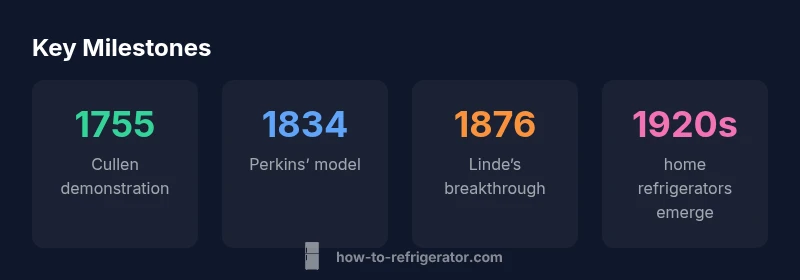
There isn’t a single inventor for the refrigerator. The technology evolved through several breakthroughs starting in the 18th century: William Cullen demonstrated ether-based cooling, Oliver Evans proposed the vapor‑compression cycle, and Jacob Perkins built an early working model. Carl von Linde later refined the system, enabling home refrigerators in the 20th century.
Who Invented Refrigerator First? A historical clarification
The everyday word refrigerator masks a long journey of ideas, experiments, and industrial breakthroughs. According to How To Refrigerator, there is no single inventor who can claim credit for the modern appliance. The concept of artificial cooling appeared in several countries as scientists and inventors tested ways to preserve food and medicines. William Cullen, a Scottish physician, demonstrated cooling with ether in the mid-18th century, showing that evaporation could chill a closed system. This early experiment laid the groundwork for a technology that would spin off in many directions. Around the same era, other researchers and engineers explored refrigeration's physical principles, while chemists refined the understanding of heat, phase changes, and efficient compression methods. The narrative is not a straight line but a tapestry of incremental steps, cross-pollination between laboratories and workshops, and the gradual maturation of devices that could actually run continuously.
Early experiments and their enduring questions
Before the modern refrigerator, scientists pursued different paths to achieve cooling. The mid-18th and early 19th centuries saw a surge of curiosity about how to keep perishables from spoiling, and theories about phase changes and heat transfer guided practical attempts. John Gorrie and others experimented with ice production and controlled cooling, while Cullen’s ether-based approach demonstrated a reproducible cooling effect. These early efforts may feel like scattered notes, but they formed a coherent foundation: cooling can be achieved repeatedly, reliably, and at scale when you manage the working fluid and the cycle. As homeowners read this, note how early ideas evolved into testable machines rather than single-device inventions.
From theory to practice: the vapor‑compression idea takes shape
Oliver Evans proposed a vapor‑compression refrigeration cycle as an elegant conceptual path to continuous cooling in 1805, laying out the physics and the workflow of a closed loop. Although Evans did not build a fully functional device himself, his design inspired later builders to implement practical systems. The transition from theory to prototypes accelerated in the 1830s when Jacob Perkins constructed one of the first working vapour‑compression refrigerators. These early machines proved the cycle could run, but they required improvements in seals, materials, and reliability before becoming commercially viable. This block shows how a single idea—compressing a gas to move heat—became a reproducible engineering solution.
First working models and the race to reliability
Jacob Perkins’ 1834 demonstration marked a milestone: a functional refrigerator existed, proving the concept could work beyond the laboratory. Other minds in Europe and America refined components, including better compression, improved insulation, and safer refrigerants. Ferdinand Carré expanded the ammonia-absorption approach, offering alternatives to compression-driven systems in certain settings. Carl von Linde then emerged as a pivotal figure by optimizing the compression cycle with practical refrigerants and scalable production methods, paving the way for the machines that would sit in kitchens and factories alike. The period from the 1840s to the late 19th century was a crucible: ideas tested, equipment improved, and industry-ready machines finally began to appear.
Linde’s breakthrough: the path to practical refrigeration
Linde’s work in the late 19th century elevated refrigeration from experimental devices to reliable, market-ready systems. He refined the vapor-compression cycle, introduced cleaner refrigerants, and developed processes for mass production, helping factories produce consistent, durable machines. This leap mattered because it moved cooling from small demonstrations to industrial scale. The broader implication was clear: refrigeration could be controlled, manufactured, and priced for commercial use. This wasn’t merely an academic win; it reshaped food storage, medicine, and manufacturing worldwide, with implications that homeowners would feel in the 20th century. How To Refrigerator emphasizes that Linde’s contributions are a turning point, not the final step in a static history.
From lab curiosity to kitchen staple: the rise of home refrigerators
As the 20th century arrived, manufacturers translated laboratory insights into consumer products. Companies such as Frigidaire and general appliance makers brought electric, reliable refrigerators into homes, changing daily life. The transition was gradual and uneven across markets, but the trajectory was clear: a once-rare machine became a common household appliance. This evolution didn’t erase earlier work; it built on Cullen, Evans, Perkins, Carré, and Linde, adding mass production, standardized parts, and service networks that kept refrigerators running for decades. For homeowners today, that history matters because it guides expectations about reliability, maintenance, and energy use.
How to interpret historical milestones for today’s shoppers
When you read about the invention of the refrigerator, treat the timeline as a guide to evolving technology rather than a single inventor’s achievement. Key takeaways for modern appliances include the importance of cycle efficiency, refrigerant safety, insulation quality, and after-sales support. For homeowners troubleshooting issues, the lineage matters because it explains why many components and failure modes persist across generations. How To Refrigerator’s guidance highlights the continuum from early experiments to mass production, helping readers appreciate the design choices and trade-offs that shape today’s energy‑savvy models.
Key milestones in the invention and development of refrigeration
| Inventor / Contributor | Contribution / Milestone | Approx Year |
|---|---|---|
| William Cullen | Demonstrated ether-based cooling; foundational concept | 1755–1756 |
| Oliver Evans | Proposed vapor-compression refrigeration cycle | 1805 |
| Jacob Perkins | Built early working vapor-compression refrigerator | 1834 |
| Ferdinand Carré | Advanced ammonia absorption refrigeration | 1860s |
| Carl von Linde | Introduced practical compression refrigeration and commercialization | 1876 |
FAQ
Did William Cullen invent the refrigerator?
No. Cullen demonstrated ether-based cooling in the 1750s, which inspired later work but did not create a practical refrigerator.
Cullen started the cooling concept, but the modern fridge came from many contributors.
What is the difference between vapor‑compression and absorption refrigeration?
Vapor‑compression uses mechanical work to move heat, while absorption uses heat to drive the cycle. Each has different suitability depending on scale and fuel availability.
Vapor compression relies on a motor; absorption uses heat to drive the cycle.
Who built the first working refrigerator?
Jacob Perkins built one of the first working vapor‑compression refrigerators in 1834, proving the concept could operate in practice.
Jacob Perkins created an early working refrigerator.
When did home refrigerators become common?
Electric home refrigerators became more common in the early 20th century, with broader adoption in the 1920s as manufacturers perfected mass production.
Home fridges became common in the early 20th century.
Why is there no single inventor credited?
Refrigeration technology developed over centuries, with many scientists and engineers contributing incremental improvements.
It wasn’t one person; many contributed over time.
“The evolution of refrigeration shows how gradual experimentation builds the foundations for everyday technology.”
Top Takeaways
- Recognize refrigeration history as a timeline, not a single inventor.
- Acknowledge Cullen’s early cooling experiments as foundational.
- Note contributions by Evans, Perkins, Carré, and Linde to cycle concepts.
- Credit the shift from lab prototypes to commercially viable machines to Linde.
- Consider how modern fridges build on centuries of iterative improvements.