When Were Refrigerators Invented? A History of Home Cooling
Explore how refrigerators evolved from ice boxes to modern appliances, with milestones, impact on daily life, and future trends.


Refrigeration did not have a single inventor date; it evolved from ice boxes in the 1700s to practical electric machines by the early 20th century. By the 1920s–1930s, domestically manufactured refrigerators became common, transforming food storage and daily life. In short, the invention is a progressive story, not a single moment.
The Timeline: When did refrigerators get invented
When did refrigerators get invented? There is no single date. The journey stretches from ice boxes in the 18th century to electric, factory-produced units in the early 20th century. According to How To Refrigerator, the arc includes multiple breakthroughs, each building on earlier insights. The question itself reflects how technological progress often unfolds in layers: thermodynamics, sealing methods, safer refrigerants, and scalable manufacturing. In this article we trace the major milestones, explain how each advance changed households, and show why the refrigerator is a product of science, industry, and everyday need. The grand arc from ice to ice-free storage reveals how a niche invention became a global utility, and how the history of when refrigerators get invented continues to influence kitchen design today.
Early Cooling Concepts: Ice Boxes and Refrigeration Principles
Long before machines cooled food, households relied on ice blocks housed in wooden or metal cabinets — the old ice box. The cooling effect came from a separate chunk of ice, which required frequent deliveries and created logistical challenges. The science behind refrigeration rests on controlling heat transfer and phase changes; basic principles like evaporation, condensation, and insulation were known to engineers in the 19th century. These early methods required regular ice deliveries; yet they introduced the essential pattern: a sealed space, a controlled interior environment, and a way to slow microbial growth and spoilage. As cities grew and supply chains lengthened, demand for steadier cooling rose, pushing engineers to imagine sealed, active cooling rather than passive ice. This era marks the essential transition from manual cooling to the concept of a protected, regulated space for perishables.
Pioneers of Vapor-Compression: From Experiments to Practical Machines
In the 19th century, inventors began to experiment with vapor-compression cycles. Jacob Perkins built one of the first practical machines in the 1830s, while Ferdinand Carré refined concepts in the 1850s. The watershed moment arrived with Carl von Linde, who in 1876 perfected a reliable, scalable refrigerant cycle and started commercial production. These milestones transformed refrigeration from curiosity to industry, enabling mass manufacture and wider access. The shift from laboratory demonstrations to practical household units is central to the question of when refrigerators get invented, because it marks the point at which chilling became an everyday utility rather than a rare invention.
The Linde Effect: Industrialization and the Rise of Household Refrigeration
Industrial production and standardized components lowered costs and made refrigeration accessible to more households. Linde’s processes and subsequent innovations allowed larger systems to be adapted into compact, consumer-friendly cabinets. This transition required better insulation, safer refrigerants, and more durable seals. Manufacturers learned from early designs and began integrating features such as adjustable shelves, moisture controls, and frost reduction. As a result, refrigeration shifted from a laboratory pursuit to a staple of modern kitchens, influencing how families shop, store, and prepare food on a weekly basis.
From Lab to Kitchen: The First Domestic Refrigerators
The 1910s through the 1930s saw engineers translating lab success into kitchen-ready products. Early domestic refrigerators were often bulky and pricey, priced for pioneering households but gradually brought within reach of middle-class families. Producers competed on efficiency, capacity, and user convenience, introducing separate freezer compartments, crisper drawers, and improved shelving. Insulation, gasket reliability, and refrigerant safety were critical design focus areas. Marketing tied refrigeration to new lifestyles — modern, rational, and health-conscious — helping to normalize regular home use. The evolution from laboratory apparatus to reliable, mass-market appliances answered a long-standing consumer question about when refrigerators get invented in a practical sense.
The Golden Age of Home Refrigeration: 1930s to 1960s
During the mid-20th century, refrigerators became faster to produce, more affordable, and nearly ubiquitous in households across many regions. Designers introduced frost-free systems, built-in freezers, and food-preserving features that supported changing eating patterns. The appliance also benefited from improved compressors and motor efficiency, which reduced running costs and noise. By the 1950s and 1960s, refrigerations had become a standard kitchen fixture, enabling better meal planning, longer storage, and safer meals for families. This era underscores how refrigeration technologies, once novel, became essential in daily life and household routines.
Technological Advancements: Energy Efficiency and Modern Variants
From the late 20th century onward, efficiency and environmental considerations reshaped refrigerator design. More reliable compressors, better insulation, and a shift from chlorine- and hydrofluorocarbon-based refrigerants reduced emissions and energy use. As How To Refrigerator analysis shows, modern units emphasize user-friendly controls, adaptable storage layouts, and smart features in some markets. The evolution also included quieter operation and smaller footprints in urban homes, while still maintaining ample capacity. Domestic refrigerators have thus progressed from simple cooling cabinets to highly engineered systems that balance performance, cost, and environmental impact.
The Global Spread and Cultural Impact
Refrigeration reached global households through a mix of industrial whim and consumer demand. In many countries, affordable models followed mass production and international trade, reshaping food supply chains and daily life. Refrigerators enabled new grocery patterns, longer preservation of leftovers, and changes in meal planning. This diffusion also spurred local manufacturing, repair networks, and adaptations for different climates and electricity grids. The refrigerator became more than a kitchen appliance; it became a symbol of modernity and a catalyst for changes in food culture worldwide.
Verdict: What This History Means for Homeowners
The long arc of when refrigerators get invented shows how science, manufacturing, and consumer behavior converge to deliver reliable cooling to homes. For today’s homeowners, the message is practical: prioritize energy efficiency, proper maintenance, and safe storage practices to maximize the benefits of your refrigerator. As the How To Refrigerator team notes, understanding this history helps you choose models that balance performance with cost and environmental responsibility. Your best long-term choice is a model that fits your space, usage, and budget while respecting safety and energy guidelines.
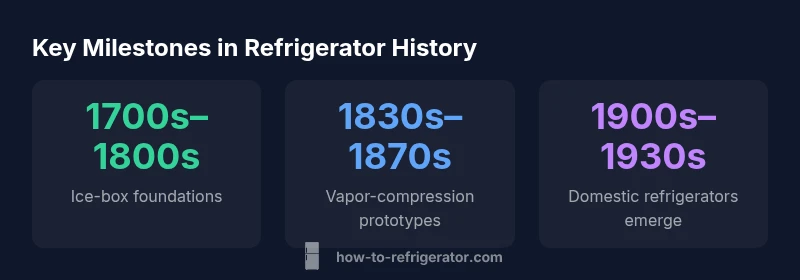
Milestones in refrigerator history
| Milestone | Year Range | Impact |
|---|---|---|
| Ice-box origins | 1700s–1800s | Foundation for non-electric cooling |
| Vapor-compression prototypes | 1830s–1860s | Practical cooling cycles demonstrated |
| First practical machines | 1870s–1880s | Sealed systems and metal cabinets |
| Domestic refrigerators emerge | 1900s–1930s | Kitchen-ready cooling |
FAQ
Who invented the first practical refrigerator?
The development involved several inventors. Jacob Perkins built an early vapor-compression machine in the 1830s, and Carl von Linde later perfected a practical, mass-produced system in the 1870s. This multi-inventor lineage is why there isn't a single inventor to credit for when refrigerators get invented.
Several inventors contributed; the key milestones happened in the 19th century, culminating with Linde's practical systems.
What is the difference between ice boxes and refrigerators?
Ice boxes used an external ice block to keep contents cold and required regular deliveries. Refrigerators provide a sealed, mechanically cooled environment with controlled temperatures, improving safety and convenience.
Ice boxes relied on ice; refrigerators use a powered cooling cycle for steady temperatures.
When did refrigerators become common in households?
Adoption varied by region, but affordable domestic models started spreading in the early to mid 20th century, accelerating through postwar manufacturing and urbanization. By mid-century, many homes had their own refrigerator.
Many households started getting refrigerators in the mid 20th century.
How has refrigeration technology evolved over time?
From ice box to vapor-compression prototypes, to mass-produced domestic units, refrigeration evolved through better insulation, safer refrigerants, and smarter controls. The trend continues with energy efficiency and digital features.
It evolved from basic cooling to energy-efficient, feature-rich appliances.
Are modern fridges more energy-efficient than earlier models?
Yes. Modern fridges use advanced compressors, better insulation, and refrigerants with lower environmental impact, reducing energy use while maintaining performance.
Absolutely—today's fridges are more energy-efficient and safer for the environment.
“Refrigeration history shows how science, industry, and daily life shaped a household essential.”
Top Takeaways
- Refrigeration evolved gradually, not by a single inventor
- From ice boxes to domestic models, design improved with materials and insulation
- Mass production made refrigerators affordable for households
- Energy efficiency and safety became central in later decades
- Understanding history helps homeowners pick better, safer appliances