Is Refrigeration the Same as HVAC? A Clear Comparison
Explore the differences and overlaps between refrigeration and HVAC, with practical guidance for homeowners, maintenance tips, and contractor questions to ensure you hire the right expert for your project.


Refrigeration and HVAC are related yet not the same. Refrigeration focuses on cooling for food preservation using a closed refrigerant loop, while HVAC centers on heating, ventilation, and air conditioning for building spaces. The two share core thermodynamics but differ in scope, components, and typical applications, so use the correct term for your project.
Why the distinction matters
According to How To Refrigerator, many homeowners struggle with the idea that is refrigeration the same as hvac, often because both systems involve heat transfer and cooling. In practice, the terms describe different scopes of work, different regulatory environments, and different maintenance needs. Mislabeling a project can lead to inappropriate quotes, licensing gaps, and unexpected costs. By understanding where refrigeration ends and HVAC begins, homeowners can communicate clearly with technicians, avoid misdiagnosis, and plan effective budgets. This distinction matters not only for repairs, but also for energy planning, safety considerations, and long-term reliability of the appliances and spaces involved. Throughout this guide, we will distinguish refrigeration from HVAC, highlight shared principles, and provide practical steps to determine which professional to hire for a given task. The keyword is is refrigeration the same as hvac, and the answer is nuanced: size, scope, and purpose drive the terminology you should use.
Core definitions
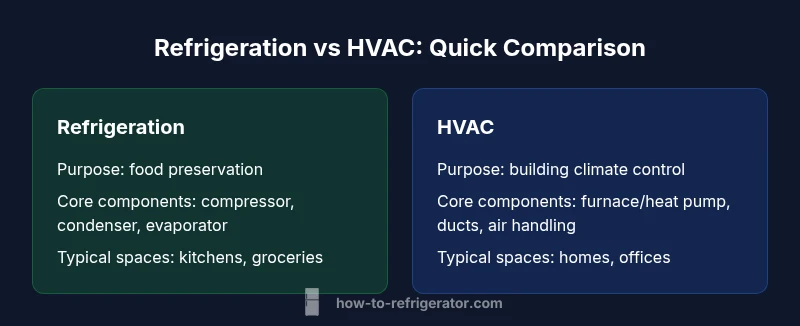
Refrigeration refers to the process of removing heat from a closed system to lower and maintain a temperature, primarily for preserving food, medicines, or perishable goods. A stand-alone refrigerator or freezer uses a closed refrigerant loop, and its primary metric is the ability to achieve and sustain safe interior temperatures. HVAC stands for heating, ventilation, and air conditioning, and it covers climate control for entire buildings or rooms, including temperature, humidity, and air quality. Central air conditioning, furnaces, heat pumps, and air handling units are all part of HVAC. The two share physics—compressors, condensers, evaporators, and heat exchangers appear in both domains—but the scale, safety requirements, and regulatory frameworks differ. For homeowners, the key takeaway is that refrigeration is typically appliance- or food-focused, while HVAC is building-focused, and the two are usually serviced by different specialists. Remember that is refrigeration the same as hvac is a common question, but the practical answer is that they serve different purposes even when thermodynamics overlap.
Shared thermodynamics and design principles
Both refrigeration and HVAC rely on the same thermodynamic cycles, specifically vapor-compression cycles and heat exchange with a refrigerant. The core idea is moving heat from a low-temperature area to a high-temperature sink using mechanical work. In refrigeration, the goal is to keep a compact space at a low, constant temperature; in HVAC, the aim is to control temperature and comfort across larger occupied spaces, often with humidity and air quality considerations. Design decisions common to both include placement of condensers for heat rejection, insulation to minimize losses, and the use of sensors to regulate temperatures. However, the design context differs: refrigeration prioritizes food safety and rapid cycling, while HVAC prioritizes occupant comfort, air distribution, and indoor air quality. For homeowners, recognizing the shared physics helps in understanding why some problems might look similar on the surface but require different inspection approaches and remedies.
Key components and how they differ
Refrigeration systems: main components include a compressor, condenser, evaporator, and expansion device, arranged in a closed loop. These components work together to extract heat from the refrigerated space and reject it to the surrounding environment. In contrast, HVAC systems rely on a building-wide network: furnaces or heat pumps as the heat source, outdoor condenser units, air handling units or ductwork, and an assortment of dampers and filters. The control logic also differs: refrigerators usually use simple thermostats or electronic controls for a single space, while HVAC employs zoning, smart thermostats, and centralized controls to manage multiple rooms and occupant comfort. Not all technicians have equal familiarity with both domains, so understanding the basic components helps you ask informed questions and avoid misquotes or misdiagnoses when hiring.
Applications and typical use cases
Refrigeration is essential for food service, groceries, and any scenario requiring controlled cold or cryogenic environments in a compact footprint. Examples include household refrigerators, stand-alone freezers, and small display cases. HVAC, on the other hand, is the backbone of building climate control: cooling and heating rooms, balancing humidity, and maintaining air quality for comfort and health. In commercial settings, large-scale refrigeration and HVAC may exist side-by-side, but they usually require different teams and systems. A kitchen in a restaurant, for instance, uses refrigeration for cold storage and an HVAC system for the dining and prep areas. In residential homes, you typically deal with a fridge and an HVAC system or heat pump as separate installations, with occasional integration in smaller apartments or condos. The key takeaway is to treat the systems as distinct unless a formal design includes integrated climate-control strategies.
Energy, efficiency, and cost considerations
Energy efficiency for refrigeration focuses on minimizing heat load within a small footprint, controlling refrigerant use, and ensuring doors and seals are tight to prevent energy leaks. For HVAC, efficiency is tied to how well the system handles heat loads across spaces, with attention to insulation, duct design, and variable-speed equipment. In practice, homeowners often notice higher energy costs during peak seasons when HVAC runs more frequently, while refrigerator energy use is relatively constant but noticeable over time due to continuous operation. Both domains offer efficiency upgrades, such as high-efficiency compressors for refrigeration and SEER-rated equipment for HVAC, targeted to reduce energy consumption. However, the best savings come from proper sizing, correct installation, and regular maintenance. Remember: proper terminology helps you select the right energy-saving strategies and contractors.
Maintenance and troubleshooting quick tips
Regular maintenance for refrigeration includes checking door seals, cleaning coils, ensuring proper refrigerant charge (performed by licensed technicians), and preventing ice buildup that can reduce efficiency. HVAC maintenance emphasizes changing air filters, cleaning or replacing coils, verifying airflow, testing refrigerant levels if applicable, and inspecting ducts for leaks. A simple check list can help homeowners identify potential issues early: listen for unusual noises, look for frost around the evaporator, check for warm air from vents, and monitor unusual energy spikes. When in doubt, consult a qualified service professional who specializes in the relevant system. Timely service prevents more costly repairs and protects food safety and indoor air quality.
How to talk to a contractor: questions to ask
When engaging a professional, ask about the scope and boundaries of their work, required licenses, and which standards they follow. Inquire about required equipment, warranty terms, and safety procedures, especially around refrigerants and electrical components. For refrigeration, ask about refrigerant handling, coil cleaning frequency, and recommended door seals. For HVAC, ask about duct sealing, airflow balancing, and zoning. If you’re uncertain whether the job involves food-related cooling or building climate control, request a diagnostic visit to confirm. Clear communication reduces misquotes and ensures you get the right service.
Common misconceptions debunked
One common misconception is that refrigeration and HVAC are the same because both involve cooling. In reality, they address different environments and requirements. Another myth is that all technicians can service both domains equally well; while some may have cross-training, most specialists focus on a primary area. A third misconception is that larger systems automatically deliver better energy efficiency; efficiency depends on proper sizing, installation, and ongoing maintenance. Finally, some people believe home appliances and central systems share the same safety rules; refrigerant handling and electrical requirements differ between a kitchen fridge and a central climate system.
Practical decision framework for homeowners
Start with defining the task: do you need cooling for food preservation or climate control for a building? Then assess scale, location, and safety requirements. Next, identify the right contractor by calling out scope and licensing. Consider whether you need a standalone appliance or a central system, and weigh upfront costs against long-term energy savings. Use a two-step approach: (1) diagnostic visit to confirm which system is involved, and (2) a written plan that outlines installation, maintenance, and warranty expectations. This approach helps you avoid misquotes and ensures you get the right expertise for your project.
Scenarios: choosing between refrigeration and HVAC in mixed-use spaces
In mixed-use spaces such as a kitchen with a large dining area, you may need both refrigeration for storage and HVAC for comfort. Start by separating the tasks and designing a plan that coordinates energy and space. If a remodeling project blurs lines between appliances and building services, bring in specialists who understand both domains and can coordinate installation. This ensures proper safety, compliance, and efficiency. Make sure to budget for both systems appropriately and to communicate clearly with contractors about the exact scope.
Comparison
| Feature | refrigeration systems | HVAC systems |
|---|---|---|
| Definition and primary purpose | Cooling and preserving food via a closed refrigerant loop | Building climate control: heating, cooling, ventilation, and air quality |
| Core components and system layout | Compressor, condenser, evaporator, expansion device | Furnace/heat source, outdoor unit, air handling, ductwork |
| Energy considerations | Focused on cooling load and continuous operation of a single space | Whole-building energy management with zoning and air distribution |
| Maintenance focus | Leak prevention, refrigerant handling, door seals | Air filter changes, duct cleaning, system diagnostics |
| Installation complexity | Often installed as standalone appliances | Integrated into building HVAC systems with zoning |
| Cost range (upfront) | Lower upfront cost for appliances; maintenance varies by model | Higher upfront and ongoing maintenance for whole-home systems |
| Best use cases | Food preservation, small-scale cooling | Residential/commercial building climate control |
Strengths
- Clarifies scope for homeowners and contractors
- Helps prevent miscommunication on projects
- Supports targeted energy-efficiency decisions
- Aids in budgeting by defining system boundaries
Cons
- Overlap and regional terminology can still confuse
- Not all contractors differentiate clearly, leading to misquotes
- Mixed-use projects may require dual expertise
HVAC and refrigeration are related but not interchangeable
HVAC covers building climate control and air quality, while refrigeration targets food preservation and compact cooling. Use precise terminology to guide hiring, budgeting, and maintenance decisions; unexpected cross-overs are possible but uncommon in typical homes.
FAQ
Is refrigeration the same as hvac?
Not usually. Refrigeration is for cooling and preserving food; HVAC provides climate control for spaces. They share thermodynamics but serve different purposes.
Not usually. Refrigeration is for food cooling; HVAC is for building climate control.
Can a home fridge be part of an HVAC system?
No, residential refrigerators operate on a separate closed loop and are not typically integrated into a central HVAC system.
No—your fridge runs its own cooling loop, separate from your home’s HVAC.
What questions should I ask a contractor when considering refrigeration vs HVAC work?
Ask about scope, required equipment, safety procedures, and warranties. Make sure the contractor clarifies whether the job is appliance repair or building-system work.
Ask about scope, equipment, safety, and warranties.
Are there overlaps where a contractor handles both refrigeration and HVAC?
Yes, especially in commercial settings. For homes, prefer specialists to ensure proper licensing and safety.
Yes, sometimes, but for homes it's best to use specialists.
How do energy costs compare between refrigeration and HVAC?
Energy use depends on size and usage; refrigerators run continuously at a small scale, while HVAC draws more energy during hot periods. Efficiency varies by model and system design.
Energy use varies; fridges run constantly, HVAC fluctuates with weather.
When should a homeowner call a professional?
Call a professional for cooling failures, leaks, or unusual noises. If unsure which system is involved, request a diagnostic visit to confirm the scope.
Call a pro for cooling failures or strange leaks or noises.
Top Takeaways
- Define the task before hiring
- HVAC is building-scale; refrigeration targets food safety
- Ask the right questions about scope, not just price
- Engage specialists to avoid cross-wiring issues