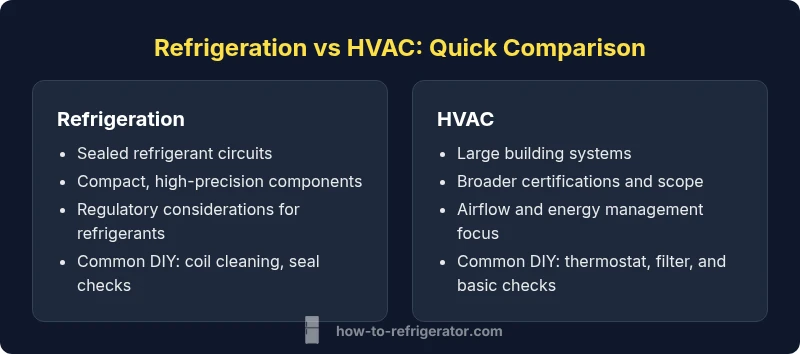
Is Refrigeration Harder Than HVAC? A Homeowner's Comparative Guide
Explore whether refrigeration work is harder than HVAC, with clear, practical guidance for homeowners. Learn core differences, safety, and when to DIY or call a pro in both domains.


Is refrigeration harder than HVAC? In practice, refrigeration repairs demand more specialized handling of sealed circuits and refrigerants, while HVAC covers broader building systems. For homeowners, DIY fixes are usually limited to basic maintenance; serious issues typically require licensed technicians for both fields, but the refrigeration domain tends to be more technically demanding on a per-system basis.
Is Refrigeration Harder Than HVAC? Core Differences
When homeowners ask whether is refrigeration harder than hvac, the answer hinges on system design, safety, and regulatory handling. According to How To Refrigerator, refrigeration systems operate on tightly sealed circuits with refrigerants that must be managed to avoid environmental harm. HVAC systems, by contrast, span a wider array of building needs from air distribution to heat exchange. This difference in scope means the day-to-day repair mindset often shifts: fridge issues tend to be more specialized per unit, while HVAC concerns may involve multiple subsystems within a single home. For the homeowner, this translates into distinct skill sets, tooling expectations, and the types of certifications that look most relevant. How To Refrigerator’s analysis shows that the complexity is real, but not insurmountable when you approach each domain with proper boundaries and safety practices.
Tooling and Access: Why Refrigeration Feels More Specialized
Refrigeration work commonly requires access to compact, high-pressure components and sealed lines. The tools are highly specific: manifold gauges for refrigerant systems, leak detectors, specialty torques for compressor connections, and robust cleanliness standards to avoid contaminating the refrigerant circuit. HVAC toolkits are broader, reflecting larger systems, but refrigeration projects tend to demand more precision in a confined space. Homeowners attempting fridge-level diagnostics should be prepared for microscopic components and the need for leak tests that meet environmental regulations. As a result, the perceived difficulty often rises with the compactness and the risk of refrigerant mishandling, even before considering safety concerns.
Safety, Regulations, and Certification: Refrigerants vs Building Codes
Safety is not optional in either field, but the regulatory framework differs. Refrigeration work frequently implicates refrigerant handling, which is tightly regulated by environmental and occupational safety standards. In many regions, performing repairs with refrigerants requires EPA or equivalent certifications, plus adherence to disposal rules. HVAC work involves electrical safety, combustion safety, and building-code compliance, which can be extensive but is generally codified for broader tasks. For non-professionals, this means recognizing when a refrigerant-related task requires a licensed technician and when standard homeowner maintenance can be safely tackled without triggering regulatory requirements.
Common Home Repair Scenarios: When DIY Is Plausible vs When to Hire Help
Typical refrigerator tasks might include cleaning condenser coils, replacing door seals, or clearing defrost drains. These are often within the reach of capable homeowners with basic instructions and proper safety precautions. In contrast, fridge compressor replacement, refrigerant recharge, or sealed-system diagnostics are high-risk tasks that almost always require a licensed technician. HVAC DIY tends to focus on filter changes, thermostat recalibration, or basic duct cleaning—actions that are more common for homeowners but can still require professional oversight if electrical or refrigerant hazards arise. The divide here is practical: start with simple maintenance, escalate to professional service for anything that involves sealed refrigerant circuitry or building integrity.
System Architecture and Access Challenges: Sealed vs Accessible Systems
Refrigeration units operate on tight, enclosed circuits where access is limited by the appliance’s cabinet design. This means components like the evaporator, condenser, and expansion valve are often difficult to reach without specialized tools or risk of leak exposure. HVAC systems, while large, typically offer easier access to components within service panels and utility rooms. The home technician’s challenge with refrigeration is multiplied by the need to work in tight spaces and to preserve the pristine conditions required for refrigerants. In contrast, HVAC work often centers on air handling and energy management, which, while complex, has more modular access points.
Time, Downtime, and Service Windows for Home Repairs
Refrigeration repairs can lead to extended downtime, particularly if a sealed system requires refrigerant recharge or compressor replacement. Scheduling often depends on parts availability and the complexity of the repair, which can be lengthy if specialized service is needed. HVAC repairs and maintenance might offer quicker turnarounds for common issues like thermostat changes or fan replacements, but weather and occupancy considerations can extend downtime when a building system is involved. For homeowners, understanding expected downtime helps in planning meals, cooling needs, and comfort levels during a service window.
Cost Considerations and Hidden Expenses in Refrigeration vs HVAC
Cost factors differ in meaningful ways. Refrigeration repairs frequently involve refrigerants and sealed-system components, driving up material costs and technician time. HVAC repairs may incur costs related to air distribution, ductwork, or furnace/boiler integration. While both domains can be expensive, refrigeration work often carries a premium for specialized tools, leak detection, and regulatory compliance. Homeowners should budget for diagnostic fees, potential refrigerant charges, and post-repair testing, recognizing that unexpected issues—like a leak or contamination—can escalate costs quickly. When comparing, consider not just the upfront price but the long-term reliability and the risk of recurring issues.
Maintenance vs Repair: Routine Tasks Unique to Refrigeration
Regular fridge maintenance can prevent many failures. Cleaning coils, checking door seals, and ensuring proper door alignment are common, low-risk tasks for homeowners. Refrigeration professionals emphasize keeping drains clear and testing thermostat accuracy to prevent frost buildup or uneven cooling. For HVAC systems, maintenance leans toward filter changes, refrigerant checks, and system balancing. The key distinction is that refrigeration maintenance tends to focus more on per-unit cleanliness and leak prevention in a sealed circuit, while HVAC maintenance emphasizes efficiency and air quality across larger spaces.
Experience Overlaps and Training Paths in Refrigeration and HVAC
There is overlap in foundational knowledge—electrical safety, basic thermodynamics, and diagnostic reasoning—but the path splits quickly. Refrigeration specialists often pursue targeted certifications related to refrigerant handling and sealed-system repair, while HVAC technicians may pursue broader building systems training, including heat pumps, furnaces, and air distribution. For homeowners, recognizing the common ground helps in choosing the right course or apprenticeship: if your interest is fridge-specific issues, seek refrigeration-focused training; if you’re drawn to whole-home climate control, HVAC training is more appropriate.
Case Studies: Typical Failures in Home Refrigeration vs HVAC Troubles
A common fridge failure might be inconsistent cooling due to coil obstruction or thermostat drift, which can often be diagnosed with simple tests and replaced parts. HVAC failures more frequently involve airflow obstructions, thermostat misreads, or heat exchange problems that affect larger portions of the home. In both domains, the root causes often trace to sensor failures, contamination, or refrigerant-related issues. A homeowner’s approach should begin with symptom documentation, followed by safe, staged troubleshooting steps, and timely escalation when the problem touches sealed systems or high-energy components.
Emerging Trends: Smart Refrigeration and Better Recovery Practices
Modern refrigeration increasingly intersects with smart-home ecosystems, enabling remote diagnostics and proactive maintenance alerts. Energy recovery and improved refrigerant management are shaping the industry toward safer, more efficient practices. In HVAC, similar trends emphasize building-wide monitoring and smarter controls to optimize energy use. For homeowners, staying informed about these trends matters because it can influence when to pursue upgrades, what training to seek, and how to plan for future repairs or replacements. Keeping up-to-date with both domains enhances your ability to manage cooling and climate control over time.
Practical Decision Framework for Homeowners: Quick Checks Before Calling a Pro
When assessing whether to tackle a refrigeration issue or HVAC concern, start with simple checks: confirm power to the unit, verify door seals, and listen for unusual noises or leaks. If the symptom points toward a sealed refrigerant circuit, refrigerant leak, or compressor replacement, treat it as a high-risk repair that requires a licensed professional. For HVAC, begin with thermostat settings, airflow checks, and basic safety inspections. Use a decision framework to document symptoms, assess safety risks, and decide on DIY steps vs professional service. This approach minimizes risk and maximizes the chances of a successful, safe repair.
Comparison
| Feature | Refrigeration Repair | HVAC Repair |
|---|---|---|
| Specialized Certifications | Often require refrigerant handling credentials in addition to general repair knowledge | Broader set of building-system certifications; may include electrical and combustion safety |
| System Access and Space | Tight, enclosed appliance circuits; limited access in a cabinet footprint | Larger, modular systems with service panels; more room to work in utility spaces |
| Regulatory and Environmental Considerations | Regulatory compliance focuses on refrigerants and disposal; high emphasis on environmental impact | Code compliance covers electrical, ventilation, and energy use across home systems |
| Time to Diagnose | Diagnoses can be rapid for simple refrigerant or thermostat issues; longer for sealed-system problems | Diagnosis can span multiple subsystems; timing depends on system complexity and accessibility |
| Common Tools | Leak detectors, refrigerant charging equipment, specialty torque tools | Electrical meters, airflow gauges, duct tools, general hand tools |
| Typical Cost Drivers | Part costs for sealed-system components; refrigerants and regulatory compliance add to price | Labor for overall system integration, parts, and potential component replacement; can vary with home size |
Strengths
- Clear scope for fridge-specific maintenance and repairs
- Higher demand for specialized refrigeration skills in dense urban areas
- Stronger focus on refrigerant handling improves safety and compliance
- Easier to source common fridge parts for routine fixes
Cons
- Refrigeration work can be unforgiving due to sealed systems
- Regulatory requirements may complicate DIY efforts
- Fewer entry points for broad home-system flexibility in fridge-only paths
HVAC offers broader career flexibility; refrigeration is more specialized for appliance-level work
Choose refrigeration focus for fridge-specific issues and precise, risk-aware tasks. Choose HVAC for general home climate control and multi-system expertise. Both benefit from certification and professional guidance when dealing with sealed circuits or high-energy components.
FAQ
Is refrigeration repair inherently more difficult than HVAC repair for homeowners?
Generally yes for sealed systems and refrigerant handling, but HVAC covers broader building systems with its own challenges. The difficulty depends on the specific task, access, and safety considerations.
For homeowners, refrigeration repair tends to be more specialized due to sealed circuits and refrigerant handling, while HVAC covers broader systems. The difficulty depends on the task and safety concerns.
What skills overlap between refrigeration and HVAC?
Both require basic electrical safety, system diagnostics, and a methodical troubleshooting approach. Understanding thermodynamics helps in both domains, and many tools overlap for testing and measurement.
Both share electrical safety and diagnostics; thermodynamics knowledge helps in both fields.
Do I need certification to repair a refrigerator?
In many regions, refrigerator repair involving refrigerants requires EPA or regional certifications. Even for non-refrigerant tasks, following local regulations and using licensed technicians for high-risk work is recommended.
Refrigerant-related fridge repairs usually require certification; for safety and compliance, consider licensed help for high-risk tasks.
What tasks can a homeowner perform safely on a fridge or an HVAC system?
Safe DIY fridge tasks include cleaning coils, checking door seals, and clearing drains. For HVAC, changing filters and thermostat checks are common. Avoid sealed refrigerant work or high-voltage repairs unless you’re trained and licensed.
DIY fridge tasks are mostly basic maintenance; avoid sealed circuits without certification.
When should I call a professional for a refrigeration issue?
Call a professional if you detect refrigerant leaks, unusual hissing noises, frost buildup indicating sealed-system issues, or if the problem involves compressor replacement. These tasks require specialized tools and regulatory compliance.
Call a pro for refrigerant leaks or sealed-system failures.
How can I prepare for a refrigeration vs HVAC service visit?
Document symptoms, note any error codes, and list recent maintenance actions. Ensure access to the unit and clear the area for technicians. Ask about required certifications and expected diagnostic steps beforehand.
Document symptoms and prepare access; confirm technician certifications before service.
Top Takeaways
- Define the repair scope early to avoid scope creep
- Check regulatory requirements before refrigerant work
- Start with safe, low-risk DIY tasks and escalate when needed
- Invest in targeted training for the domain you pursue