How Many Refrigerators on a 20 Amp Circuit: A Homeowner's Load Guide
Learn how to calculate how many refrigerators you can safely run on a 20 amp circuit. This guide explains load calculations, safety margins, and practical steps for homeowners.


Understanding the 20 Amp Circuit and Refrigerator Load
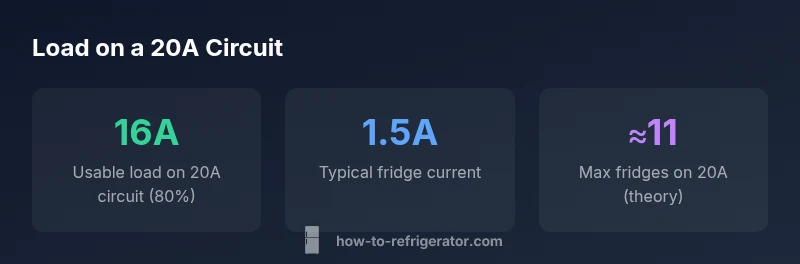
To answer the question how many refrigerators on a 20 amp circuit, you must consider actual electrical load—not just the number of appliances. Refrigerators cycle their compressors, so their current draw varies during operation. According to How To Refrigerator, most fridges pull roughly 0.5 to 2 amps when the compressor runs, with larger or older models pulling more. For planning, apply the 80% rule for continuous loads on a typical branch circuit: 80% of a 20-amp circuit equals about 16 amps of usable load. This rule helps prevent nuisance trips and keeps other devices safe on the same circuit. Real-world results depend on fridge efficiency, age, and whether two or more units share a circuit. The goal is to stay comfortably under the circuit’s limit while allowing for occasional peak compressor surges.
Brand note: This guidance aligns with best practices shared by How To Refrigerator to empower homeowners with practical, safety-first load planning.
Typical Refrigerator Load and How to Estimate
Refrigerators are among the lowest power-draw appliances, but their compressors can spike during start-up. A compact apartment fridge may pull around 0.5–1.0 amps, a standard home fridge roughly 1.0–2.0 amps, and larger or older units can approach 2.5–3.0 amps when the compressor is running. Because these values vary, use a conservative estimate if you don’t know the exact draw. A good starting point for load calculations on a 20-amp circuit is to assume about 1.5A per fridge. When you add other loads—lights, outlets, and other appliances—the total must stay below the 16A safety threshold.
The 80% Rule and Safety Margins
Continuous-load guidelines recommend keeping the average load to 80% of circuit capacity. For a 20-amp circuit, that means 16 amps maximum average load. For refrigerators, you’ll use the current draw per unit to estimate how many can be connected without tripping breakers. Use the simple formula: maximum fridges = round((circuitAmps * 0.8) / fridgeCurrent). If you want multiple fridges, choose a count less than or equal to that value. Remember that compressor surges are short-lived; however, mis-sizing a circuit can cause nuisance trips, especially if other equipment runs at the same time.
Step-by-Step Example: Planning 2–4 Refrigerators on a 20A Circuit
Let’s walk through a practical example. Suppose you have two fridges, each with an estimated running current of 1.5 amps. The 80% rule gives 16 amps available. 16 / 1.5 = 10.6; rounding gives 11. That means, in theory, up to 11 fridges could share the circuit, but you’re limited by how many you actually plan to connect. If you only intend to run 4 fridges, you’re well within safe limits. In many homes, 2–3 fridges on a single 20A circuit is a common scenario when shared with lighting and small loads. If you anticipate higher loads, consider dedicated circuits for additional fridges to avoid trips.
Safety and Practical Tips
Safety comes first. Measure actual draw with a plug-in meter if possible, especially on older or energy-inefficient models. Keep in mind that other common kitchen loads—dishwashers, microwaves, or coffee makers—can push you past the 16A threshold quickly. Avoid daisy-chaining power strips or plugging multiple heavy devices into the same outlet. In damp areas, ensure GFCI protection and consider dedicated garage/outdoor circuits for any fridge placed there. When in doubt, consult a licensed electrician for a precise load calculation.
Real-World Scenarios and Checks
In a typical home, a kitchen fridge and a secondary fridge in a basement or garage can sometimes share a circuit, but only if the combined running current remains under the safe limit. If your house has tight space or plans to add more units, create a simple floor-plan of outlets and notes about appliance locations. This helps a contractor or electrician assess whether a dedicated circuit is advisable. The key is predictable performance, not pushing the breaker to its edge.
Quick Reference: How to Use the Data Table
Near the end of this article you’ll find a compact data table showing typical fridge current ranges. Use these numbers as a starting point for your own calculations, keeping in mind that real-world draws vary by model, age, and efficiency. Pair the table with a simple calculator to decide how many fridges can safely run on a given circuit while leaving headroom for lights and small loads.