Can You Refrigerate Food When It's Warm? Safe Cooling Guidelines
Discover whether you can refrigerate warm foods, why quick cooling matters, and step-by-step methods to keep leftovers safe and flavorful.


Yes. You can refrigerate warm foods, but cool them promptly to avoid dangerous bacterial growth. Use shallow, breathable containers, spread in thin layers, and aim to reach 40°F (4°C) within two hours. If you need to store large amounts, divide into smaller portions and place them where air can circulate.
Why Proper Cooling Matters
When hot or warm foods sit at room temperature, bacteria can multiply rapidly. The window for safe cooling is narrow, and the classic two-hour rule is widely recommended to limit growth and maintain quality. The goal is to bring food from high temperatures to 40°F (4°C) or below as quickly as possible. This reduces toxin production and helps preserve texture, color, and aroma. According to How To Refrigerator, starting the cooling process promptly protects family health and minimizes waste, while science shows that increasing surface area accelerates cooling. Large roasts, stews, and casseroles require segmentation into smaller portions to avoid extended cooling times. By embracing these principles, homeowners can prevent foodborne illness while keeping leftovers tasty and safe for later.
The 2-Hour Rule and Temperature Targets
The two-hour rule is a widely accepted guideline for perishable foods. From a safety standpoint, aim to bring hot items down to 40°F (4°C) or below within two hours of cooking. If you cannot achieve that within the time limit, consider using an ice bath or chilling method to expedite the process. The ultimate objective is to minimize time spent in the danger zone (between about 40°F and 140°F / 4°C and 60°C), where bacteria thrive. By ensuring your fridge is set to a safe temperature and by portioning food into smaller, shallower containers, you can maintain both safety and quality. How To Refrigerator’s analysis highlights the importance of rapid cooling to support home health and reduce waste.
How to Cool Food Safely Before Refrigeration
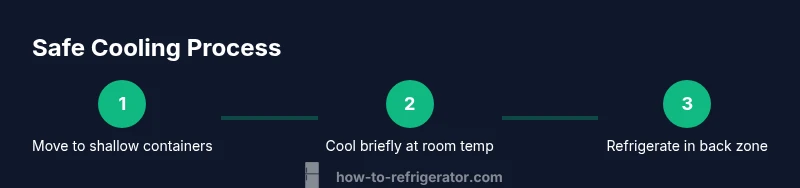
Begin with immediate, practical steps to accelerate cooling. Remove heavy lids on pots to allow air exchange, then transfer hot dishes into shallow, wide containers (about 1–2 inches deep) to maximize surface area. Let the containers sit at room temperature for a brief period—typically 10–15 minutes—so heat begins to dissipate. After this short rest, refrigerate the containers in the back of the fridge where temperatures are most stable. Use an instant-read thermometer to verify that the internal temperature has fallen to around 40°F (4°C) within the first two hours. Finally, avoid stacking containers tightly; give each item room to circulate air for even cooling. These steps, recommended by the How To Refrigerator team, balance speed with safety and help preserve flavor and texture.
Container Choice, Airflow, and Fridge Organization
Container selection matters as much as the cooling method. Use shallow, wide containers made of metal or glass so heat can escape quickly. Lids or wraps are fine, but avoid sealing containers too tightly before the food cools, as trapped steam can slow cooling. Place containers on a cooling rack or a tray to elevate them off the fridge shelves, promoting air movement around each item. Don’t overcrowd the fridge; allow space for cold air to circulate. Organization is key: keep similar foods together, label dates, and place newer items toward the back to ensure you’re always consuming the oldest leftovers first.
Safe Scenarios: Leftovers, Soups, and Large Quantities
Leftovers benefit most from quick, even cooling in shallow containers. For soups and sauces, portion them into 1–2 inch depths and use a wide-mouth container for quick heat exchange. Large quantities, such as roasts or batch-cooked meals, should be divided into several smaller containers rather than stored in one large vessel. If time constraints force you to delay cooling, consider an ice-water bath to drop temperatures before transferring to the fridge. By following these approaches, you minimize the time food spends in the danger zone and maintain safety and quality for future meals.
Signs Your Food Has Cooled Safely and When to Discard
Safe cooling is indicated by a steady drop in internal temperatures to 40°F (4°C) or lower within the two-hour window. If the food remains above 40°F (4°C) after two hours, re-evaluate; re-chill or discard if there are signs of spoilage such as off smells, unusual textures, or mold. Always trust your senses and when in doubt, safety comes first. Remember that reheating does not neutralize all toxins, so prevention during cooling is essential to keep your kitchen safe.
Reheating and Re-serving Leftovers
Reheating leftovers should restore the food to a safe internal temperature, typically 165°F (74°C), and should be done quickly and evenly. Only reheat the portion you plan to eat; avoid reheating the entire batch multiple times. If leftovers have not cooled properly or show signs of spoilage, discard them rather than attempting to salvage flavor. Keeping a consistent reheating process ensures both safety and taste, reducing waste while protecting household health.
Tools & Materials
- Shallow containers (1–2 inch depth)(Metal or glass helps heat escape; lids are optional until the item is cooling)
- Instant-read thermometer(Verify internal temperature reaches 40°F (4°C) within the first two hours)
- Cooling rack or trivet(Elevates containers to improve airflow around foods)
- Timer or clock(Track how long foods stay at room temperature vs in fridge)
- Labels or marker(Date and meal name help with rotation and safety)
- Clean workspace and utensils(Prevents cross-contamination during rapid cooling)
Steps
Estimated time: 2-6 hours total
- 1
Transfer to shallow containers
Move hot foods into several shallow containers (1–2 inches deep) to maximize surface area, speeding cooling. Avoid leaving food in deep pots or bulky vessels.
Tip: Metal containers or shallow glass maximize heat transfer and shorten cooling time. - 2
Cool briefly at room temperature
Let containers rest uncovered for 10–15 minutes on a clean surface to shed initial heat before fridge transfer. Do not leave at room temperature for more than two hours total.
Tip: Keep them away from walls and other heat sources for even cooling. - 3
Refrigerate in the cold zone
Place containers toward the back of the fridge and away from the door, where temperatures are most stable. Do not stack containers tightly.
Tip: Space containers to allow air to circulate freely around them. - 4
Verify internal temperature
Use an instant-read thermometer to confirm each item reaches 40°F (4°C) or below within the two-hour window. If not, split into more containers and chill further.
Tip: Re-check after 20–30 minutes if initial readings are borderline. - 5
Store in small portions for airflow
Keep portions small and spread out so air reaches all surfaces. Label dates to monitor safety and freshness.
Tip: Avoid stacking; this helps maintain uniform cooling across all containers. - 6
Plan for reheating
When ready to eat, reheat leftovers to an internal temperature of 165°F (74°C), preferably using even heat in a pan or oven.
Tip: Only reheat what you will consume in one sitting to prevent repeated heating cycles.
FAQ
Can I put hot soup directly in the fridge?
It’s better to cool slightly before refrigeration, using shallow containers and a brief room-temperature rest to speed cooling. Do not place steaming liquids directly into the fridge.
Don't put hot soup directly into the fridge; cool briefly and use shallow containers to speed cooling.
What is the recommended cooling time before refrigeration?
Aim to bring foods below 40°F (4°C) within two hours of cooking. If this isn’t possible, use rapid cooling methods to reduce time in the danger zone.
Try to bring foods down to 40 degrees within two hours.
Is it safe to refrigerate leftovers after reheating?
Yes. Cool leftovers promptly after reheating and store in shallow containers. Do not leave reheated food at room temperature.
Yes, cool promptly after reheating and refrigerate.
How should large quantities be cooled?
Divide into smaller portions and use shallow containers to speed cooling. Large blocks of food cool slowly and stay in the danger zone longer.
Divide large quantities into small portions for fast cooling.
Does steam mean the food is too hot to fridge?
Steaming food should be cooled to a safe temperature before refrigerating. Let steam dissipate and use practical containers for safe cooling.
Let steam fade and then refrigerate in shallow containers.
How long can leftovers stay in the fridge?
Store leftovers for a few days only, then reheat to a safe temperature before eating. Trust signs of spoilage and discard if questionable.
Use leftovers within a few days and reheat safely.
Watch Video
Top Takeaways
- Cool hot foods quickly in shallow containers.
- Reach 40°F (4°C) within 2 hours.
- Place containers in the fridge’s back zone.
- Avoid tight stacking; ensure airflow around foods.
- Reheat leftovers to a safe temperature before serving.