Can You Put Warm Food in the Refrigerator? A Homeowner's Guide
Learn safe cooling practices for warm foods, how to minimize bacteria risk, and step-by-step tips to rapidly bring hot dishes to safe fridge temperatures while maintaining overall appliance efficiency.


Yes—you can place warm foods in the refrigerator, but you should cool them promptly and use proper methods. Break large portions into shallow containers, aim to bring food to 40°F (4°C) within 2 hours, and avoid overloading the fridge to maintain even cooling.
Can You Put Warm Food in the Refrigerator? Practical guidance for busy kitchens
Many households ask, can you put warm food in refrigerator? The short answer is yes, but it must be done with safe cooling practices to minimize bacterial growth and keep other foods safe. The fastest, safest approach is to start cooling immediately after cooking, use shallow containers to maximize surface area, and monitor the food until it reaches a safe temperature before storage. According to How To Refrigerator, following these cooling steps helps maintain overall fridge health and reduces the risk of cross-contamination while saving time during weeknights.
The science of cooling: how refrigerators handle heat
Refrigerators remove heat from their interior by circulating cold air. When warm food enters, the appliance must work harder, temporarily raising the internal temperature and potentially affecting nearby foods. The key is surface area: the more surface exposed to cold air, the quicker the interior temperature stabilizes. This means opting for wide, shallow containers rather than deep, bulky ones. Proper placement also matters—avoid blocking vents and keep foods away from the door where temperatures fluctuate with every opening.
Safe cooling guidelines: the two-hour rule and practical adaptations
Food safety guidelines emphasize not letting perishable foods linger in the “danger zone” (roughly 40°F to 140°F). If your cooking keeps foods above 140°F, divide portions into shallow trays, then cool rapidly. A common, practical approach is to reduce thickness to 2 inches or less and use an ice bath or fan-assisted cooling for large quantities. Always check temperatures with a food thermometer and ensure the food reaches 40°F (4°C) within two hours, then refrigerate promptly.
How to cool warm foods quickly: a practical step-by-step approach
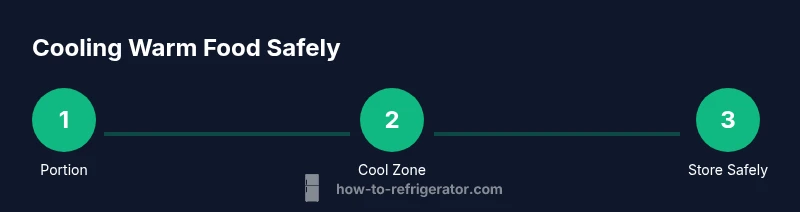
Start with small, shallow portions to maximize surface area. Move the food from hot pans to shallow containers, spread evenly, and place on a cooling rack or in the fridge’s upper shelves. If large quantities, use an ice bath or place containers in front of a cold air flow (not directly under a vent) while stirring occasionally to distribute cooling evenly. Once the internal temperature hits 40°F (4°C) or lower, seal and store. This approach protects quality and safety.
Containers and tools that speed up cooling
Choose shallow, wide containers made of metal or BPA-free plastic. A cooling rack or sheet pan can lift containers so air circulates underneath. A food thermometer helps verify safe temperatures. Optional but helpful: large trays, ice packs, or an ice bath setup for very hot batches. In all cases, avoid leaving food in deep, thick pots that trap heat and slow cooling.
Avoiding common mistakes that slow cooling or invite spoilage
Never place steaming-food directly into a crowded fridge. Do not rely on the fridge door to cool hot batches, as temperature fluctuations can affect stored foods. Avoid stacking hot containers; give air space for proper airflow. Label leftovers with dates and plan to use them within a safe window, and always recheck temperatures before refrigerating again.
Special cases: soups, stews, sauces, and casseroles
Soups and stews cool faster when divided into shallow, wide containers. Thick sauces and gravies benefit from thin layering too. For casseroles, portion into multiple shallow dishes rather than one deep pan. These methods cut cooling times and help maintain overall fridge stability.
When to worry: signs your fridge is struggling after adding warm food
If the fridge seems warmer than usual, or if shelves near the cooling coils feel warm, pause adding more items and check the temperature setting (ideally around 34–40°F / 1–4°C). If temperature hovers inconsistently, contact a repair service to avoid spoilage of other perishables.
Reheating leftovers: safe practices after refrigeration
When ready to eat, reheat leftovers to a minimum internal temperature of 165°F (74°C) for safety, and only reheat what you will consume in a single sitting to avoid repeated cooling and reheating cycles. Store reheated portions promptly and avoid leaving them at room temperature for extended periods.
Tools & Materials
- Shallow, BPA-free containers(2 inches deep or less to maximize surface area for rapid cooling)
- Food thermometer(High-precision probe thermometer; check at multiple points)
- Wide, shallow trays or pans(Metal preferred for quick heat transfer and cooling)
- Ice bath setup (optional)(Large bowl with ice and cold water if cooling large quantities quickly)
- Labels or markers(Date label for storage and use-by guidance)
Steps
Estimated time: 20-45 minutes
- 1
Portion food into shallow containers
Transfer hot food into wide, shallow containers as soon as practical to increase surface area and speed up cooling. Avoid deep pots that trap heat.
Tip: The shallower the food, the faster it cools; aim for 2 inches or less depth. - 2
Begin rapid cooling (if large quantity)
If cooling a large batch, place containers on a tray and position near a cold air source. Use an ice bath for very hot items to drop temperature quickly.
Tip: Stir or rotate containers to promote even cooling and monitor temps closely. - 3
Check temperature within 2 hours
Use a food thermometer to confirm the internal temperature has dropped to 40°F (4°C) or below.
Tip: If still above 40°F after 2 hours, move to a cooler setup or split into more containers. - 4
Refrigerate promptly
Once the food reaches 40°F (4°C) or lower, seal containers and place them in the fridge on the shelves away from raw meats.
Tip: Do not overload the fridge; allow air to circulate around items. - 5
Label and track leftovers
Label with date first stored and plan to use within a safe window.
Tip: Use a first-in, first-out approach for safety. - 6
Plan for reheating safely
When ready to eat, reheat to 165°F (74°C) and only reheat what you will consume in one sitting.
Tip: Discard leftovers if smells or textures look off. - 7
Maintain fridge organization
Keep the fridge at stable temps around 34–40°F (1–4°C) and avoid placing new warm items directly on top of cooled foods.
Tip: Use door shelves for non-perishables to minimize airflow disruption. - 8
Review and adjust habits
Periodically review cooling times, container choices, and fridge performance to maintain safe food handling.
Tip: Small improvements can significantly reduce spoilage risk.
FAQ
Is it safe to put warm food in the refrigerator?
Yes, but you must cool the food within 2 hours and use shallow containers to speed cooling. Keep the fridge organized and avoid placing hot items next to ready-to-eat foods.
Yes. Cool the food quickly, use shallow containers, and keep the fridge organized to prevent spoilage.
What is the recommended cooling time for hot leftovers?
Aim to bring the food to 40°F (4°C) or lower within two hours of cooking, using shallow containers or an ice bath for large batches, then refrigerate promptly.
Target 40 degrees or lower within two hours using shallow containers or ice bath if needed.
Can I use an ice bath to cool food quickly?
Yes, an ice bath is effective for rapid cooling of large quantities. Submerge the containers in ice water and stir occasionally to distribute cooling evenly.
An ice bath works well for fast cooling; keep containers in the ice and stir occasionally.
Should I cover food before refrigerating?
Cover food or store in sealed containers after it has reached 40°F (4°C) to limit moisture loss and prevent odors from spreading. Leave space for airflow when possible.
Cover once cooled to protect against moisture loss and odors.
How can I tell if refrigerated food has spoiled?
Look for off smells, unusual colors, or a slimy texture. If unsure, discard to avoid foodborne illness.
If it smells off or looks different, better to discard.
What temperatures should refrigerators maintain?
Most home fridges should be kept within a safe range around 34–40°F (1–4°C) to keep foods fresh and minimize bacterial growth.
Keep your fridge around one to four degrees Celsius.
Watch Video
Top Takeaways
- Cool hot foods quickly in shallow containers
- Check temps to ensure 40°F (4°C) or lower within 2 hours
- Avoid overloading fridge; maintain good airflow
- Label leftovers and reuse promptly to minimize waste