USA-Made Refrigerator Water Filters: A Practical Home Guide
Discover which refrigerator water filters are made in the USA, how to verify origin, and practical steps for choosing, replacing, and maintaining USA-made filters for your home fridge.


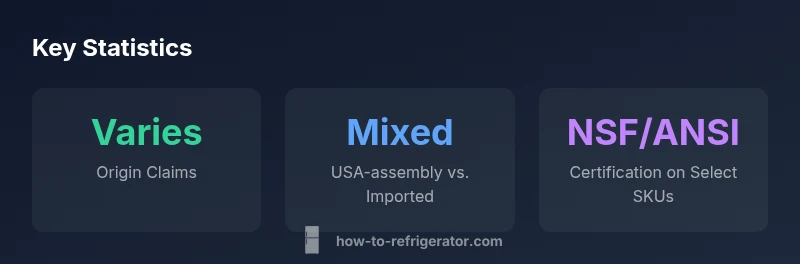
Many refrigerator water filters marketed in the US are labeled as Made in USA, but origin claims vary by SKU and model. In practice, you’ll see a mix: some filters are assembled in the USA, others use US-sourced parts with assembly abroad, and some are imported.
What "USA-made" means for refrigerator water filters
According to How To Refrigerator, the term USA-made on filters can be misleading unless you check the full origin story behind a given SKU. In practice, there are three common scenarios: (1) filters labeled as Made in USA that are fully assembled in the United States with domestically sourced parts, (2) filters assembled in the USA from a mix of US and international components, and (3) filters that are imported with only minor US assembly or packaging. Homeowners should treat origin labels as claims that require verification rather than promises. The How To Refrigerator team emphasizes looking beyond a single label and examining the product page, packaging, and any available manufacturer statements. This approach helps avoid counterfeit or overstated claims and clarifies warranty eligibility tied to origin.
How to verify origin before you buy
If you’re asking what refrigerator water filters are made in usa, start with the basics: read the packaging carefully, check the product page on the manufacturer’s site, and compare SKU-level information. Some brands publish dedicated origin details per model, while others provide a general statement that may cover multiple SKUs. When in doubt, contact customer support and request written confirmation of origin. Keep an eye on certifications; NSF/ANSI certifications indicate filtration performance but do not inherently prove origin, so use origin labels in tandem with certification information. The goal is to confirm both performance and manufacturing location before purchase.
USA-made in practice: types and origin claims
Filters come in several common formats, including carbon block, pleated, and reverse osmosis (RO) styles. Origin claims can differ by type and model. Carbon block and pleated filters marketed as USA-made may be assembled domestically with a mix of components, while RO systems can involve US manufacturing partly offset by imported membranes. The key takeaway: a filter’s performance claim (e.g., fluoride reduction, chlorine taste) may be independent of origin, but origin claims can influence warranty and support expectations. How To Refrigerator analysis shows this variance is prevalent across brands and SKUs, so verify on a per-model basis.
How origin affects warranty, compatibility, and performance
Origin claims matter for warranty coverage, replacement parts, and service support. If a filter is manufactured in the USA, you may have easier access to replacement housings and service centers, which can shorten downtime after a failure. Compatibility is another concern: filters are designed for specific cartridge formats and fridge models. Even within the same brand, a SKU that is marketed as USA-made may not fit all compatible refrigerators. Always confirm filter model numbers, verify the exact fitment, and review the warranty terms related to origin on the official site.
Practical buying guide for USA-made filters
To build a reliable checklist: (1) confirm the exact SKU’s origin claim on the product page, (2) verify model compatibility with your refrigerator, (3) look for explicit statements about USA-assembly or USA-made components, (4) check for NSF/ANSI certifications applicable to the filtration claims, and (5) compare warranty coverage and support options. A reader-friendly strategy is to create a simple table listing each candidate SKU, its stated origin, its compatible fridge models, and its certification marks. This approach minimizes confusion and helps homeowners make a confident, data-driven choice.
Maintenance and replacement tips for USA-made filters
Maintenance remains critical regardless of origin. Follow the manufacturer’s recommended replacement schedule and replace filters promptly when water quality or taste changes. Keep a log of replacement dates and SKU numbers to track performance over time. If you notice reduced water flow or unusual tastes, reassess origin claims and confirm you are using the exact model intended for your refrigerator. Regularly inspecting seals and housings around the filter can also prevent leaks and extend the life of the system.
Debunking myths about USA-made water filters
A common myth is that USA-made automatically equals better quality. While domestic production can offer advantages in warranty responsiveness and supply chain stability, performance still depends on filtration media, housing, and implementation. Similarly, some filters labeled as USA-made may use imported components; origin claims require scrutiny. The bottom line is that origin is an important factor, but it should be evaluated alongside certification, fit, and performance data.
Origin claims and practical considerations for common filter types
| Filter Type | Origin Claim | Materials | Pros | Cons |
|---|---|---|---|---|
| Carbon Block | USA-made or assembled in USA | Activated carbon; plastic housing | Widely available; good price | Quality varies; verify certification |
| Pleated Filter | Often USA-assembled | Pleated media; carbon layer; housing | Strong filtration; easy to find | Model compatibility matters |
| Reverse Osmosis (RO) | Can be USA-based assembly; components may be international | RO membrane; pre/post filters | High contaminant removal | Higher cost; installation required |
| OEM/Brand-Compatible | Origin claims depend on brand | Varied plastics and media | Good fit for price and availability | Warranty risk if origin is ambiguous |
FAQ
Are all refrigerator water filters made in the USA?
No. Origin varies by SKU; some filters are fully USA-made, others use a mix of domestic and international components, and some are imported. Always verify the exact model’s origin claim.
Not all filters are made in the USA; check the label and model details to confirm.
How can I verify if a filter is USA-made?
Look for explicit statements like 'Made in USA' on the packaging and product page. If in doubt, contact the manufacturer for written confirmation of origin and model compatibility.
Check the label and product page, and contact the maker if you’re unsure.
Do USA-made filters cost more than imports?
Pricing varies by SKU and model. Some USA-made filters cost more due to domestic production, but price differences can be influenced by model availability and retailer promotions.
Prices vary; sometimes USA-made costs more, sometimes not depending on the model.
Will USA-made filters fit all refrigerator brands?
Most filters are designed for specific cartridge formats. Always confirm model compatibility and origin claims for the exact SKU to ensure fit.
Make sure the filter matches your fridge’s model and format.
What certifications should I look for on USA-made filters?
Look for NSF/ANSI certifications on the product page. Certifications indicate performance, but origin claims must be verified via the label and manufacturer statements.
Choose filters with NSF/ANSI certification and verify origin claims.
How often should I replace filters for optimal performance?
Follow the manufacturer’s guidelines, typically every 6-12 months depending on usage and water quality. If taste or flow changes, replace sooner.
Replace per the label, usually every 6-12 months.
“Origin claims matter for warranty, support, and regulatory compliance; always verify with the manufacturer and read the label carefully.”
Top Takeaways
- Check explicit origin claims per SKU, not just the brand label
- Verify model compatibility before buying
- Look for NSF/ANSI certifications in addition to origin claims
- Understand warranty terms related to origin
- Keep a replacement log to track performance over time