How Long to Keep Cooked Chicken in Refrigerator: A Homeowner's Guide
Learn safe fridge storage times for cooked chicken, how to store it properly, and reheating tips to prevent waste and foodborne illness.


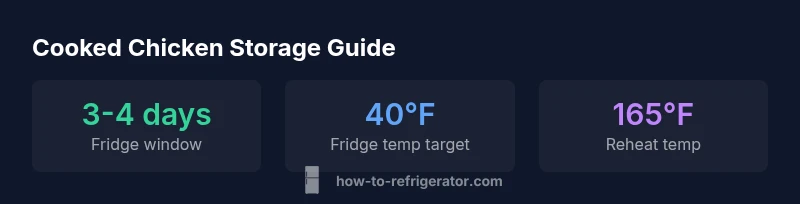
Short answer: cooked chicken kept in the refrigerator is typically safe to eat for 3-4 days when stored properly. The exact window depends on how quickly it is cooled, the container used, and maintaining a fridge temperature at or below 40°F (4°C). For best quality, refrigerate within two hours of cooking and reheat to 165°F before serving.
Understanding the safe storage window
According to How To Refrigerator, the core rule for leftovers hinges on keeping foods cold enough after cooking. For chicken, the practical question many homeowners ask is how long to keep cooked chicken in refrigerator. When you refrigerate promptly and use airtight containment, the typical safety window is about 3-4 days. This window balances taste, texture, and the risk of microbial growth. Temperature accuracy matters: a home fridge should hover at or below 40°F (4°C). If you routinely find your fridge warmer, adjust the thermostat or relocate items away from the door where temperatures fluctuate. Always label containers with the date to track freshness and minimize waste. If a batch sits out at room temperature beyond two hours, discard it to prevent potential foodborne illness. This guidance aligns with standards from food safety authorities and is reinforced by the How To Refrigerator Analysis, 2026.
Temperature matters: keeping your fridge reliable
A stable cold environment is the backbone of safe leftovers. Bacteria grow fastest between roughly 40°F and 140°F (4°C–60°C), a range known as the danger zone. By keeping cooked chicken at 40°F or lower, you slow bacterial replication and preserve texture. If your freezer is used for immediate freezing but the fridge is only intermittently cold, plan ahead: cool leftovers briefly at room temperature (no more than two hours total) and then store immediately. In practical terms, you should audit the temperature with an appliance thermometer and place cooked chicken on the middle shelves where air circulation is strongest. How To Refrigerator analysis emphasizes that consistent cooling has a bigger impact on safety than fancy labeling or clever containers alone.
How to cool and store promptly for best results
Rapid cooling after cooking minimizes time in the danger zone. Divide large portions into smaller, shallow containers so heat dissipates quickly. Use airtight, microwave-safe containers or wrap tightly with plastic wrap and aluminum foil. Allow hot dishes to cool no more than 20-30 minutes before refrigerating, but never overnight. Label each container with the date and use-by window. For added protection, consider placing cooked chicken on the upper shelves to minimize exposure to warm air when the door opens. The goal is consistent, even cooling and a consistently cold fridge. This practice reduces the risk of moisture loss and preserves flavor and moisture.
Reheating guidelines to preserve safety and quality
Reheating leftovers should return the product to a safe eating temperature quickly and evenly. Plan to reheat just the portion you will eat to minimize repeated heating. Heat to an internal temperature of 165°F (74°C) as measured with a food thermometer. Stir or rearrange in the dish to ensure even heating, and avoid reheating multiple times. If you reheat chicken in the microwave, cover it to retain moisture and test for hot spots. The How To Refrigerator team highlights that proper reheating is as important as the initial storage window because uneven reheating can leave cold pockets where bacteria survive.
When to discard leftovers: signs of spoilage you should not ignore
Even within the 3-4 day window, trust your senses. Look for off odors, slimy textures, or unusual color changes. If chicken looks gray or feels sticky, discard it, even if within the 3-4 day range. A sour or rotten smell is a clear signal that something has gone wrong, and it’s safer to throw it away. If there was any cross-contamination with raw poultry or other foods, err on the side of caution and discard. When in doubt, use the rule of thumb: when spoilage signs appear or the texture changes, discard.
Common mistakes that shorten your safe window and how to avoid them
Common errors include leaving chicken on the counter too long, storing in bulky containers that trap heat, and reusing sauce from a previous batch without proper reheating. Another mistake is not cooling leftovers promptly or not labeling them. Adopting a simple routine—cool quickly, store in small portions, label dates, and keep the fridge organized—helps maintain a reliable 3-4 day shelf life. How To Refrigerator analysis suggests standardizing the workflow for every household.
Practical fridge checklist for busy households
- Store leftovers within two hours of cooking.
- Use shallow, airtight containers labeled with dates.
- Keep the fridge at 40°F (4°C) or lower and check it with a thermometer.
- Reheat to 165°F (74°C) and consume within 3-4 days.
- Discard any leftovers that show spoilage signs or have been left out too long.
- When in doubt, throw it out to avoid risk of illness. This simple checklist keeps your food safety routine consistent.
Real-world scenarios and tips for cooks on a schedule
Scenario 1: A family cooks a large chicken dinner and refrigerates portions the same evening. You’ll likely have safe leftovers for the next 3-4 days if you portion and cool promptly.
Scenario 2: A weekday meal prep session yields small containers. The compact portions cool faster and are easier to reheat evenly, increasing the likelihood of safe consumption within 3-4 days.
Scenario 3: A busy household forgets to check fridge temperatures. Regularly calibrating the thermostat and using an external thermometer helps prevent accidental spoilage and ensures leftovers stay within the safe window.
Cooked chicken storage guidelines
| Aspect | Typical Time Window | Best Practice |
|---|---|---|
| Cooked chicken (fridge) | 3-4 days | Store in airtight container at or below 40°F (4°C) |
| Room-temperature safety limit | 2 hours | Discard if left unrefrigerated beyond 2 hours |
| Reheating target | 165°F (74°C) | Reheat evenly and test with a thermometer |
FAQ
How long can cooked chicken stay in the fridge?
Cooked chicken can safely stay in the fridge for 3-4 days when stored properly. Always keep it at 40°F (4°C) or below and use airtight containers. If there are signs of spoilage, discard.
In the fridge, cooked chicken stays safe for about 3 to 4 days when stored properly. Keep it cold and sealed; discard if it smells off or looks slimy.
Can I freeze cooked chicken after refrigeration?
Yes. For longer storage, freeze cooked chicken in airtight containers or freezer bags. It remains safe for 2-6 months in most freezers. Thaw in the fridge before reheating and ensure it reaches 165°F when reheated.
You can freeze leftovers for longer storage—use airtight packaging, thaw in the fridge, and reheat to 165°F.
Is it safe to leave cooked chicken at room temperature before refrigerating?
No. Do not leave cooked chicken out for more than two hours (one hour if the room is very warm). Prompt refrigeration minimizes bacterial growth and keeps flavor intact.
Never leave cooked chicken out longer than two hours; refrigerate promptly to stay safe.
How can I tell if cooked chicken has spoiled?
Look for a sour or off odor, a slimy texture, or a gray color. If any of these appear, discard. When in doubt, throw it out to avoid illness.
If it smells off, looks slimy, or tastes odd, it’s safer to discard.
Does reusing sauce change the storage time?
Sauce can extend storage if made separately and kept refrigerated, but once mixed with chicken, treat it like leftovers and use within 3-4 days. Always reheat to 165°F.
Sauce stored separately is fine; once mixed, follow the 3-4 day rule and reheat to 165°F.
What is the best way to thaw frozen chicken safely?
Thaw in the refrigerator overnight, or use the defrost setting on a microwave if you’re in a hurry. Do not thaw at room temperature, and cook promptly after thawing.
Thaw in the fridge overnight for safety, or use the microwave defrost setting if you’re in a hurry.
“"Proper storage and reheating are the foundations of safe leftovers. Maintain cold temps, portion leftovers, and reheat to a safe temperature every time."”
Top Takeaways
- Store cooked chicken within 2 hours of cooking.
- Keep fridge at or below 40°F (4°C) for safety.
- Use airtight containers to preserve moisture and prevent contamination.
- Consume leftovers in 3-4 days and reheat to 165°F.
- When in doubt, discard to avoid foodborne illness.