How Long Is Cooked Turkey Good in the Refrigerator: A Homeowner's Guide
Learn how long cooked turkey stays safe in the fridge, how to store it properly, and tips to prevent spoilage. Expert guidance from How To Refrigerator.


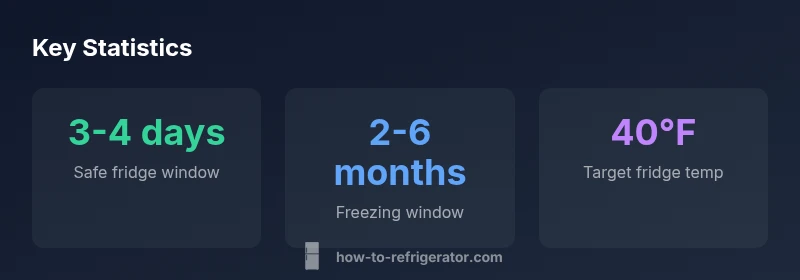
Cooked turkey is generally safe in the refrigerator for 3 to 4 days when stored properly. Keep it at or below 40°F (4°C) in shallow, airtight containers, label with the date, and refrigerate promptly after cooking. For longer storage, freezing is recommended. If you used leftovers in casseroles or sandwiches, ensure total storage time remains within the same window.
Why storage times matter for leftovers
Leftover turkey spares you cooking time, but improper storage invites bacteria growth. According to How To Refrigerator, the fridge slows but does not halt microbial activity. The safe window depends on temperature, packaging, and how quickly you refrigerate after cooking. For most households, the rule of thumb is to chill promptly to 40°F or below and keep leftovers in shallow, airtight containers to maximize surface area for fast cooling. If turkey sits at room temperature for more than two hours, discard the portion. This guidance applies to whole pieces, sliced meat, and mixed dishes containing turkey. Kitchen safety hinges on consistency: treat every batch the same, date the container, and avoid reusing containers that previously held raw poultry, which can contaminate cooked meat. Remember that taste and texture degrade over time, even while the meat remains technically safe.
Temperature basics and how they protect you
Safety starts with temperature. Refrigerators should be kept at or below 40°F (4°C) and freezers at 0°F (-18°C) or colder. Temperature fluctuations, door openings, and crowded shelves can raise risk. Store cooked turkey in shallow containers to reduce cooling time and prevent heat from the center of a chunk from remaining warm. Avoid stacking heavy items on top, which can compress the packaging and affect cooling efficiency. Cross-contamination is another key risk; keep cooked turkey away from raw meats and ready-to-eat foods in separate sections or containers with tight lids. A simple labeling system—date and contents—helps you track freshness and plan meals accordingly.
How long cooked turkey lasts in the fridge
For most households, properly stored cooked turkey remains safe in the fridge for 3 to 4 days. Size and preparation affect this window: sliced turkey cools faster than a large roast and casseroles containing turkey may preserve differently due to added ingredients. If stuffing is inside the turkey, the safe window remains 3-4 days, but stuffing itself can have different safety dynamics depending on moisture and ingredients. Always refrigerate leftovers promptly and use airtight, shallow containers to promote rapid cooling and even temperature distribution. As a rule, when in doubt, err on the side of caution and discard.
Best practices for storage
Effective storage starts at cooking and ends with cooling. Immediately after cooking, portion turkey into multiple shallow containers to maximize surface area and speed up cooling. Use airtight lids or wrap tightly with plastic wrap, then place the containers at the back of the fridge where the temperature is most stable. Label each container with the date and contents. Keep sauces and gravies separately or within clearly labeled compartments. If you anticipate multiple meals from leftovers, consider dividing portions into single-meal packs to avoid repeated reheating of the same general batch.
Spoilage signs and testing
Always inspect leftovers before reheating. Spoiled turkey may emit a sour or ammonia-like odor, show a slimy texture, or exhibit unusual color changes. If any of these signs are present, discard the portion. When unsure, perform a quick sniff test, but never taste-test meat that seems questionable. For safety, rely on time-based rules rather than appearance alone when judging leftovers.
Freezing as an option to extend shelf life
If you don’t plan to eat leftovers within 3-4 days, freezing is a practical option. Freeze in airtight containers or heavy-duty freezer bags, leaving extra space for expansion. For best quality, use within 2-6 months; flavor and texture may degrade over time, especially after the 3-month mark. Thaw safely in the refrigerator or use a cold-water thaw method if you need to accelerate. Do not thaw at room temperature, which can allow rapid bacterial growth.
Reheating leftovers safely
Reheat turkey thoroughly to an internal temperature of 165°F (74°C) before serving. Use even heating and avoid reheating multiple times. If you plan to reheat only a portion, consider reheating in the oven or on the stovetop with a splash of broth to maintain moisture. Resting the meat for a few minutes after reheating helps rediscover tenderness. Always check with a food thermometer to confirm the safe temperature before serving.
Common mistakes to avoid
Common errors include leaving turkey out too long before refrigeration, stacking hot containers in a crowded fridge, and ignoring date labels. Don’t rely on appearance alone; odor and texture can be deceptive. Avoid freezing partially thawed meat, and don’t refreeze leftovers that have already thawed. Finally, keep your fridge organized so you can easily identify which containers are nearing the end of their safe window.
Practical timelines: scenarios
Scenario A: You cooked a Thanksgiving-size turkey and sliced portions into containers on the day of serving. Plan 3-4 days for leftovers, using a single-serve approach to avoid repeated reheating. Scenario B: You made a turkey casserole with gravy and vegetables. Because moisture and other ingredients can influence safety, treat it as a 3-4-day fridge item and consider freezing any extras if you won’t finish within that window.
Troubleshooting and what to do next
If you’re unsure whether leftovers are safe, err on the safe side and discard. For ongoing appliance checks, verify your fridge consistently maintains 34-40°F, and consider keeping a simple log of date-stamped leftovers. If you frequently encounter waste, reevaluate portion sizes or storage methods to improve both safety and quality. Remember: proper storage is often the best defense against spoilage.
Cooked turkey storage guidance in the refrigerator
| Scenario | Fridge duration (days) | Notes |
|---|---|---|
| Cooked turkey (plain) | 3-4 | Keep in shallow containers |
| Turkey with stuffing | 3-4 | Stuffing can alter safety times |
| Deli-sliced turkey | 3-4 | Keep sealed and separate from raw foods |
FAQ
How long can you keep turkey leftovers in the fridge after cooking?
Typically 3-4 days. Store promptly in airtight containers and keep at 40°F (4°C) or lower.
Typically 3 to 4 days; refrigerate promptly in airtight containers.
Is it safe to store turkey in the fridge if it was stuffed?
Stuffed turkey can stay within the same 3-4 day window, but the stuffing section may spoil sooner. Remove stuffing and refrigerate separately if possible.
Stuffing can spoil faster; store turkey and stuffing separately when possible.
What are signs of spoilage in cooked turkey?
Unpleasant odor, slimy texture, or color changes indicate spoilage. Discard any portions showing these signs.
Off smell or slimy texture means it’s time to discard.
Can reheating leftovers multiple times be safe?
Reheat leftovers once to 165°F (74°C). Reheating multiple times increases risk of uneven heating and spoilage.
Reheat once to a safe temp, avoid repeated reheating.
Does fridge temperature affect storage time?
Yes. A consistently cold fridge (≤40°F/4°C) helps maximize safety and quality; fluctuations shorten the safe window.
Keep the fridge cold and stable for best results.
What should I do if turkey was left out at room temperature for more than two hours?
Discard any turkey left out longer than two hours. Bacteria can multiply quickly at room temperature.
If it sat out longer than 2 hours, throw it away.
“Proper labeling and prompt refrigeration are the simplest defenses against foodborne illness.”
Top Takeaways
- Store turkey quickly after cooking to maximize safety
- Label leftovers with date to track freshness
- Keep fridge at 40°F (4°C) or lower
- Freeze portions for longer storage if needed
- Discard leftovers if you notice signs of spoilage or feel uncertain