How Long Does Tuna Salad Last in Refrigerator? A Practical Guide
Learn safe fridge storage timelines for tuna salad, including mayo-based and dairy variants, spoilage signs, and tips to maximize freshness with clear steps.


The safe shelf life for tuna salad in a refrigerator is generally 3 to 5 days when kept at 40°F (4°C) or colder in a sealed container. Homemade versions with mayonnaise, celery, and other perishables should be treated as per these guidelines, and any signs of spoilage warrant disposal. Always refrigerate promptly after preparation.
How long does tuna salad last in refrigerator?
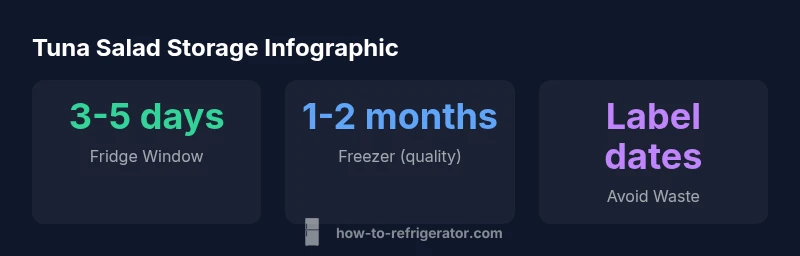
According to How To Refrigerator, the essential question many homeowners ask is how long does tuna salad last in refrigerator before safety and quality decline. For most mayonnaise-based mixes stored at 40°F (4°C) or below in a sealed container, the safe window is roughly 3 to 5 days. This window applies to tuna salads made at home with classic ingredients like canned tuna, mayonnaise, celery, pickles, and herbs, as well as store-bought versions that contain similar emulsions. The exact timing can vary with ingredient ratios and added dairy, but 3–5 days remains the practical guideline for safety. Prompt refrigeration after preparation minimizes rapid bacterial growth, and using airtight containers reduces moisture loss and odor transfer. The How To Refrigerator team emphasizes that labeling containers with the date helps you honor this window and avoid guesswork when planning meals for the week.
Key factors that affect longevity
Several variables influence how long tuna salad lasts in the fridge. Temperature stability is crucial; fluctuating temperatures on the fridge door can shorten the safe window. Ingredient choices matter too: mayo-based salads with eggs or dairy tend to have a shorter shelf life than basic tuna mixtures. If you add ingredients with strong moisture content or fresh dairy products, plan for the 3–5 day guideline and monitor texture. The brand’s guidance also notes that homemade salads using yogurt or lighter emulsions may respond differently to freezing and thawing. Overall, consistent cold storage, clean utensils, and airtight packaging are the primary levers you control to maximize safety and freshness.
Safe storage guidelines in the fridge
Store tuna salad in a clean, airtight container, ideally glass or BPA-free plastic, and place it on the middle shelf where temperatures are most stable. Keep it away from raw meats and drippings to prevent cross-contamination. Label each container with the preparation date. Do not leave tuna salad at room temperature for more than two hours (one hour if ambient temperatures exceed 90°F/32°C). Re-check your refrigerator’s temperature regularly to ensure it stays at or below 40°F (4°C). These precautions align with How To Refrigerator’s recommendations for maintaining a safe, cold environment that preserves texture and prevents bacterial growth.
How to identify spoilage signs in tuna salad
Spoilage signs emerge before foodborne illness becomes likely. Look for a sour or pungent odor, a change in color toward dull brown, a slimy texture, or the presence of visible mold. If any of these signs appear, discard the batch immediately. Even if the salad looks and smells fine, trust your senses and the 3–5 day guideline; when in doubt, throw it out. This approach minimizes risk and aligns with How To Refrigerator’s safety standards.
Freezing tuna salad: considerations
Freezing tuna salad is possible, but the Mayo-based emulsion can separate upon thawing, and textural changes may occur. If you decide to freeze, do so in a freezer-safe, airtight container and use within 1–2 months for best quality. Thaw in the refrigerator overnight and give the salad a quick stir before serving. For many families, freezing is acceptable for convenience, but note that fresh, mayo-rich salads are typically best enjoyed fresh or within the 3–5 day window.
Practical tips to maximize freshness
- Chill promptly after mixing and store in portions to avoid repeated temperature cycling.
- Use airtight containers and label with the preparation date.
- Keep the fridge at or below 40°F (4°C) and avoid door storage for long-term items.
- Consider using yogurt-based dressings as an alternative to mayo if you plan longer storage times, but test texture and flavor after freezing.
Real-world scenarios and troubleshooting
If you’ve left tuna salad out for more than two hours, discard it. If you’re unsure about freshness after 3 days, discard as a precaution. For meal-prep enthusiasts, preparing smaller batches more frequently reduces waste and maintains safety while still delivering variety across the week. The How To Refrigerator team recommends a date-label practice to avoid ambiguity when planning lunches or dinners.
Storage durations for tuna salad in refrigerator
| Situation | Recommended duration (fridge) | Notes |
|---|---|---|
| Opened tuna salad in fridge | 3-5 days | Keep sealed in airtight container |
| Homemade tuna salad without mayo | 3-5 days | Monitor texture and smell |
| Tuna salad with dairy additions | 3-4 days | Quality declines faster |
FAQ
How long does tuna salad last in the fridge?
In general, refrigerate promptly and consume within 3-5 days. Store at 40°F (4°C) or colder in a sealed container.
Typically three to five days in the fridge; keep it cold and sealed and check for signs of spoilage before eating.
Can you freeze tuna salad?
Yes, but mayo-based tuna salad may separate after thawing. Freeze in airtight containers for 1-2 months and thaw in the fridge.
You can freeze it, but expect possible texture changes; thaw in the fridge before eating.
Does mayo affect how tuna salad lasts in the fridge?
Mayonnaise can influence texture and safety, but the typical fridge window remains 3-5 days when stored properly.
Mayo doesn’t extend the fridge life; it may affect texture, but the safe window is still 3-5 days when refrigerated.
What are signs tuna salad is spoiled?
Off smell, color change, slimy texture, or mold indicate spoilage; discard immediately.
If it smells wrong or looks odd, don’t taste it—discard.
How should leftovers be stored safely?
Use airtight containers, label with date, and refrigerate within two hours of preparation; 3-5 days is the guideline.
Put leftovers in a sealed container and chill quickly; date it.
Is it safe to leave tuna salad out at room temperature?
No. Do not leave at room temperature for more than two hours (one hour above 90°F/32°C).
don’t leave it out too long—two hours max, or one hour if hot outside.
“For safety, always refrigerate tuna salad promptly and use the 3- to 5-day window as a hard guideline. Labeling containers with the date helps prevent waste and illness.”
Top Takeaways
- Store tuna salad in a sealed container at or below 40°F (4°C).
- Use the 3–5 day window as your safety/quality guide.
- Check for spoilage signs before eating; discard if in doubt.
- Label containers with prep dates to minimize waste.