How to Check Refrigerator Temperature
Learn how to check refrigerator temperature accurately, troubleshoot thermostat readings, and maintain safe, energy-efficient cooling for your food and drinks at home.


To ensure food safety and energy efficiency, how to check refrigerator temperature regularly is essential. The ideal targets are 37–40°F (3–4°C) for the main compartment and 0°F (-18°C) for the freezer. Use a reliable thermometer placed in the center of the fridge shelf and in the freezer, then adjust the thermostat as needed and recheck after 24 hours.
Why Checking Refrigerator Temperature Matters
Maintaining the correct refrigerator temperature is a foundational step in preventing foodborne illness and reducing energy usage. When a fridge runs too warm, bacteria can multiply on perishable items, leading to spoilage and waste. If it runs too cold, you may waste energy and cause freezer burn or damage to sensitive foods. For homeowners, knowing how to check refrigerator temperature helps you protect health, save money, and extend appliance life. In this guide, we’ll cover practical methods to measure temperature accurately, interpret results, and adjust settings safely. As you explore how to check refrigerator temperature, remember that consistent monitoring builds confidence and ensures safer storage of leftovers, dairy, meats, and produce. How To Refrigerator’s approach emphasizes clear steps you can take tonight.
Related Terms and Concepts
- Temperature gradient: Cold air may settle unevenly; readings can vary by shelf location.
- Thermometer accuracy: Calibrated devices yield more reliable data than generic gauges.
- Defrost cycles: Frequent door openings can impact readings and energy use.
Tip: Use two thermometers if you want compartment-specific data—one for the main fridge and one for the freezer. This helps you see variation and tailor settings to your actual usage.
The Importance of Accurate Readings
An accurate temperature reading is the foundation of safe food storage. In domestic homes, a single unreliable gauge can mislead you into unsafe temperatures or unnecessary cooling, both of which waste energy. Reading the temperature correctly ensures your fridge maintains the ideal zone for freshness while minimizing energy consumption. If you’re learning how to check refrigerator temperature for the first time, keep a log of readings and any adjustments you make. Over time, you’ll recognize patterns related to door usage, ambient room temperature, and loading practices. How To Refrigerator team emphasizes routine checks as part of preventive maintenance.
Tools & Materials
- Digital fridge/freezer thermometer with probe(A thermometer with a thin probe is best for placement in the main compartment and freezer; ensure it has a clearly readable display.)
- Placement accessories (foam or cork spacers)(Optional supports to position the probe away from walls and shelves.)
- Notepad or app for logging(Record readings, times, and any adjustments to track trends.)
- Pen/pencil(For quick note-taking during checks.)
- Access to thermostat controls(Know how to adjust settings safely after testing.)
Steps
Estimated time: 30-60 minutes
- 1
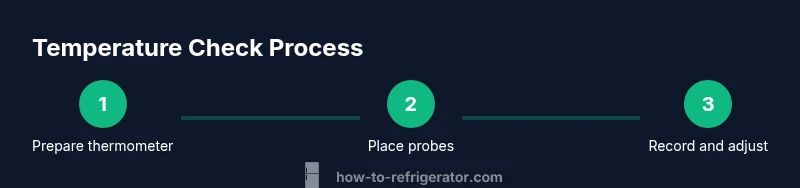
Prepare the thermometer
Unpack the thermometer, ensure the probe is clean, and switch on the device. Calibrate if your model requires it, following the manufacturer’s instructions. This ensures each reading reflects true temperature, not device bias.
Tip: If calibrating, use the ice-water method for a quick check: 32°F (0°C) should read on most calibrated devices. - 2
Place the probe correctly in the fridge
Insert the probe into the center of the main compartment away from the door, shelves, and any crisper regions. Avoid touching walls or gaskets to prevent skewed readings caused by cold air jets.
Tip: Avoid placing the probe too close to the door where warm air enters when opened. - 3
Place a second probe in the freezer
Position the freezer probe in the middle of a shelf, not against the back wall. Freezer temperatures are typically more stable, so a single good reading can be enough if your unit is smaller, but two readings improve confidence.
Tip: If you have a combined unit with shared air pathways, separate readings help catch uneven cooling. - 4
Log initial readings
Wait at least 15 minutes after placement, then record the temperature in both compartments. If your thermometer has a digital display, read both temperatures and note the units (F or C).
Tip: Record the time and whether the doors were opened during the test for context. - 5
Compare against target ranges
Check readings against recommended targets: fridge around 37–40°F (3–4°C) and freezer at 0°F (-18°C). If readings fall outside, plan adjustments and recheck after a short interval.
Tip: Small adjustments can have big effects; make one adjustment at a time and recheck before making another change. - 6
Adjust thermostat if needed and recheck
If the fridge is too warm or too cold, tweak the thermostat by small increments. Wait 12–24 hours and re-measure to confirm stability before concluding.
Tip: Avoid rapid cycling of settings. Give the unit time to settle between changes.
FAQ
How often should I check refrigerator temperature?
Check at least monthly and after power outages or door repairs. Regular checks help prevent spoilage and save energy.
Check your fridge temperature at least once a month or after events like a power outage to keep food safe and save energy.
What is a safe temperature range for the fridge and freezer?
Fridge should be around 37–40°F (3–4°C); freezer should be 0°F (-18°C). These ranges minimize bacterial growth and freezer burn.
Keep the fridge at about 37 to 40 degrees Fahrenheit and the freezer at 0 degrees Fahrenheit for best safety.
What if my temperatures are close but not exact?
Small deviations are common. Make minor adjustments, recheck after 12–24 hours, and monitor trends over several days.
If readings are close but not exact, adjust slightly and recheck in a day or two to confirm stability.
Can door openings affect readings?
Yes. Every time the door opens, warm air can raise fridge temps briefly. Measure after a period of stable use for accurate results.
Door openings can skew readings; test after the fridge has settled with typical use.
Do I need two thermometers for accuracy?
Two probes offer compartment-specific data and improve accuracy, especially in larger or older units.
Using two thermometers helps ensure accuracy for both fridge and freezer compartments.
Watch Video
Top Takeaways
- Check fridge and freezer temps regularly.
- Aim for 37–40°F in the fridge and 0°F in the freezer.
- Use calibrated thermometers for accuracy.
- Log readings and adjust gradually, rechecking after each change.