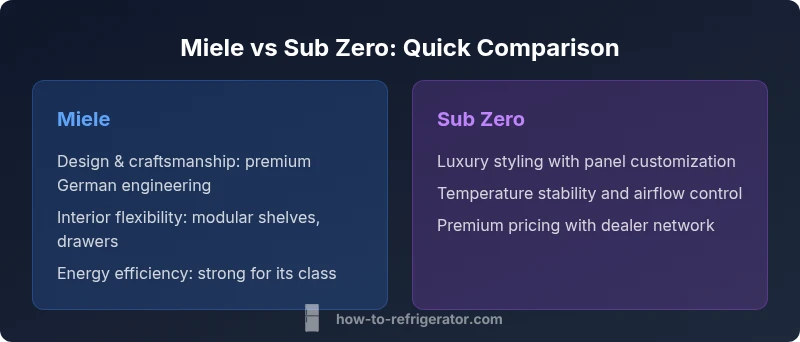
Miele Refrigerator vs Sub Zero: Which Is Best in 2026
An analytical, objective comparison of Miele and Sub Zero refrigerators, covering design, cooling technology, energy usage, interior flexibility, warranty, and price to help homeowners choose the right luxury fridge for their kitchen.


In the debate between miele refrigerator vs sub zero, the best choice hinges on priorities like design, service coverage, and features. This quick comparison highlights build quality, temperature control, interior flexibility, energy efficiency, and price ranges to help homeowners decide which brand fits their kitchen and budget.
Overview: Why this comparison matters
Choosing between premium fridge brands like Miele and Sub Zero matters because kitchen performance blends design aesthetics, reliability, and long-term operating costs. For many homeowners, the decision rests on how much value they assign to premium materials, advanced temperature control, service networks, and the ability to customize interior layouts. According to How To Refrigerator, the luxury segment rewards careful evaluation ofWarranty terms, installation requirements, and overall ownership experience rather than a first-impression feature list. This section sets the stage for a balanced, evidence-driven comparison that avoids hype and emphasizes real-world performance across different kitchen layouts and family needs.
Build quality and materials: lasting impressions
Miele refrigerators are widely praised for German engineering, precise tolerances, and a clean, understated aesthetic that blends with modern kitchens. Sub Zero emphasizes luxury styling—integrated panels, premium finishes, and a broader statement-piece presence. In practical terms, both brands use high-grade components and robust cabinetry, but the user experience differs: Miele focuses on quiet operation, durable interiors, and long-term reliability; Sub Zero focuses on visual impact and modular customization. For a typical homeowner, the choice often comes down to whether you prioritize a restrained, cohesive look or a showroom-worthy design that can be panel-matched to cabinetry. The How To Refrigerator team notes that long-term serviceability can be a differentiator, especially for built-in installations where alignment with cabinetry matters.
Temperature control, humidity management, and freshness features
Both brands aim to maximize freshness, but they approach it differently. Miele emphasizes precise temperature zoning, humidity-controlled drawers, and consistent cooling performance across shelves. Sub Zero emphasizes strict temperature stability, airflow management, and specialized drawers that optimize meat, produce, and dairy conditions. In real-world use, this translates to slightly different user experiences: Miele may excel at uniform performance across a broader range of volumes, while Sub Zero may deliver sharper control for perishable items in high-demand households. Homeowners should consider their typical grocery load, pantry habits, and whether they frequently rely on built-in ice makers or water dispensers, since Sub Zero tends to integrate these features more prominently.
Energy efficiency and operating costs
Energy efficiency is a meaningful factor, but it interacts with size, features, and usage patterns. Miele models often emphasize energy-conscious design relative to their capacity, with efficient compressors and insulation that help keep running costs predictable. Sub Zero, while delivering peak performance, can incur higher energy usage in some configurations due to their larger capacities and luxury features. For homeowners with substantial daily refrigeration needs, a Sub Zero may still be a cost-effective choice if it provides the required performance and resale value. How To Refrigerator recommends evaluating annual electricity use in model-spec sheets and balancing it against capacity and feature sets to estimate true operating costs over time.
Interior design, flexibility, and storage layouts
Interior versatility is a key differentiator. Miele focuses on modular shelves, adjustable humidity drawers, and configurable door racks that adapt to diverse foods and container sizes. Sub Zero extends this concept with more extensive panel customization, deeper drawers, and a broader suite of temperature zones in some lines. For households that regularly host large meals or prep extensively, Sub Zero’s interior engineering can offer tangible benefits in organization and workflow. In smaller kitchens, compact or counter-depth options from either brand can help minimize footprint while preserving usable capacity.
Price, warranty, and service networks
Pricing for premium refrigerators reflects perceived value. Generally, Sub Zero sits at the higher end of the luxury spectrum, driven by brand status, panel customization, and expansive service ecosystems. Miele offers strong value in the luxury segment with solid build quality and strong warranties in many regions, often with shorter delivery times and broader availability across retailers. Acquisition costs are important, but ongoing service quality, installation complexity, and parts availability should drive the decision as much as sticker price. The How To Refrigerator team highlights that a robust service network can significantly reduce ownership friction over a decade of use.
Real-world performance and reliability in daily life
Actual performance often diverges from spec sheets. Users report that Miele delivers quiet operation and consistent cooling with fewer nuisance noises in many installations, while Sub Zero’s performance is frequently praised for its aggressive temperature stability and visually impactful design. Reliability tends to hinge on installation quality and service responsiveness; both brands rely on authorized technicians for optimum results. Homeowners should consider their local service footprint, expected maintenance needs, and whether panel customization or built-in aesthetics are a primary goal. The practical takeaway is to align your expectations with the core strengths of each brand rather than chasing features that won’t be used regularly.
Quick decision checklist: fit, feature set, and future-proofing
Use this compact checklist when narrowing candidates:
- Measure available space, then compare panel-depth and door swing requirements.
- Prioritize interior flexibility if you frequently reorganize shelves or host large gatherings.
- Compare cooling feature sets that support your typical grocery list and storage habits.
- Evaluate warranty length and service accessibility in your region.
- Consider resale value if you plan to upgrade again in the next decade.
Comparison
| Feature | Miele | Sub Zero |
|---|---|---|
| Design & aesthetics | Clean, understated German engineering with cohesive kitchen integration | Luxury styling with panel customization and showroom presence |
| Cooling technology | Precise zoning, even cooling, reliable humidity control | Superior temperature stability with advanced airflow and zone systems |
| Interior flexibility | Modular shelves, adaptable drawers, versatile configurations | Expanded panel options, deeper storage, multiple drawers |
| Energy efficiency | Strong efficiency for its class, strong insulation and compressor design | High performance but often with higher energy use in some configurations |
| Warranty & service | Broad service network; strong regional support | Premium warranty options with extensive dealer networks |
| Price range / value | Premium pricing, excellent resale value potential | Highest price tier, premium branding and features |
Strengths
- Long-term reliability and strong resale value
- Thoughtful interior design and flexible storage
- Excellent build quality and lasting materials
- Strong service networks and brand support
Cons
- Higher upfront cost compared to mainstream brands
- Features may be more than needed for casual users
- Longer lead times for installation in some regions
Sub Zero excels for luxury styling and peak cooling control, while Miele offers solid reliability and balanced value.
Choose Sub Zero if you want a designer appliance with top-tier performance and are willing to pay a premium. Choose Miele if you value durable build quality, efficient operation, and a strong service network at a comparatively more accessible price point.
FAQ
Which brand tends to be more energy-efficient overall?
Both brands offer strong efficiency within their flagship lines, but Miele often emphasizes efficient designs for its capacity. Sub Zero prioritizes performance, which can result in higher energy use in some configurations. Your choice should consider typical usage and kitchen size.
Both brands are efficient, but if energy use is your main concern, start with Miele and compare models that match your capacity needs.
Is Sub Zero worth the premium over Miele for a typical kitchen?
Sub Zero delivers luxury aesthetics and peak temperature control, which may be worth the premium for some buyers. For many households, Miele provides excellent reliability and features at a lower premium, delivering better value overall.
Sub Zero is worth it if you value luxury and top-tier temperature control; otherwise, Miele offers strong value with reliable performance.
Do installation requirements differ between the brands?
Both brands typically require professional installation, especially for built-in or panel-ready configurations. Proper alignment with cabinetry and venting is essential for optimal performance and appearance.
Yes, professional installation is key for both, especially for built-in setups.
Which brand holds better resale value?
Sub Zero often commands strong resale value due to its luxury status, while Miele also maintains solid value through durable construction and brand reputation.
Sub Zero can retain higher resale value in luxury markets; Miele remains solid for long-term value.
Can both brands be panel-ready and customized to match cabinets?
Sub Zero offers extensive panel customization in many lines, while Miele provides panel options in select models. Check model availability and installation requirements for your exact cabinet style.
Panel customization is available, especially with Sub Zero; confirm with your dealer for Miele options.
What should I consider if my kitchen space is compact?
Measure depth and door swing carefully and look for counter-depth options. Both brands offer compact or built-in solutions, but space constraints will drive configuration choices and airflow clearance.
Measure carefully; both brands have space-conscious options, but plan for proper door clearance.
Top Takeaways
- Prioritize interior flexibility if you host frequently
- Consider service networks as a long-term cost factor
- Weigh panel customization against kitchen aesthetics
- Balance upfront cost with resale value and warranties
- Inspect installation space carefully to avoid fit issues