Can You Buy a Refrigerator Without an Ice Maker? A Practical Guide
Explore whether you can buy a refrigerator without an ice maker, understand trade-offs, price ranges, energy use, and buying tips to pick the right model for your home.


Yes. You can buy refrigerators without built-in ice makers. Non-ice-maker models are common in budget lines and compact sizes, offering lower upfront costs and simpler water-free operation. They suit kitchens with limited water access or a preference for tray-based ice storage. They still provide reliable cooling and frost-control, but you'll rely on ice trays or external ice solutions.
Brand context and buying landscape
According to How To Refrigerator, the decision to buy a refrigerator without an ice maker hinges on how much you value upfront cost, water supply planning, and maintenance simplicity. In 2026, the market still offers a broad mix of non-ice-maker options, especially in compact and budget lines. Appliance vendors frequently emphasize ice-makers as a standard feature, but the absence of one can be a deliberate design choice to save space or to fit apartments with limited water access. The How To Refrigerator Team notes that many homeowners find tray-based ice storage perfectly adequate, while others upgrade to external ice makers or water dispensers to preserve convenience. When evaluating models, consider how often you actually use ice and whether a separate system would fit your kitchen workflow. This framing helps you compare models on value rather than feature count.
How to read product listings for non-ice-maker models
When you search for refrigerators without ice makers, listings will often label them as “ice-maker-free,” “no ice maker,” or simply omit ice-making components in the feature list. Look beyond marketing terms and verify in the specifications: check the “Ice Maker” row, the energy label, and the freezer configuration. Some brands offer detachable ice-storage accessories as standalone options, which may be listed as add-ons rather than built-in features. If a listing is vague, check the product manual or retailer Q&A. For apartment dwellers or homes with limited water access, note whether a water dispenser is present independently of an ice maker—this is common in certain non-ice-maker configurations.
Size, layout, and capacity considerations
Non-ice-maker refrigerators come in compact, standard, and larger formats. In compact models, you trade ice-making capability for floor space, which is ideal for small kitchens, offices, or break rooms. In standard and larger formats, pay attention to door swing, interior layout, shelf adjustability, and freezer space. A common trade-off is a smaller ice-making area, but you may gain more adjustable shelving, better door storage, and easier maintenance. Capacity is not just cubic feet; consider how you’ll organize groceries, frozen items, and beverage storage. If you regularly host guests or batch-freeze, plan for a freezer that accommodates bulk items without forcing you to overpack the refrigerator compartment.
Pros and cons of non-ice-maker fridges
Pros include lower upfront cost, fewer moving parts that could fail, and simpler maintenance. They’re often more compact, which can save space in smaller kitchens or apartments. Cons include the need to manage ice strategically—either via trays, external ice-makers, or occasional ice delivery—and potential impact on convenience for households that rely on constant ice access. Consider how often you use ice and whether a removed feature aligns with your lifestyle. For some buyers, the reduced maintenance burden and price are worth the trade-offs; for others, consistent access to ice is a non-negotiable.
Price range and total cost of ownership
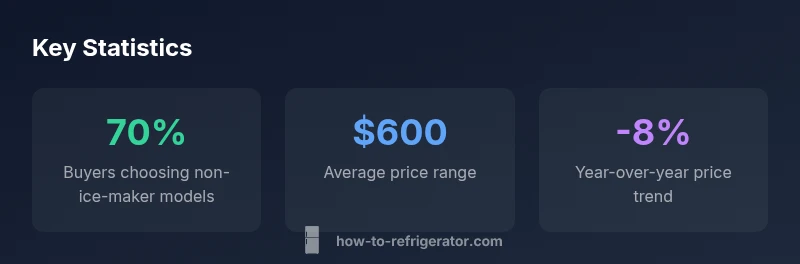
Prices for non-ice-maker refrigerators vary by size, style, and energy efficiency. As a general guide, smaller units aimed at apartments or studios commonly fall in the $400-$700 range before tax and delivery. Mid-size models with upgraded energy efficiency typically land around $700-$1,100. Larger or premium non-ice-maker options can approach $1,100-$1,800, especially when paired with advanced features like touch controls or smart connectivity. These figures are approximate ranges based on the 2026 market and reflect typical promotions. If you’re on a strict budget, look for models with a simple control panel, standard shelves, and a frost-free system to minimize maintenance costs over time.
Energy efficiency and long-term costs
Non-ice-maker fridges can be highly energy-efficient, particularly in compact formats where efficiency and compact design yield strong energy stars. Even without an ice maker, look for Energy Star certification, good door seals, and proper insulation. Over the life of the appliance, energy savings compound, especially if you replace an older, less efficient unit. If you intend to minimize energy use further, compare annual energy consumption labels and prioritize models with efficient compressors and smart defrost features. These considerations help estimate long-term operating costs and align your purchase with energy goals.
Ice-management options if you skip the ice maker
If you skip the internal ice maker, you still have practical options to keep ice handy. Use large freezer trays, a compact freezer ice maker kit, or an external countertop ice maker that connects to a tray. Some households opt for a small freezer dedicated to ice storage or for buying ice in bags during peak months. For beverage-centric homes, a water dispenser that doesn’t require an internal ice maker can provide convenience without increasing the footprint of the refrigerator. Evaluate which approach best fits your kitchen layout and daily routines.
Buying tips: what to check before you buy
Create a simple pre-purchase checklist: verify the absence of an ice maker in the product specs, confirm energy efficiency, measure door openings to ensure fit, and assess interior layout for shelf adjustability. Check frost-free operation and whether the freezer compartment has sufficient space for your typical frozen items. Look for solid warranty terms and accessible parts in case you need maintenance in the future. Finally, read reviews focusing on reliability and long-term performance, since non-ice-maker models can vary by line and region.
Could you retrofit or upgrade later? A practical note
Some buyers wonder if they can retrofit an ice maker later. In practice, retrofitting a built-in ice maker is highly model-dependent and may require an entirely new door or interior redesign. If ice access is essential, consider purchasing a model that offers a compatible external ice-maker option or a future upgrade path. Always check with the retailer or manufacturer about upgrade compatibility before purchase to avoid surprises. If you decide mid-stream that ice is a must-have, you can explore standalone ice-makers or a small freezer solution to expand capacity and maintain flexibility.
Comparison of non-ice-maker refrigerator options by size
| Model Type | Ice Maker Included | Approx. Price Range | Energy Rating | Notes |
|---|---|---|---|---|
| Compact Under 20 cu ft | No | "400-800" | "Energy Star" | Ideal for small kitchens and apartments |
| Standard 20-25 cu ft | Optional | "600-1000" | "Energy Star" | Balanced size with good shelving |
| Large 26-30 cu ft | Usually yes | "800-1200" | "Energy Star" | Family-friendly capacity |
FAQ
Is it cheaper to buy a fridge without an ice maker?
Yes, non-ice-maker models typically cost less upfront due to fewer components. Long-term costs depend on usage patterns and ice storage solutions.
Yes. Non-ice-maker models usually cost less upfront; consider long-term costs tied to ice storage and maintenance.
Do non-ice-maker fridges have water dispensers?
Many do not include a built-in water dispenser. Some offer external water options or separate dispensers, so verify the exact configuration in specs.
Most non-ice-maker fridges don’t include a water dispenser; check the model specs for your setup.
Can I add an ice maker later?
Retrofits are rarely straightforward and depend on the model. It’s usually better to choose a model designed with future upgrade paths or add an external solution.
Retrofits aren’t common; if ice is essential later, consider an external option or a model with upgrade paths.
Are non-ice-maker fridges quieter?
They can be slightly quieter due to fewer moving parts, but overall noise levels depend on compressor design and age.
They can be a bit quieter, but it depends on the compressor and overall design.
What should I check for energy efficiency?
Look for Energy Star certification, good door seals, and proper insulation. Compare labeled annual energy consumption across models.
Check Energy Star rating, seals, and insulation, and compare annual energy use.
Where can I buy non-ice-maker refrigerators?
Major retailers and online marketplaces offer non-ice-maker fridges. Use filters like 'no ice maker' or inspect product specs carefully.
Major retailers and online shops carry non-ice-maker fridges; search for no-ice-maker options.
“"Non-ice-maker refrigerators deliver solid cooling performance with fewer moving parts, making them a smart choice for budgets and compact kitchens. The key is aligning features with your daily ice needs."”
Top Takeaways
- Evaluate your ice needs before buying to choose non-ice-maker vs. ice-maker models
- Compare price ranges across sizes to find real value
- Prioritize energy efficiency to minimize long-term costs
- Plan ice storage or external options if you skip the built-in ice maker
- Check compatibility and warranties before upgrading features later