When Was the Refrigerator Invented? A Historical Timeline
Trace the refrigerator's invention from 18th-century cooling experiments to modern energy-efficient kitchen appliances. Explore key milestones, inventors, and how this evolution shaped food safety and daily life.


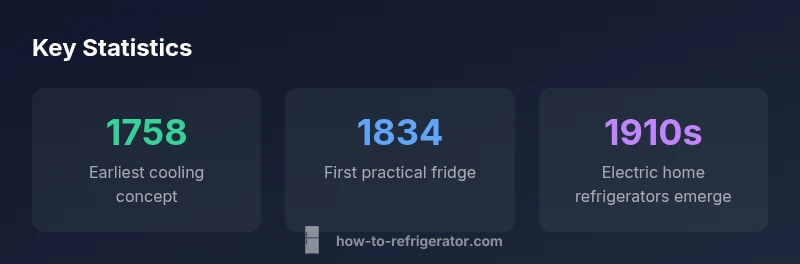
The refrigerator’s history begins with mid-18th‑century cooling experiments, with a practical vapor‑compression fridge built in 1834 by Jacob Perkins, and electric home models appearing in the 1910s—becoming common in households by the 1930s. This timeline shows the move from theory to a reliable kitchen appliance. Understanding these milestones helps homeowners appreciate modern efficiency and food safety standards.
Origins of artificial cooling
When addressing the question when was the refrigerator invented? it helps to trace the origins of artificial cooling. In the mid-18th century, researchers like William Cullen demonstrated that cooling could be achieved in a closed system through evaporation. Although the apparatus was experimental and not a consumer appliance, it established the scientific principles behind refrigeration. In the following decades, inventors experimented with ice-making machines, natural cooling methods, and early compressed-air techniques. These early efforts weren't practical for households, but they established the foundation for later engineers to translate theory into machines. By the late 18th and early 19th centuries, innovators began designing closed-loop systems that compressed refrigerants and circulated them through sealed circuits. The modern question of when the refrigerator was invented is really a timeline: a sequence of breakthroughs that gradually moved cooling from laboratory demonstrations into kitchens worldwide.
From experiments to practical machines
The leap from curiosity to a working refrigerator occurred in 1834 when American-born inventor Jacob Perkins built a practical vapor-compression refrigerator. His design used a closed cycle where a volatile liquid evaporated in a low-pressure chamber, absorbing heat, and was condensed back into a liquid under pressure. This concept—evaporation cooling driven by a compressor—became the essential mechanism behind nearly all later refrigerators. In the 19th century, other researchers refined cycle efficiency, improved seal integrity, and tested safer refrigerants, gradually turning a lab demonstration into viable machinery. While Perkins's device was large and experimental, it proved that a household-scale machine was technically feasible. The broader story of refrigeration thus moves from novelty to necessity as engineers solved issues of leakage, reliability, and material compatibility that limited early prototypes.
Industrial milestones and the Linde era
The next major shift happened with Carl von Linde's ammonia-based refrigeration process in the 1870s. Linde's machines made large-scale refrigeration practical for industries such as breweries and meat packing, demonstrating that compression refrigeration could operate reliably in harsher conditions. This industrial success created the demand for more compact, safer systems, and the scientific understanding of heat exchange, compression ratios, and refrigerant purity expanded rapidly. The dissemination of ammonia-based cycles laid the groundwork for later domestic models, because the same thermodynamic principles apply at smaller scales. By the end of the 19th century, engineers were drawing on these industrial innovations to design enclosed, safer, and more efficient units that could fit into urban homes. The transition from industrial icehouses to modern refrigerators was not instantaneous, but the underlying thermodynamics were clearly established.
Home refrigerators enter the market
The early 20th century marked the first real wave of electric home refrigerators. The first electric refrigerators designed for households appeared in the 1910s, with manufacturers experimenting with motorized cooling and sealed cases. In the 1920s and 1930s, improvements in manufacturing, cost reduction, and general consumer acceptance propelled refrigerators from novelty to staple appliance in many middle-class homes. The shift coincided with changes in food packaging, urban living, and the rise of grocery chains that relied on reliable cold storage. It's worth noting that adoption varied by region and income, but the overall trend showed a rapid expansion of home refrigeration as electricity became more widely available and manufacturing scaled up.
Design evolution and refrigerants
As refrigerators moved into homes, designers faced challenges beyond cooling performance. The mid-20th century introduced new refrigerants and materials, improving safety and efficiency. Early refrigerants used ammonia and sulfur dioxide in industrial settings; later, halogenated compounds became common in household units. The choice of refrigerant affected environmental impact, odor, and leakage risk, prompting regulations and phased transitions as scientists and policymakers sought lower global warming potential. In parallel, engineers improved insulation, door seals, and interior organization to maximize energy efficiency. These design refinements lowered operating costs for households and reduced waste by extending shelf life. The story of when refrigerators became mainstream hinges as much on energy efficiency and safety as on raw cooling power.
Energy efficiency and modern features
From the 1970s onward, energy efficiency standards and consumer demand pushed manufacturers toward more efficient designs. Modern refrigerators commonly feature inverter compressors, smart controls, and improved insulation. The transition to eco-friendly refrigerants—aligned with environmental protection goals—further shaped product development. Today, many units include energy-saving modes, digital dashboards, and connectivity that enables remote monitoring. For homeowners, this means lower electricity bills and more reliable temperature control. The evolution of energy efficiency is a key reason the refrigerator remains a core kitchen appliance, and it is a major factor in influencing purchase decisions.
Global adoption and cultural impact
Adoption of refrigeration varied across regions, climates, and infrastructures. In colder regions, iceboxes persisted longer in households, while warm climates accelerated the uptake of modern refrigerators. The spread was influenced by electricity access, urbanization, and consumer education about safe food storage. Refrigerators not only kept food fresh; they also altered cooking habits, grocery shopping patterns, and even meal planning. The global history of the refrigerator is thus as much about technology as it is about shifts in daily life, commerce, and public health outcomes.
The science behind why refrigerators work
At its core, a refrigerator relies on a closed-loop thermodynamic cycle. A compressor raises the pressure of a refrigerant, forcing it to move through a condenser where heat is released to the surroundings. The refrigerant then passes through an expansion device and evaporator, absorbing heat from the interior and cooling the space. The cycle repeats, maintaining temperatures that slow bacterial growth and preserve perishables. While the physical hardware has evolved—more efficient compressors, better insulation, and smarter controls—the fundamental physics remains constant: moving heat from a low-temperature zone to a higher-temperature environment using work. Understanding this helps explain why the refrigerator is feasible and how improvements in materials and controls translate into real-life energy savings.
Looking ahead: the future of home refrigeration
The future of household cooling centers on energy efficiency, refrigerant safety, and smarter integration with other home systems. Innovations like variable-speed compressors, tighter insulation, and adaptive temperature management promise to reduce energy use while maintaining food quality. Researchers continue to explore alternatives to traditional refrigerants, aiming for lower environmental impact without compromising performance. The ongoing evolution of the refrigerator reflects broader trends in sustainability, digital intelligence, and user experience, underscoring why this appliance remains central to modern kitchens.
Historical milestones that bridged theory and everyday kitchen use
| Era/Representative Model | Key Feature | Impact on Home Life |
|---|---|---|
| Cullen's cooling demo (1748/1758) | Evaporation cooling | Laid groundwork for artificial cooling |
| Perkins' vapor-compression fridge (1834) | Vapor-compression cycle | First practical refrigerator |
| Linde ammonia system (1876) | Industrial compression | Industrial-scale refrigeration groundwork |
| Electric home refrigerators (1910s–1920s) | Electric motor cooling | Made home refrigeration common |
FAQ
When did the first practical refrigerator appear?
Jacob Perkins built the first practical vapor-compression refrigerator in 1834. It demonstrated that a working, household-scale cooling machine was technically feasible, though early models were large and experimental.
Jacob Perkins built the first practical vapor-compression refrigerator in 1834, proving household-scale cooling was possible.
Who invented the refrigerator?
There wasn't a single inventor. The refrigerator emerged from a sequence of contributions, including William Cullen in the 1750s, Jacob Perkins in 1834, and Carl von Linde in 1876, each advancing the science and engineering of cooling.
Many inventors contributed over time, culminating in modern refrigeration.
Why is refrigeration important in households?
Refrigeration slows bacterial growth and preserves food, reducing waste and enhancing food safety for everyday meals.
It slows bacteria and helps keep food safe longer.
How did refrigerators evolve after the 1950s?
Postwar improvements focused on energy efficiency, better insulation, and safer refrigerants, with features like automatic defrost and improved seals becoming common.
Postwar upgrades made fridges more efficient and easier to use.
What are modern trends in fridge technology?
Current trends include inverter compressors, smart controls, and refrigerants with lower environmental impact.
Expect smarter controls and eco-friendly refrigerants.
Where can I read more about refrigerator history?
Look to credible sources from major publications and government energy sites for a detailed history of cooling technology and policy.
Check credible sources from major publications and energy sites.
“Refrigeration history is a timeline of scientific progress meeting practical engineering. Each milestone tightened control over temperature and food safety in homes.”
Top Takeaways
- Refrigeration history spans centuries, not a single date
- Lab breakthroughs translated into practical home appliances
- Electric models drove mass adoption and safe food storage
- Energy efficiency and eco-friendly refrigerants shape modern design